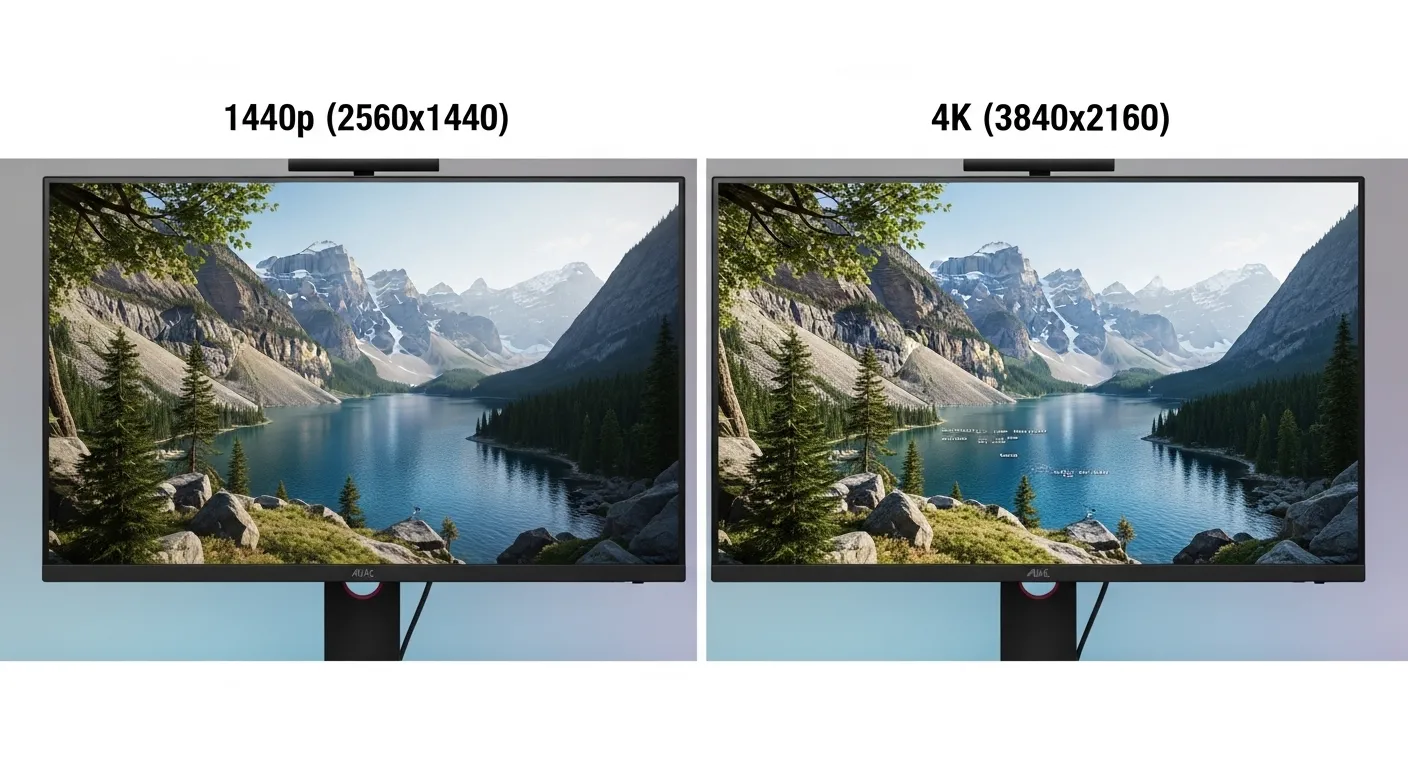
A few years ago, a gamer bought a new monitor to enjoy his favorite games. At the store, he saw two options: 1440p and 4K. Both looked clear and beautiful, but he was not sure which one to choose. This is where understanding the difference between 1440p and 4K becomes important.
The difference between 1440p and 4K mainly relates to screen resolution, picture clarity, and performance. 1440p has fewer pixels, while 4K has many more pixels. Because of this, 4K usually looks sharper and more detailed.
Many people who buy TVs, monitors, or gaming systems often wonder about the difference between 1440p and 4K. Knowing the difference between 1440p and 4K helps people choose the right display for gaming, movies, and work.
Linking Hook
To understand screens better, let us explore the difference between 1440p and 4K step by step.
Key Difference Between Both
The key difference is resolution.
- 1440p has a resolution of 2560 × 1440 pixels.
- 4K has a resolution of 3840 × 2160 pixels.
This means 4K has about four times more pixels than 1080p and many more pixels than 1440p, so the image looks sharper and clearer.
Why Their Difference Is Important
Understanding the difference between 1440p and 4K is useful for both beginners and experts.
For learners, it helps them choose the right screen for school work, gaming, or watching videos. For example, a student may choose a 1440p monitor because it is cheaper but still clear.
Experts such as video editors and designers often prefer 4K because it shows more details. They can see small changes in photos and videos.
In society, screens are used everywhere. People watch movies, learn online, and play games. Knowing the right resolution helps people save money and enjoy better visuals.
Pronunciation
1440p
- US: fourteen-forty pee
- UK: fourteen-forty pee
4K
- US: four kay
- UK: four kay
Difference Between the Keywords
1. Resolution
1440p has fewer pixels than 4K.
Examples:
- A 1440p monitor shows clear text on a website.
- A 4K TV shows very sharp movie scenes.
2. Image Sharpness
4K images usually look sharper.
Examples:
- A nature photo looks good in 1440p.
- The same photo looks extra detailed in 4K.
3. Performance for Gaming
1440p is easier for computers to run.
Examples:
- Many gaming PCs run games smoothly in 1440p.
- 4K gaming needs a stronger graphics card.
4. File Size
4K videos are larger in size.
Examples:
- A 1440p video may take less storage space.
- A 4K video may take much more space.
5. Price
4K devices are often more expensive.
Examples:
- A 1440p monitor may cost less money.
- A 4K TV may cost more because of higher resolution.
6. Internet Requirement
4K streaming needs faster internet.
Examples:
- A 1440p video loads quickly online.
- A 4K video may buffer on slow internet.
7. Screen Size Compatibility
4K works best on larger screens.
Examples:
- A 27-inch monitor looks great at 1440p.
- A large 55-inch TV looks amazing in 4K.
8. Video Editing
4K is often preferred for professional editing.
Examples:
- A beginner editor may work in 1440p.
- A filmmaker may edit movies in 4K.
9. Power Usage
4K systems may use more power.
Examples:
- A laptop running 1440p may save battery.
- A laptop running 4K may drain the battery faster.
10. Future Technology
4K is becoming the new standard.
Examples:
- Many games still support 1440p well.
- New TVs and streaming platforms promote 4K.
Nature and Behaviour
1440p
1440p offers a balance between quality and performance. It gives clear images but does not require extremely powerful hardware. Many gamers prefer it because it runs smoothly.
4K
4K focuses on maximum detail and clarity. It shows very sharp images and fine textures. However, it needs stronger devices and more storage.
Why People Are Confused About Their Use
People often feel confused because both resolutions look good on modern screens. Also, marketing and advertisements sometimes focus only on the word 4K, which makes people think it is always the best choice.
Another reason is that the difference may not be very clear on small screens. On a small monitor, 1440p and 4K may look similar.
Comparison Table
| Feature | 1440p | 4K | Similarity |
| Resolution | 2560×1440 | 3840×2160 | Both are high-definition |
| Image quality | Very clear | Extremely sharp | Both show detailed images |
| Gaming | Easier to run | Needs stronger GPU | Both used by gamers |
| Price | Usually cheaper | Usually more expensive | Both available in many brands |
| File size | Smaller | Larger | Both store digital video |
Which Is Better in Different Situations?
For gaming, 1440p is often better for many players. It offers smooth gameplay and high image quality. Gamers with mid-range computers can run games faster with fewer slowdowns.
For movies, editing, and large TVs, 4K can be better. The higher resolution shows more detail in landscapes, faces, and objects. People who watch movies on large screens may notice the extra clarity of 4K.
In simple terms, 1440p is good for balance, while 4K is good for maximum detail.
Metaphors and Similes
Sometimes screen quality is explained using simple comparisons.
- 1440p is like reading a clean printed book. The words are clear and easy to see.
- 4K is like looking through a powerful magnifying glass. Every small detail becomes visible.
These comparisons help people understand image clarity.
Connotative Meaning
1440p
The connotation is often balanced and practical.
Example:
- Many gamers say 1440p is the smart choice for performance.
4K
The connotation is usually premium or advanced.
Example:
- A 4K TV is often seen as a luxury or high-end product.
Idioms or Proverbs
These idioms are related to seeing and clarity.
1. Seeing is believing
Example:
- When he watched the movie in 4K, he said, “Seeing is believing.”
2. Crystal clear
Example:
- The mountains looked crystal clear on the 1440p monitor.
Works in Literature
Technology and visual quality appear in many modern books.
- “The Visual Story” Bruce Block (2001) Genre: Film and media studies
- “In the Blink of an Eye” Walter Murch (2001) Genre: Film editing
- “Digital Filmmaking” Mike Figgis (2014) Genre: Technology and film
Movies
High-resolution visuals are important in modern cinema.
- Avatar 2009, USA
- Blade Runner 2049 2017, USA
- Dune 2021, USA
These movies are famous for their high-quality visuals and detailed scenes.
FAQ Section
1. Is 4K better than 1440p?
Yes, 4K usually looks sharper because it has more pixels.
2. Is 1440p good for gaming?
Yes. Many gamers prefer 1440p because it runs smoothly and still looks clear.
3. Do I need a powerful computer for 4K?
Yes. 4K gaming and editing usually require a stronger graphics card.
4. Can the human eye see the difference?
Yes, especially on large screens or when sitting close to the display.
5. Which resolution should I choose?
Choose 1440p for gaming performance and 4K for maximum detail and large screens.
Usefulness in Our Surroundings
Screen resolution affects many parts of daily life. People watch movies, play games, learn online, and work on computers.
Higher resolution helps doctors view medical images clearly. Designers use it to create detailed graphics. Teachers also use high-quality screens to show educational videos.
Because of this, understanding screen resolutions helps people choose better technology.
Final Words About Both
Both 1440p and 4K are excellent display resolutions. 1440p provides a great mix of performance and clarity, while 4K offers stunning detail and sharp images.
Choosing between them depends on the user’s needs, budget, and device power.
Conclusion
The difference between 1440p and 4K mainly comes down to resolution, clarity, and performance needs. 1440p offers clear images and smooth performance, especially for gaming.
It also requires less powerful hardware and lower internet speed. On the other hand, 4K provides extremely sharp visuals and more detail, making it ideal for large screens, movies, and professional work.
Both resolutions have their advantages. For many people, 1440p is a practical choice. For those who want the highest level of detail, 4K is the better option. By understanding their differences, users can choose the right display for their needs and enjoy better viewing experiences.

I am David, a passionate blog writer who loves creating informative and easy-to-understand content. I write articles that explain the difference between common topics, language concepts, and everyday knowledge. My goal is to help readers learn new things in a simple and clear way. Through research and practical examples, I try to provide useful and reliable information for students, learners, and curious readers around the world.