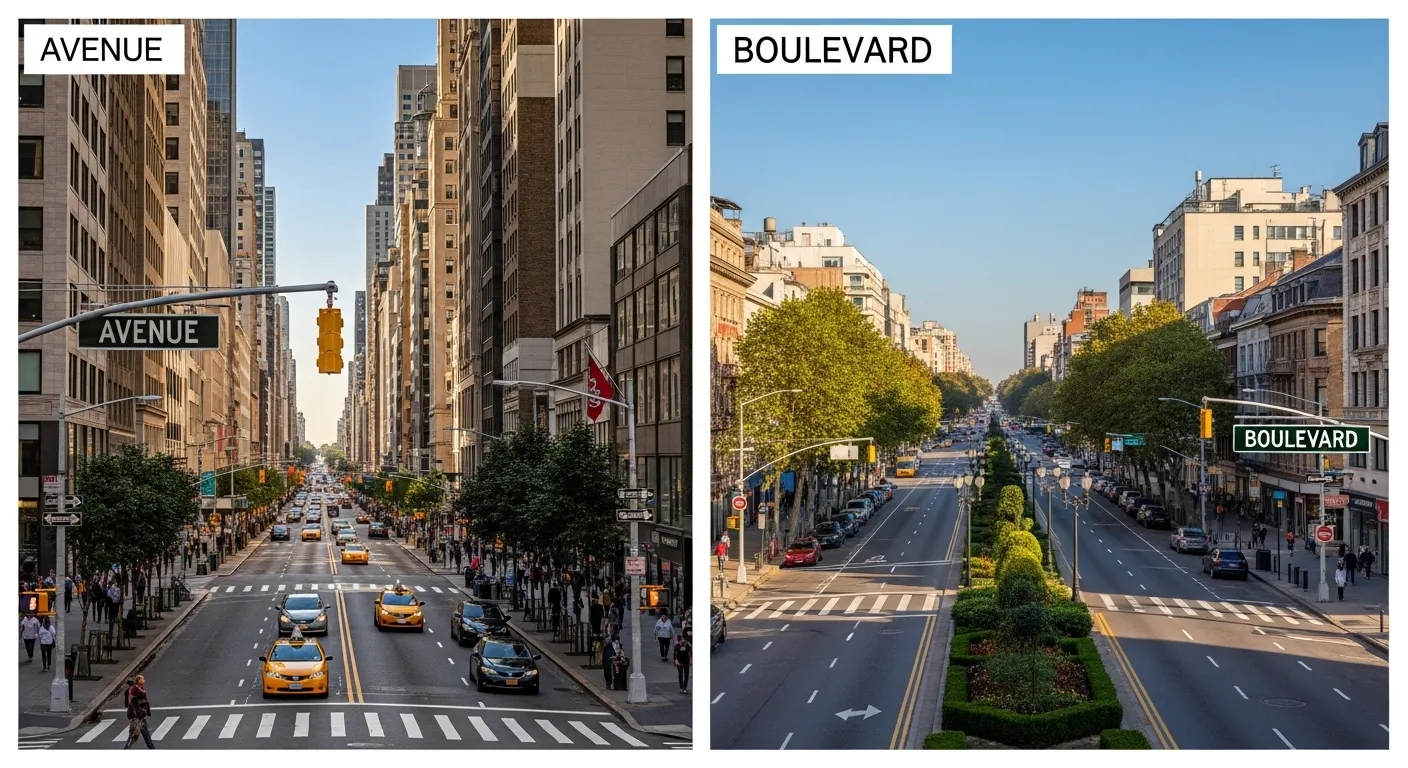
One day, a traveler walked through a big city. First, he walked on a long road with many trees on both sides. People called it an avenue.
Later, he reached a wider road with a green space in the middle and many lanes of traffic. That road was called a boulevard. The traveler wondered why the city used two different names for roads.This small story shows the difference between avenue and boulevard in a simple way.
Cities use different names for roads to explain how they look and how people use them. Learning the difference between avenue and boulevard helps students, travelers, and city planners understand maps better. When we know the difference between avenue and boulevard, we can also learn how cities are designed. In this article, we will clearly explain the difference between avenue and boulevard using easy examples.
Key Difference Between the Both
The main difference is simple.
An avenue is usually a long straight road with trees on the sides.
A boulevard is a wide road that often has a green space or divider in the middle.
Why Their Difference Is Important to Know
Knowing road types helps people read maps and follow directions. Students learn how cities grow. Experts like city planners use these words to design safe and beautiful streets.
When people understand road names, they can travel easily, give clear directions, and plan better towns.
Pronunciation
Avenue
- US: AV-uh-noo
- UK: AV-uh-nyoo
Boulevard
- US: BOOL-uh-vard
- UK: BOO-luh-vahd
Before we explore more, let us look closely at the difference between avenue and boulevard in detail.
Difference Between Avenue and Boulevard
1. Width of the Road
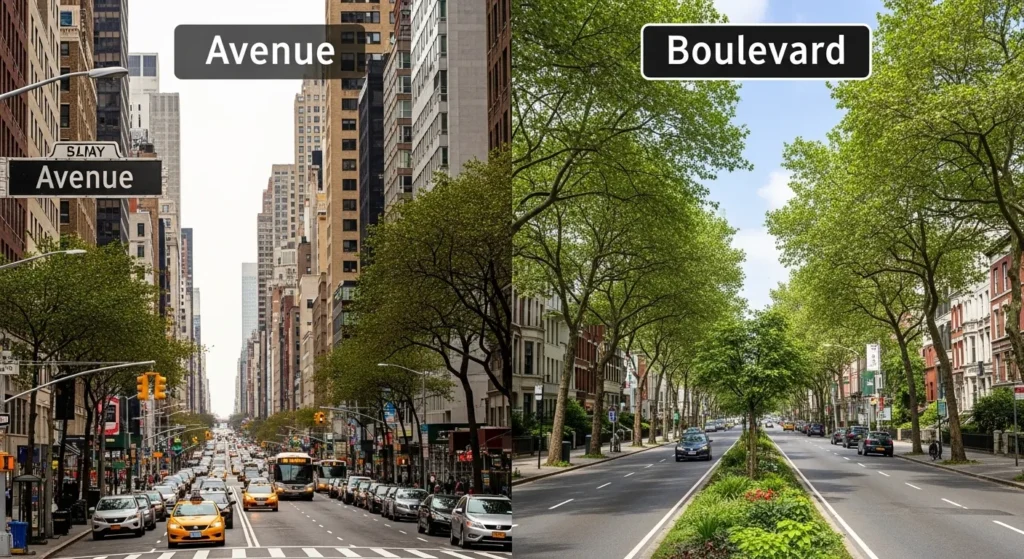
An avenue is usually wide, but a boulevard is often wider.
Examples:
- Fifth Avenue in New York is wide but still smaller than many boulevards.
- Sunset Boulevard in Los Angeles is very wide.
2. Middle Divider
Boulevards often have a green divider in the center. Avenues usually do not.
Examples:
- A boulevard may have trees and flowers in the middle.
- Many avenues only have lanes without a green center.
3. Traffic Lanes
Boulevards usually have many lanes. Avenues may have fewer lanes.
Examples:
- A boulevard may have six lanes.
- An avenue may have four lanes.
4. Design Purpose
Avenues help connect areas of a city. Boulevards are made for beauty and large traffic.
Examples:
- An avenue connects homes and offices.
- A boulevard connects big city areas.
5. Landscaping
Boulevards often have gardens and trees in the center and sides.
Examples:
- A boulevard may have flowers in the middle strip.
- An avenue usually has trees only on the sides.
6. Speed of Traffic
Traffic on boulevards often moves faster.
Examples:
- Cars may move quickly on a boulevard.
- Traffic may be slower on an avenue.
7. City Planning
Boulevards are often part of big city design plans.
Examples:
- Boulevards are used for grand city entrances.
- Avenues mainly help move people across neighborhoods.
8. Size of Surrounding Buildings
Boulevards often have large buildings nearby.
Examples:
- Hotels and theaters are often on boulevards.
- Shops and offices are common on avenues.
9. Historical Use
Boulevards started in Europe as large, grand roads.
Examples:
- Old cities built boulevards where city walls once stood.
- Avenues became common later in city grids.
10. Appearance
Boulevards often look more decorative than avenues.
Examples:
- Boulevards may have statues and fountains.
- Avenues usually look simpler.
Nature and Behavior of Both
Avenue
An avenue is practical. It helps people travel across a city. It connects neighborhoods and business areas.
Boulevard
A boulevard is both useful and beautiful. It carries heavy traffic but also adds beauty to the city.
Why People Are Confused About Their Use
People get confused because many cities do not follow strict rules. Sometimes a road called an avenue may look like a boulevard. Also, different countries use these words in different ways.
Table Showing Difference and Similarity
| Feature | Avenue | Boulevard | Similarity |
| Width | Wide | Very wide | Both are large roads |
| Divider | Usually none | Often has middle divider | Both carry traffic |
| Lanes | Fewer | Many lanes | Both allow vehicles |
| Design | Simple | Decorative | Both are city streets |
| Landscaping | Trees on sides | Trees and gardens | Both may have trees |
Which Is Better in What Situation?
Avenue
An avenue is better when a city needs a road to connect neighborhoods, shops, and offices. It helps people move from one area to another quickly.
Avenues are also good for walking and shopping areas because they often pass through busy city centers.
Boulevard
A boulevard is better for heavy traffic and city beauty. It is good for big roads that carry many cars. The green spaces also make the city look nice and relaxing.
Metaphors and Similes
Writers sometimes use these words in comparisons.
Examples:
- “Life opened before her like a bright avenue.”
- “The lights stretched like a shining boulevard of stars.”
Connotative Meaning
Avenue
- Usually positive or neutral.
Example: “Education is an avenue to success.”
Boulevard
- Often positive and grand.
Example: “The city welcomed visitors with a grand boulevard.”
Idioms or Expressions
Avenue
Expression: “An avenue of opportunity.”
Example: Learning languages gives many avenues of opportunity.
Boulevard
Expression: “Dream boulevard.”
Example: The artist felt he was walking on a dream boulevard of success.
Works in Literature
- Bleak House Novel by Charles Dickens (1853) mentions city avenues.
- The Sun Also Rises Novel by Ernest Hemingway (1926) mentions boulevards of Paris.
- The Great Gatsby Novel by F. Scott Fitzgerald (1925) includes grand city streets.
Movies with These Words
- Sunset Boulevard (1950, USA)
- Boulevard Nights (1979, USA)
- Mulholland Drive (2001, USA – named after a famous boulevard)
Frequently Asked Questions
1. What is the main difference between avenue and boulevard?
An avenue is a wide road, while a boulevard is usually wider and has a divider in the middle.
2. Do all boulevards have trees?
Most boulevards have trees or gardens, but not all.
3. Can an avenue be very busy?
Yes. Many avenues carry heavy traffic.
4. Are boulevards only in big cities?
They are mostly found in large cities.
5. Why do cities use different road names?
Different names help explain the design and purpose of the road.
How Both Are Useful for Surroundings
Avenues help people move easily around the city. They connect homes, schools, and offices. Boulevards make cities beautiful and allow heavy traffic to move smoothly. Together, they make cities organized and pleasant.
Final Words for Both
Both avenues and boulevards are important parts of city life. They help people travel, explore, and enjoy the city environment.
Conclusion
Understanding the difference between avenue and boulevard helps people read maps and understand city design. An avenue is usually a wide road that connects areas of a city.
A boulevard is wider and often has a green divider in the center. Both roads serve important purposes. Avenues help daily travel, while boulevards often add beauty and space for large traffic.
Even though cities sometimes use these names in different ways, the basic idea remains the same. Learning the difference between avenue and boulevard helps students, travelers, and planners understand how cities are built and how roads guide our daily journeys.

I am David, a passionate blog writer who loves creating informative and easy-to-understand content. I write articles that explain the difference between common topics, language concepts, and everyday knowledge. My goal is to help readers learn new things in a simple and clear way. Through research and practical examples, I try to provide useful and reliable information for students, learners, and curious readers around the world.