Imagine a group of students building a small machine for a school science project. One student brings a simple launcher made with rubber bands, while another shows a large model with a swinging arm and a heavy counterweight.
Both machines can throw objects, but they work in different ways. This is where the difference between catapult and trebuchet becomes interesting.Long ago, armies used these machines to throw stones at castles and walls.
Today, people still study them in history classes and engineering projects. Learning the difference between catapult and trebuchet helps students understand how ancient technology worked.
Although both machines launch objects through the air, their design and power are not the same. When we study the difference between catapult and trebuchet, we also learn about physics, force, and motion. For learners and history lovers, understanding the difference between catapult and trebuchet makes medieval technology easier and more exciting to explore.
Linking Hook
Now that we understand what these machines are, let us explore the main differences between them.
Key Difference Between Both
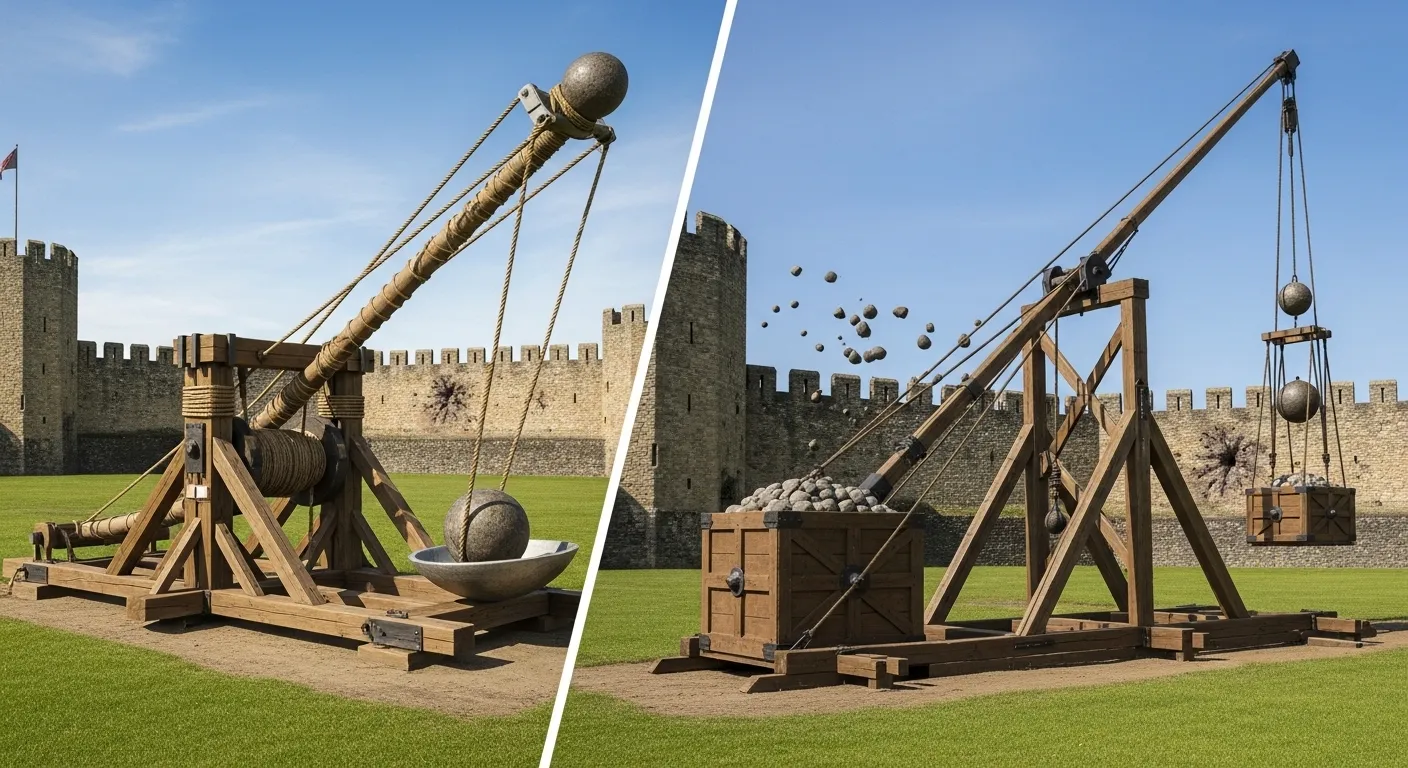
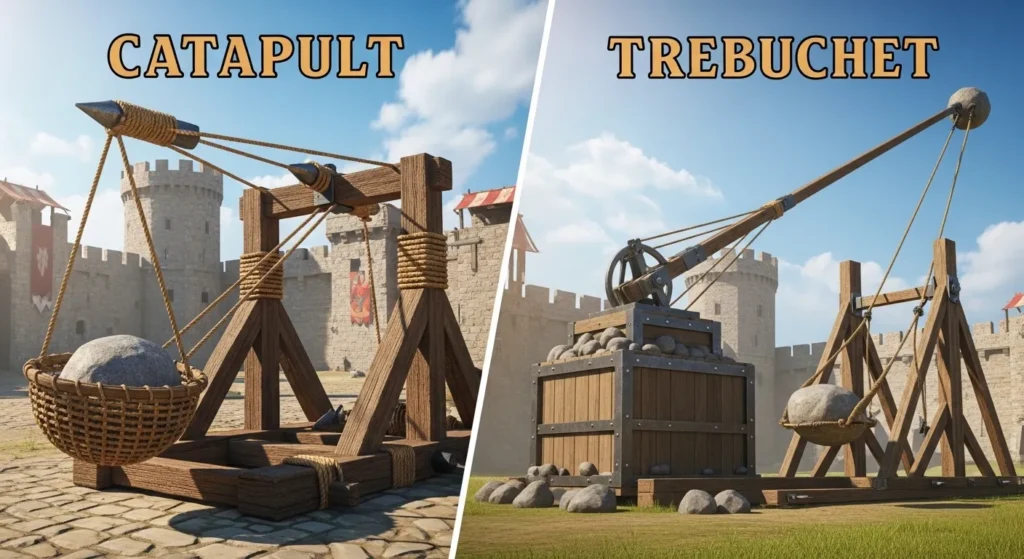
The main difference between catapult and trebuchet is how they create power.
A catapult stores energy in tension or twisting ropes and releases it quickly to launch objects.
A trebuchet uses gravity and a heavy counterweight to swing a long arm and throw objects much farther.
Why Their Difference Is Important
Understanding the difference between catapult and trebuchet is important for both learners and experts.
Students learn basic physics concepts such as force, energy, and motion. Engineers study these machines to understand early mechanical design. Historians also examine them to learn how ancient armies attacked castles.
Knowing their differences helps people see how technology improved over time. Catapults were simpler and easier to build. Trebuchets were larger and more powerful. This knowledge helps us understand medieval warfare, engineering progress, and creative problem solving.
Pronunciation
Catapult
- US: /ˈkætəˌpʌlt/
- UK: /ˈkætəpʌlt/
Trebuchet
- US: /ˈtrɛbjʊˌʃeɪ/
- UK: /ˈtrɛbjʊʃeɪ/
Difference Between the Main Keywords
1. Power Source
A catapult uses stored tension or twisted rope.
A trebuchet uses gravity from a heavy counterweight.
Examples:
- A rope-powered catapult throws a stone forward.
- A toy catapult uses rubber bands.
- A trebuchet lifts a heavy weight to launch a rock.
- A large trebuchet throws stones over castle walls.
2. Design
Catapults have a simple arm and frame.
Trebuchets have a long arm with a counterweight.
Examples:
- A classroom model catapult has a small arm.
- Ancient soldiers built wooden catapults.
- A trebuchet has a swinging arm and sling.
- Medieval engineers designed large trebuchets.
3. Size
Catapults can be small or medium.
Trebuchets are usually very large.
Examples:
- A toy catapult fits on a desk.
- Small catapults were used by soldiers.
- A trebuchet can be taller than a house.
- Some trebuchets need many people to build.
4. Throwing Distance
Catapults throw objects at shorter distances.
Trebuchets can throw objects much farther.
Examples:
- A catapult may throw a stone 100 meters.
- A toy catapult throws a ball across a room.
- A trebuchet can launch stones hundreds of meters.
- Large trebuchets reach enemy walls easily.
5. Accuracy
Catapults are less accurate.
Trebuchets can be more accurate.
Examples:
- A catapult may miss a target often.
- Small catapults are hard to aim.
- A trebuchet can hit large castle walls.
- Engineers adjust the trebuchet sling for better aim.
6. Complexity
Catapults are simple machines.
Trebuchets are more complex machines.
Examples:
- A catapult can be built quickly.
- Children can make catapults in school.
- Trebuchets need careful design.
- Engineers plan trebuchets carefully.
7. Energy Type
Catapults store energy in ropes or springs.
Trebuchets use gravitational energy.
Examples:
- Twisted rope powers a catapult.
- Rubber bands can power small catapults.
- A heavy weight powers a trebuchet.
- Gravity pulls the counterweight down.
8. History
Catapults were used earlier in ancient times.
Trebuchets became popular in the Middle Ages.
Examples:
- Ancient Greeks used catapults.
- Roman armies improved catapults.
- Medieval armies used trebuchets in sieges.
- Kings used trebuchets to break castle walls.
9. Materials
Catapults use wood and rope.
Trebuchets use wood, rope, and heavy stones.
Examples:
- A wooden catapult frame holds the arm.
- Strong rope powers the catapult.
- A trebuchet uses a large wooden frame.
- Heavy stones act as counterweights.
10. Purpose
Both machines were used in wars to break defenses.
Examples:
- Catapults threw stones at enemy soldiers.
- Catapults also launched fire pots.
- Trebuchets destroyed castle walls.
- Trebuchets threw heavy rocks into forts.
Nature and Behaviour
Catapult
A catapult is fast and simple. It releases energy quickly and launches objects in a sudden motion. Because of its simple design, it is easier to build and use.
Trebuchet
A trebuchet is powerful and steady. Its swinging arm moves slowly at first and then speeds up. This motion helps it throw heavy objects very far.
Why People Are Confused About Their Use
Many people think both machines are the same because they both throw objects. They also look similar in pictures and movies.
Another reason is that the word “catapult” is often used for all launching machines. Because of this, people sometimes call trebuchets catapults even though they work differently.
Comparison Table
| Feature | Catapult | Trebuchet |
| Power source | Tension or twisted rope | Gravity and counterweight |
| Design | Simple arm | Long arm with sling |
| Size | Small or medium | Usually large |
| Throw distance | Shorter | Much farther |
| Complexity | Simple | More complex |
| Accuracy | Lower | Higher |
| Energy type | Elastic energy | Gravitational energy |
| History | Ancient times | Middle Ages |
Similarity: Both are siege machines used to launch objects.
Which Is Better in Different Situations?
A catapult is better when people need a simple and quick machine. It is easier to build and does not need large materials. This makes it useful for small projects, experiments, or quick battlefield setups in ancient times.
A trebuchet is better when power and distance are important. Its counterweight system can launch very heavy stones far away. Because of this, medieval armies used trebuchets to destroy strong castle walls. Even today, trebuchets are popular in engineering competitions and science demonstrations.
Metaphors and Similes
These words can also appear in comparisons.
Catapult metaphor example:
- “The new idea catapulted the company to success.”
Trebuchet simile example:
- “The ball flew through the air like a trebuchet stone.”
Connotative Meaning
Catapult
- Positive: fast success
- Example: The singer’s first song catapulted her to fame.
- Example: The singer’s first song catapulted her to fame.
- Neutral: quick movement
- Example: The car accident catapulted the bag forward.
- Example: The car accident catapulted the bag forward.
Trebuchet
- Neutral: strong mechanical power
- Example: Engineers built a trebuchet for a science fair.
- Example: Engineers built a trebuchet for a science fair.
- Positive: impressive strength
- Example: The machine worked like a powerful trebuchet.
- Example: The machine worked like a powerful trebuchet.
Idioms or Proverbs
While these words are not common in idioms, they appear in expressions.
Catapult expression:
- “Catapult someone into success.”
Example: The viral video catapulted him into fame.
Trebuchet expression (descriptive phrase):
- “Powerful as a trebuchet.”
Example: The machine pushed the stone forward, powerful as a trebuchet.
Works in Literature
- The Pillars of the Earth Historical Fiction Ken Follett 1989
- The Walking Drum Adventure Louis L’Amour 1984
- The Archer’s Tale Historical Fiction Bernard Cornwell 2000
Movies
- Kingdom of Heaven 2005 United States
- Robin Hood 2010 United States / United Kingdom
- Outlaw King 2018 United Kingdom
FAQ Section
1. What is the main difference between catapult and trebuchet?
A catapult uses tension or twisted rope, while a trebuchet uses gravity and a counterweight.
2. Which machine throws objects farther?
A trebuchet usually throws objects much farther than a catapult.
3. Were both used in medieval wars?
Yes. Both machines were used during castle sieges.
4. Which machine is easier to build?
A catapult is simpler and easier to build.
5. Why is a trebuchet stronger?
It uses gravity and a heavy counterweight, which creates more power.
Usefulness in Our Surroundings
Today, these machines are useful in education and entertainment. Teachers use catapult and trebuchet models to explain physics concepts such as force, energy, and motion. Students build them in science fairs and engineering competitions.
They also appear in museums, history parks, and documentaries. These machines help people understand how ancient technology worked and how humans solved problems with simple tools.
Final Words About Both
Catapults and trebuchets are important examples of early engineering. They show how people used creativity and physics long before modern machines existed.
Conclusion
The difference between catapult and trebuchet is mainly about how they produce power and how far they can launch objects.
A catapult uses tension or twisted ropes to release energy quickly, while a trebuchet uses gravity and a heavy counterweight to swing a long arm.
Because of this design, trebuchets are usually larger and more powerful.Understanding the difference between catapult and trebuchet helps students learn about history, physics, and engineering.
These machines also show how ancient inventors solved problems using simple ideas. Even today, people study and build them for learning and fun. By exploring their differences, we gain a deeper appreciation for the creativity and knowledge of the past.

I am James Anderson an English author known for his insightful and engaging writing in contemporary literature. With a focus on [insert genre, e.g., fiction, non-fiction, or specific themes], he explores complex human emotions and social dynamics, blending thought-provoking ideas with accessible storytelling. His work has earned recognition for its clarity, depth, and ability to connect with a wide audience, establishing him as a respected voice in modern English literature.