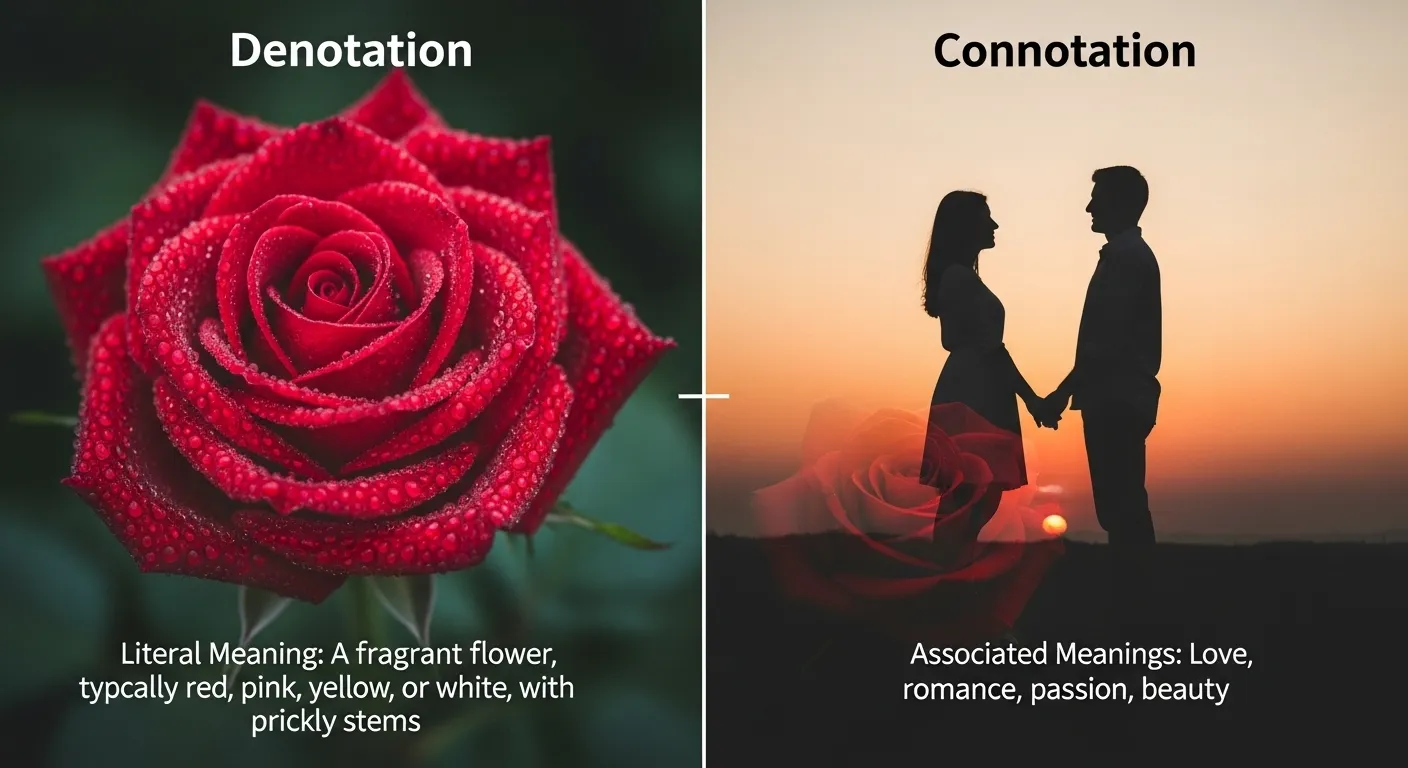
Have you ever used a word and felt its tone mattered? That feeling links to the difference between connotation and denotation. Words carry more than dictionary meanings. They also carry emotions and cultural hints.
For example, “home” and “house” seem similar. Yet, they feel different. One feels warm and personal. The other feels neutral and physical. This is where the difference between connotation and denotation becomes clear.
Understanding this concept improves writing and speaking. It helps you choose the right tone. It also prevents misunderstandings. Moreover, it makes your communication more powerful.
So, why does this matter so much? Because words shape how people think and feel. When you know the difference between connotation and denotation, you control that impact.
In this guide, you will learn both meanings clearly. You will also see real-life examples. By the end, you will use words more effectively.
Featured Snippet
The difference between connotation and denotation is simple. Denotation is the literal meaning of a word. Connotation is the emotional or cultural meaning attached to it.
What Is Connotation (Simple Explanation With Examples)
Connotation refers to the feeling a word creates. It depends on context, culture, and personal experience.
For example, “slim” and “skinny” mean similar things. However, “slim” sounds positive. “Skinny” often sounds negative.
Another example is “childlike” versus “childish.” Both relate to children. Yet, one feels sweet. The other feels immature.
So, connotation adds emotion and tone. It goes beyond the dictionary meaning.
What Is Denotation (Easy Definition + Real-Life Examples)
Denotation is the exact, dictionary meaning of a word. It is direct and objective.
For example, the denotation of “dog” is a domesticated animal. It has four legs and barks.
Similarly, “blue” denotes a color. It does not include feelings unless context adds them.
Denotation stays constant. It does not change with emotions or culture.
Key Difference Between Connotation and Denotation (Quick Answer)
The key difference between connotation and denotation is this. Denotation is literal and fixed. Connotation is emotional and flexible.
Connotation vs Denotation Comparison Table
| Feature | Connotation | Denotation |
| Meaning Type | Emotional | Literal |
| Nature | Subjective | Objective |
| Changes with context | Yes | No |
| Example | “Cheap” feels negative | “Cheap” means low cost |
| Use | Tone and mood | Clear definition |
Quick Summary
The difference between connotation and denotation is about meaning layers. Denotation is direct and clear. Connotation adds emotion and tone. Both work together in language. Therefore, understanding both improves communication.
Why the Difference Between Connotation and Denotation Matters
This difference shapes how people interpret words. For example, marketing uses positive connotations. Writers use them to create mood.
Moreover, choosing the wrong word can confuse readers. It can also offend people. Therefore, knowing the difference between connotation and denotation helps avoid mistakes.
It also improves persuasive writing. You can guide emotions while staying clear.
Pronunciation (US & UK)
Connotation
• US: /ˌkɑːnəˈteɪʃən/
• UK: /ˌkɒnəˈteɪʃən/
Denotation
• US: /ˌdiːnoʊˈteɪʃən/
• UK: /ˌdiːnəʊˈteɪʃən/
Difference Between Connotation and Denotation
Literal vs Emotional
• Denotation is literal. Connotation is emotional.
• Example 1: “Snake” denotes an animal.
• Example 2: “Snake” connotes danger or betrayal.
Fixed vs Flexible
• Denotation stays fixed. Connotation changes.
• Example 1: “Home” always means a place to live.
• Example 2: “Home” may feel warm or sad.
Objective vs Subjective
• Denotation is objective. Connotation is subjective.
• Example 1: “Rose” denotes a flower.
• Example 2: “Rose” may symbolize love.
Dictionary vs Culture
• Denotation comes from dictionaries. Connotation comes from culture.
• Example 1: “White” denotes a color.
• Example 2: “White” may symbolize peace.
Neutral vs Emotional Tone
• Denotation is neutral. Connotation adds tone.
• Example 1: “Old” denotes age.
• Example 2: “Ancient” may feel dramatic.
Direct vs Implied Meaning
• Denotation is direct. Connotation is implied.
• Example 1: “Cheap” means low price.
• Example 2: “Cheap” may imply poor quality.
Stable vs Changing Meaning
• Denotation rarely changes. Connotation evolves.
• Example 1: “Cool” denotes temperature.
• Example 2: “Cool” may mean trendy.
Academic vs Creative Use
• Denotation suits formal writing. Connotation suits creative writing.
• Example 1: Science uses denotation.
• Example 2: Poetry uses connotation.
Clear vs Suggestive
• Denotation gives clarity. Connotation suggests ideas.
• Example 1: “Lion” denotes an animal.
• Example 2: “Lion” suggests bravery.
Language Learning Role
• Denotation helps beginners. Connotation helps advanced learners.
• Example 1: Learners use dictionaries.
• Example 2: Experts use tone and nuance.
Similarities Between Connotation and Denotation
Both Are Word Meanings
• Both explain what words mean.
• Example: “Apple” has both literal and symbolic meanings.
Both Affect Communication
• Both shape understanding.
• Example: A sentence can sound friendly or rude.
Both Used Together
• They work side by side.
• Example: Stories use both meanings.
Both Important in Language
• You need both for clarity and style.
• Example: Essays need accuracy and tone.
Nature and Behaviour of Connotation vs Denotation
Denotation is stable and predictable. It rarely changes. It helps with clarity and facts.
Connotation is dynamic and emotional. It shifts with context and culture. It adds depth and richness.
Together, they create powerful communication. Without one, language feels incomplete.
Why People Confuse Connotation and Denotation
Many learners focus only on dictionary meanings. They ignore emotional meanings.
Also, some words seem simple. However, their tone changes in context. This causes confusion.
Moreover, language evolves. Connotations shift over time. Therefore, the difference between connotation and denotation becomes harder to spot.
Connotation vs Denotation: Which One Should You Choose?
It depends on your goal. If you want clarity, use denotation. If you want emotion, use connotation.
For example, academic writing needs denotation. Creative writing needs both.
So, don’t choose only one. Instead, balance both for effective communication.
Metaphors and Similes (with examples)
Metaphors often rely on connotation. They create deeper meaning.
Example: “Time is a thief.”
This suggests loss, not literal theft.
Similes also use connotations.
Example: “She is as brave as a lion.”
Connotative Meaning (positive/negative tone)
Words can carry positive or negative tones.
Positive: “Affordable” sounds better than “cheap.”
Negative: “Stubborn” sounds worse than “determined.”
Thus, connotation shapes perception.
Idioms or Proverbs (use in sentences)
Idioms depend heavily on connotation.
“Break the ice” means start a conversation.
“She broke the ice with a joke.”
“A blessing in disguise” means hidden benefit.
“The delay was a blessing in disguise.”
Works in Literature (include writer, genre, year)
Writers use connotation to add depth.
• “Animal Farm” by George Orwell (novel, 1945) uses symbolic connotations.
• “The Raven” by Edgar Allan Poe (poem, 1845) uses dark connotations.
Denotation provides clarity. Connotation builds emotion.
Movies (include year and country)
Movies also use both meanings.
• “Inception” (2010, USA) uses layered meanings and symbolism.
• “Parasite” (2019, South Korea) uses strong connotations about class.
FAQ (5 Questions)
What is the difference between connotation and denotation in simple terms?
The difference between connotation and denotation is emotional versus literal meaning.
Why is connotation important in writing?
Connotation adds tone and feeling. It makes writing more engaging.
Can a word have both meanings?
Yes, every word has both. Context decides which matters more.
How do I identify connotation vs denotation?
Check the dictionary for denotation. Notice feelings for connotation.
Is connotation always emotional?
Yes, it reflects feelings, tone, or cultural meaning.
Usefulness in Daily Life
This concept helps in everyday communication. It improves conversations and writing.
For example, choosing polite words avoids conflict. Also, it helps in marketing and storytelling.
Moreover, it builds better understanding between people.
Final Words About Both
The difference between connotation and denotation is essential for language mastery. One gives clarity. The other adds emotion.
Together, they create powerful and meaningful communication.
Key Takeaways
• Denotation is literal meaning
• Connotation is emotional meaning
• Both work together in language
• Context shapes connotation
• Understanding both improves communication
Conclusion
The difference between connotation and denotation is simple yet powerful. Denotation gives clear meaning. Connotation adds emotional depth. Together, they shape how we understand words.
When you learn this difference, your communication improves. You choose words more carefully. You also express ideas more effectively. So, always consider both meanings when speaking or writing.

I am E.M. Forster (1879–1970), a renowned English novelist and essayist, famous for A Room with a View, Howards End, and A Passage to India. I explore human relationships, social class, and personal freedom, making my work a key part of 20th-century English literature.