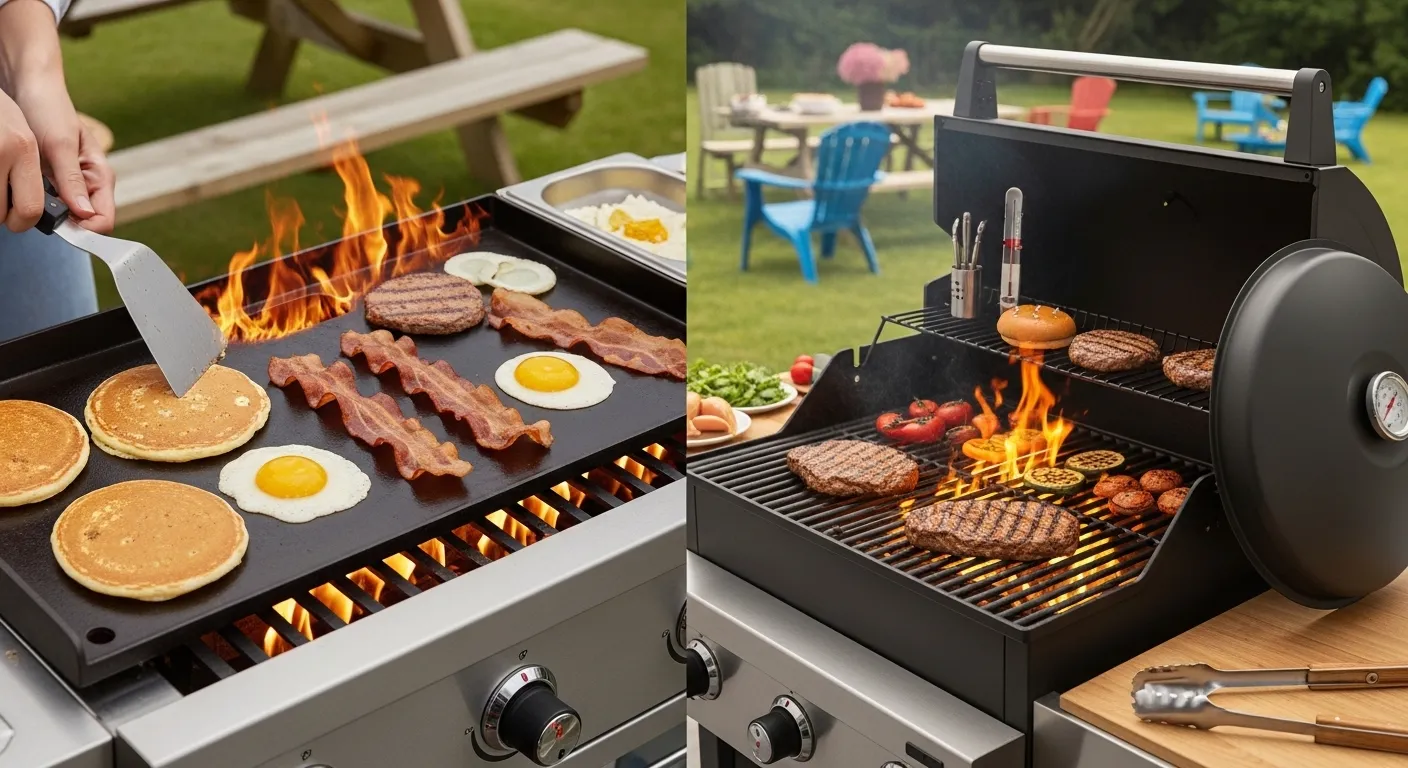
Imagine waking up on a sunny Sunday morning, craving breakfast. You pull out your kitchen tools, but a question arises: should you use a griddle or a grill? Both are popular cooking appliances, yet their functions are distinct.
The difference between griddle and grill often confuses beginners and even some experts. A griddle is a flat, smooth cooking surface, perfect for pancakes, eggs, and sandwiches, while a grill features bars or ridges, ideal for steaks, vegetables, or barbecue flavors.
Understanding the difference between griddle and grill ensures perfect cooking results every time. Whether in a home kitchen or a professional restaurant, knowing how to use a griddle versus a grill makes cooking efficient, enjoyable, and delicious.
Pronunciation:
- Griddle US: /ˈɡrɪd.əl/, UK: /ˈɡrɪd.əl/
- Grill US: /ɡrɪl/, UK: /ɡrɪl/
Now that we know what they are, let’s dive deeper into the difference between griddle and grill and see why choosing the right one matters.
Difference Between Griddle and Grill
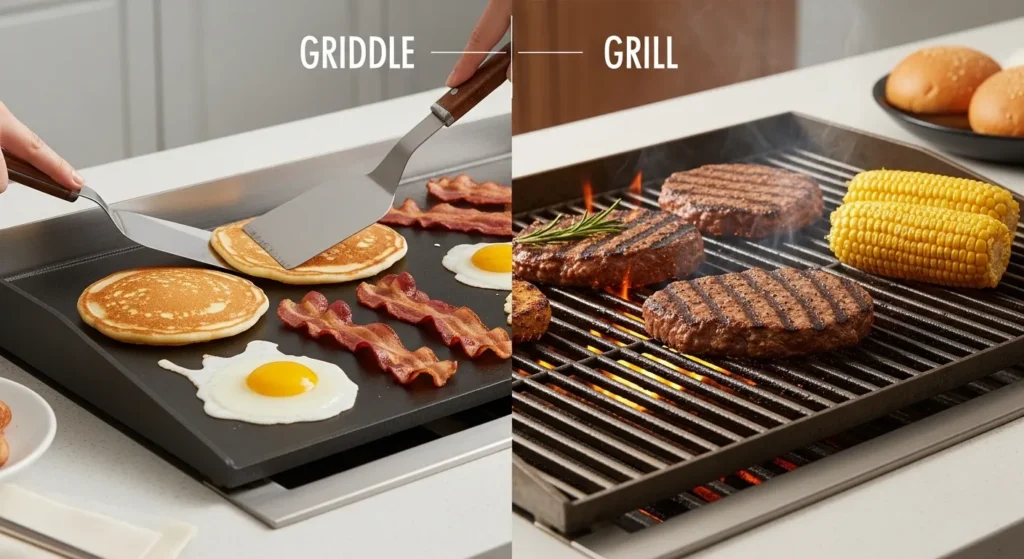
Here are 10 key differences explained with examples:
- Surface Type
- Griddle: Flat, smooth surface. Perfect for evenly cooked foods.
Example 1: Cooking pancakes in a flat pan.
Example 2: Frying eggs without sticking. - Grill: Raised bars or ridges allow fats to drip.
Example 1: Grilling a steak to get sear marks.
Example 2: Char-grilled vegetables with smoky flavor.
- Griddle: Flat, smooth surface. Perfect for evenly cooked foods.
- Heat Distribution
- Griddle: Provides uniform heat across the surface.
Example: Cooking multiple slices of bread evenly. - Grill: Heat is concentrated along bars; leaves ridges.
Example: Char marks on burgers.
- Griddle: Provides uniform heat across the surface.
- Food Flavor
- Griddle: Mild, neutral flavor; no smoky effect.
Example: Soft, buttery pancakes. - Grill: Imparts smoky, charred taste.
Example: BBQ ribs with grilled aroma.
- Griddle: Mild, neutral flavor; no smoky effect.
- Cooking Speed
- Griddle: Slower; ideal for delicate foods.
Example: Omelets need gentle heat. - Grill: Faster, especially for thick meats.
Example: Grilled chicken breasts cook quickly.
- Griddle: Slower; ideal for delicate foods.
- Use Indoors vs Outdoors
- Griddle: Mostly indoor use.
Example: Kitchen breakfast station. - Grill: Often outdoor or backyard use.
Example: Weekend BBQ in the garden.
- Griddle: Mostly indoor use.
- Cleaning and Maintenance
- Griddle: Easy to clean; smooth surface.
Example: Wipe after cooking eggs. - Grill: Harder; grease can stick between bars.
Example: Scrubbing grill bars after steaks.
- Griddle: Easy to clean; smooth surface.
- Food Versatility
- Griddle: Great for small, flat foods like pancakes, eggs, sandwiches.
- Grill: Works best for thicker meats and vegetables needing char marks.
- Griddle: Great for small, flat foods like pancakes, eggs, sandwiches.
- Fat Management
- Griddle: Retains all fats; useful for buttered foods.
- Grill: Lets fats drip away; healthier cooking.
- Griddle: Retains all fats; useful for buttered foods.
- Appearance of Food
- Griddle: Smooth, even surface, no marks.
Example: Golden pancakes. - Grill: Distinct grill marks.
Example: Steak with striped ridges.
- Griddle: Smooth, even surface, no marks.
- Material and Design
- Griddle: Cast iron, aluminum, or non-stick.
- Grill: Often stainless steel or cast iron bars with gaps.
- Griddle: Cast iron, aluminum, or non-stick.
Nature and Behavior of Griddle vs Grill
- Griddle: Gentle, consistent, reliable, and ideal for soft foods. Behavior is predictable; easy to control heat.
- Grill: Bold, intense, adds character; heat is uneven, creating charred textures and smoky aromas.
Why People Are Confused About Their Use
Many confuse griddle and grill because both are cooking tools producing hot surfaces. People assume all “flat-top” surfaces are grills, but griddles cook evenly without char marks, whereas grills create ridges and smoky flavor.
Table: Difference and Similarity Between Griddle and Grill
| Feature | Griddle | Grill | Similarity |
| Surface | Flat, smooth | Bars/ridges | Both are cooking surfaces |
| Heat Distribution | Even heat | Uneven, concentrated | Both use direct heat |
| Flavor | Neutral | Smoky/charred | Both enhance taste |
| Ideal Foods | Pancakes, eggs, sandwiches | Steak, veggies, BBQ | Both cook various foods |
| Cleaning | Easy | Hard | Both need regular cleaning |
Which Is Better in What Situation?
- Griddle: Best for breakfast, delicate foods, and indoor cooking. Its even heat ensures soft, evenly cooked meals.
- Grill: Best for BBQ, outdoor parties, and meats needing charred flavor. It creates authentic smoky taste and visual appeal.
Use in Metaphors and Similes
- Griddle: “Smooth as a griddle” something consistent and even.
- Grill: “Under the grill” in intense scrutiny or pressure.
Connotative Meaning:
- Griddle Neutral/positive: reliable, gentle cooking.
- Grill Positive/negative: intense, challenging, bold.
Idioms or Proverbs Related
- “Take it off the grill” , finish quickly or resolve an issue.
- “Not all that sizzle is cooked on a griddle” appearances can be deceiving.
Works in Literature
- Griddle Breakfast at Tiffany’s (1958, novel, Truman Capote) breakfast scenes.
- Grill Lord of the Flies (1954, novel, William Golding) symbolic cooking fire scenes.
Movies Featuring Griddle or Grill
- Chef (2014, USA) kitchen scenes, griddle use.
- Barbecue (2017, France) outdoor grilling culture.
Frequently Asked Questions
- Can I use a griddle instead of a grill?
- Yes, but no char marks or smoky flavor.
- Yes, but no char marks or smoky flavor.
- Is a grill healthier than a griddle?
- Often yes, because excess fat drips away.
- Often yes, because excess fat drips away.
- Are griddles only for breakfast?
- No, they work for sandwiches, meats, and desserts.
- No, they work for sandwiches, meats, and desserts.
- Which heats faster?
- Grills heat faster for thick foods; griddles heat evenly for soft foods.
- Grills heat faster for thick foods; griddles heat evenly for soft foods.
- Are both suitable indoors?
- Griddles are better indoors; grills require ventilation.
- Griddles are better indoors; grills require ventilation.
How Both Are Useful for Surroundings
- Griddles reduce smoke and indoor mess.
- Grills encourage outdoor social cooking, community BBQs, and eco-friendly grilling with charcoal or gas.
Final Words
Understanding the difference between griddle and grill empowers cooks to select the right appliance. Both have their strengths and create unique culinary experiences.
Conclusion
Griddles and grills, while seemingly similar, serve different purposes. Griddles provide a smooth, even cooking surface, ideal for pancakes, eggs, and sandwiches. Grills offer ridges, smoky flavor, and faster cooking for meats and vegetables.
Knowing the difference between griddle and grill is essential for home cooks and professional chefs alike. By mastering both, one can achieve culinary precision, enhance flavor, and make cooking enjoyable.
Their distinct characteristics, usage contexts, and metaphorical associations demonstrate their significance in daily life, literature, and entertainment. Choosing the right tool improves outcomes, reduces mistakes, and elevates meals from ordinary to extraordinary.

I am D. H. Lawrence (David Herbert Lawrence) an influential English novelist, poet, essayist, and literary critic born on September 11, 1885, in Eastwood, Nottinghamshire, England. He is widely regarded as one of the most important writers of the 20th century.
I work often explored human relationships, emotional intimacy, industrialization, and the conflict between modern society and natural instincts.