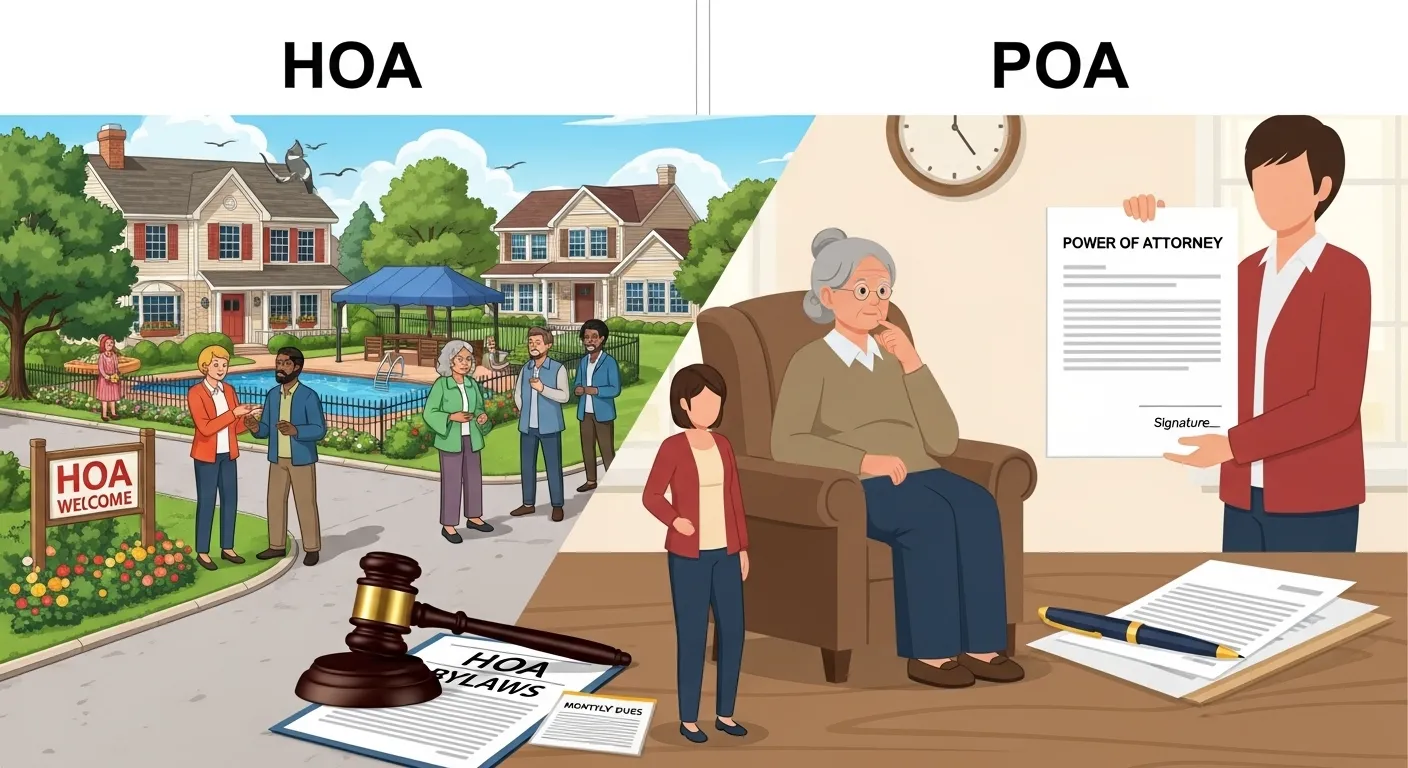
Imagine you move into a beautiful neighborhood with clean streets, green parks, and well-maintained houses. Soon after moving in, you receive a letter explaining community rules and monthly fees.
This is where terms like HOA and POA appear. Many people wonder about the difference between HOA and POA when they first encounter these organizations.An HOA (Homeowners Association) usually manages rules and shared facilities within a residential community,
while a POA (Property Owners Association) may govern a wider range of properties such as homes, land, or vacation properties. Understanding the difference between HOA and POA helps property buyers make better decisions before purchasing real estate.
In real life, buyers often overlook these associations until rules affect their daily lives. That is why learning the difference between HOA and POA is important for homeowners, investors, and real estate professionals. When people clearly understand the difference between HOA and POA, they can avoid confusion and manage their properties more effectively.
Pronunciation
- HOA
- US: /ˌeɪtʃ.oʊˈeɪ/
- UK: /ˌeɪtʃ.əʊˈeɪ/
- US: /ˌeɪtʃ.oʊˈeɪ/
- POA
- US: /ˌpiː.oʊˈeɪ/
- UK: /ˌpiː.əʊˈeɪ/
- US: /ˌpiː.oʊˈeɪ/
Understanding these terms is only the beginning. Let’s explore the difference between HOA and POA in detail.
Key Difference Between HOA and POA
The main difference is their scope and authority.
- HOA mainly governs residential homeowners within a specific housing community.
- POA can govern various types of property owners, including landowners, vacation homes, or mixed properties.
Why Knowing Their Difference Is Important for Learners and Experts
Understanding these associations is essential in modern society.
For learners:
- Helps them understand property management systems.
- Prevents confusion when buying a house.
For experts and professionals:
- Real estate agents must explain rules to buyers.
- Lawyers and investors need to understand property regulations.
Both organizations influence community planning, property value, and neighborhood harmony, which makes their distinction socially important.
Difference Between HOA and POA

Below are 10 major differences explained in simple language.
1. Meaning
HOA: Organization of homeowners in a housing community.
Examples:
- A gated residential society.
- A suburban neighborhood with shared parks.
POA: Organization of property owners managing different types of properties.
Examples:
- A lake community with cabins.
- A land development area with mixed property types.
2. Membership
HOA: Only homeowners can join.
Examples:
- House owners in a planned housing society.
- Residents of a condominium complex.
POA: Any property owner can join.
Examples:
- Owners of empty land in a development area.
- Owners of vacation properties.
3. Scope of Authority
HOA: Authority limited to residential housing.
Examples:
- Regulating house paint colors.
- Managing neighborhood parks.
POA: Authority may include multiple property types.
Examples:
- Regulating lakes or recreational land.
- Managing shared roads across properties.
4. Property Types
HOA: Mostly residential homes.
Examples:
- Townhouses.
- Single-family homes.
POA: Residential, commercial, or land property.
Examples:
- Resorts and cabins.
- Mixed-use developments.
5. Governance Structure
HOA: Usually run by a board of homeowners.
Examples:
- Board elections among residents.
- Resident committees.
POA: May include landowners or developers.
Examples:
- Developer representatives.
- Mixed owner boards.
6. Rules and Regulations
HOA: Focus on home appearance and lifestyle rules.
Examples:
- Lawn maintenance requirements.
- Restrictions on parking.
POA: Focus on property use and community resources.
Examples:
- Land usage policies.
- Environmental rules around lakes or forests.
7. Fees
HOA: Regular monthly or yearly homeowner fees.
Examples:
- Paying for security services.
- Paying for landscaping.
POA: Fees may vary depending on property ownership.
Examples:
- Maintenance fees for roads.
- Shared utility service fees.
8. Facilities Managed
HOA: Community amenities for residents.
Examples:
- Swimming pools.
- Community centers.
POA: Larger shared facilities.
Examples:
- Private lakes.
- Community marinas.
9. Legal Structure
HOA: Strict legal frameworks in housing communities.
Examples:
- Enforcing property rules.
- Issuing penalties for violations.
POA: Broader governance structures.
Examples:
- Property development policies.
- Land use agreements.
10. Purpose
HOA: Maintain neighborhood quality and property value.
Examples:
- Keeping houses uniform.
- Maintaining streets.
POA: Manage shared resources among property owners.
Examples:
- Maintaining lakes.
- Managing recreational land.
Nature and Behaviour of HOA and POA
HOA Nature:
HOAs are community-focused organizations. They emphasize uniformity, aesthetics, and residential harmony.
Their behavior tends to be structured and rule-oriented because they regulate daily residential life.
POA Nature:
POAs are broader organizations. They focus more on property rights, shared infrastructure, and land management. Their behavior is flexible because they manage different property types.
Why People Are Confused About Their Use
People often confuse HOA and POA because:
- Both manage community properties.
- Both collect membership fees.
- Both enforce rules and regulations.
- Their names sound similar.
In many regions, the responsibilities of HOAs and POAs also overlap, which increases confusion.
Table Showing Differences and Similarities
| Aspect | HOA | POA | Similarity |
| Meaning | Homeowners association | Property owners association | Both manage communities |
| Members | Homeowners only | Any property owner | Membership organization |
| Property Types | Residential | Mixed property | Community governance |
| Scope | Limited area | Wider area | Rule enforcement |
| Facilities | Housing amenities | Shared land resources | Maintenance services |
Which Is Better in What Situation?
HOA:
An HOA is better for residential communities where homeowners want a clean, organized, and uniform environment.
HOAs maintain neighborhood appearance and shared amenities like parks, gyms, and pools. If you want structured rules and predictable property standards, an HOA system works well.
POA:
A POA is better when a community includes different types of properties such as cabins, land plots, and recreational facilities.
It offers flexible governance and allows various property owners to cooperate in managing shared resources like lakes, roads, or forests.
Metaphors and Similes
- HOA: “An HOA is like a neighborhood manager keeping everything in order.”
- POA: “A POA works like a council of landowners guiding property use.”
Connotative Meanings
HOA
- Positive: organized community
- Negative: strict rules
- Neutral: residential management
Example: “The HOA ensures the neighborhood stays clean.”
POA
- Positive: cooperative property management
- Negative: complex governance
- Neutral: property organization
Example: “The POA manages the lake shared by property owners.”
Idioms or Proverbs Related to Property and Community
- “Good fences make good neighbors.”
Example: Community rules in HOAs help maintain harmony. - “A man’s home is his castle.”
Example: Property owners value independence even within POA rules.
Works in Literature Featuring These Terms
(Direct works using these exact terms are limited)
- Homeowners Associations and Housing Communities – Nonfiction, Evan McKenzie, 1994
- Privatopia – Social commentary, Evan McKenzie, 1994
Movies Related to Community Associations
(No major films are directly titled HOA or POA, but related themes appear in:)
- Lakeview Terrace (2008, USA)
- Neighbors (2014, USA)
Frequently Asked Questions
1. What does HOA stand for?
HOA stands for Homeowners Association.
2. What does POA stand for?
POA stands for Property Owners Association.
3. Are HOA and POA the same?
No. HOAs manage residential homeowners, while POAs may include different property types.
4. Do both collect fees?
Yes. Both associations usually collect fees for maintenance and services.
5. Which one has more authority?
It depends on community rules, but POAs often have broader authority over property types.
How Both Are Useful for Surroundings
HOAs and POAs help maintain community order and protect property values. They organize maintenance services, manage shared facilities, and resolve disputes between residents or property owners.
These organizations also encourage cooperation among neighbors and improve the overall environment of residential or mixed property communities.
Final Words
HOA and POA both serve important roles in property management. They create organized communities, protect property values, and ensure shared resources are properly maintained.
Conclusion
Understanding the difference between HOA and POA is essential for anyone involved in real estate or property ownership.
While an HOA focuses mainly on residential communities and homeowner rules, a POA covers a wider range of property types and shared resources. Both organizations aim to maintain community standards and improve the living environment.
However, their scope, membership, and responsibilities differ significantly. Buyers, investors, and professionals should carefully review association rules before purchasing property. By clearly understanding the difference between HOA and POA, individuals can make informed decisions and avoid conflicts in property management and community living.

I am James Anderson an English author known for his insightful and engaging writing in contemporary literature. With a focus on [insert genre, e.g., fiction, non-fiction, or specific themes], he explores complex human emotions and social dynamics, blending thought-provoking ideas with accessible storytelling. His work has earned recognition for its clarity, depth, and ability to connect with a wide audience, establishing him as a respected voice in modern English literature.