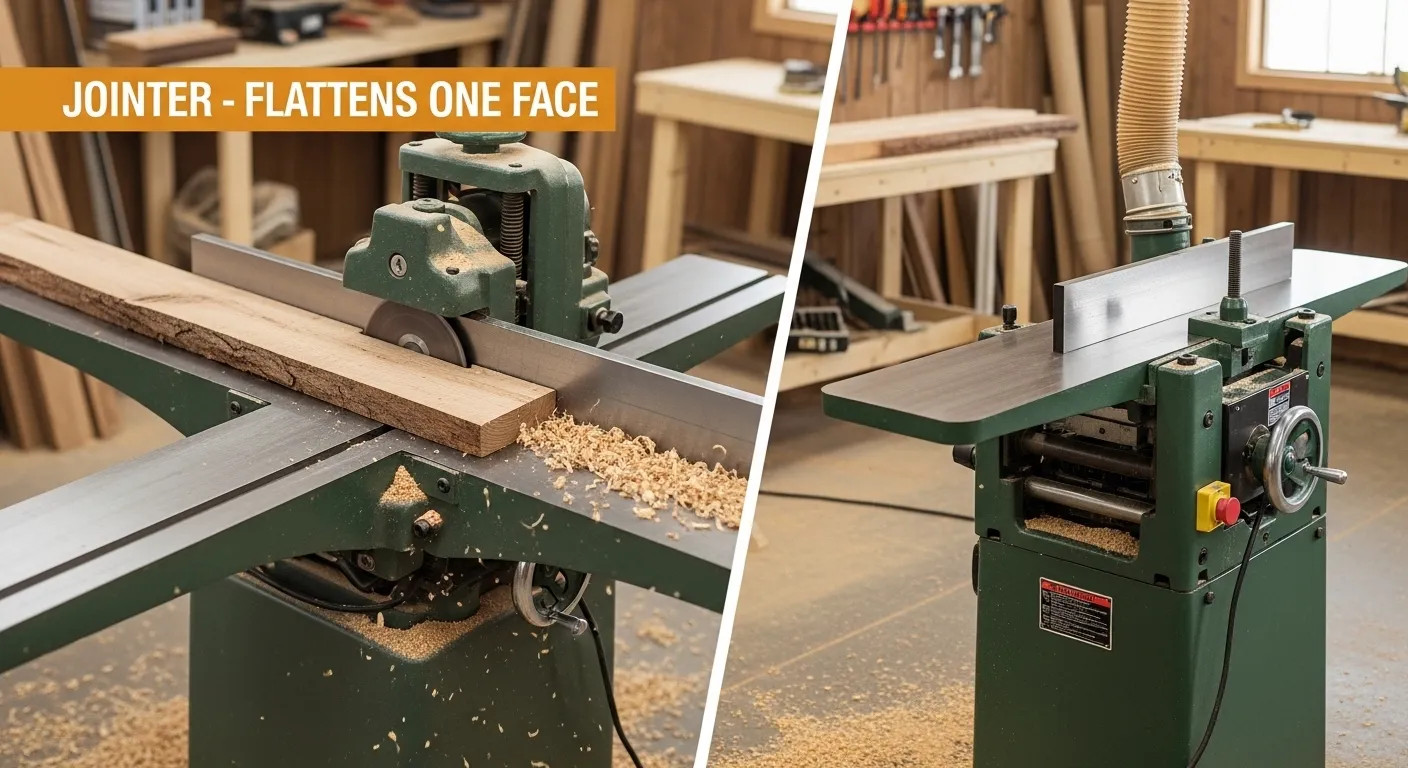
Imagine a carpenter in a small workshop preparing a rough wooden board for a beautiful table. The wood looks uneven and twisted. First, the carpenter uses a jointer to flatten one side of the board.Then, the board goes through a planer to make the thickness even across the entire surface.
This simple workflow clearly shows the difference between jointer and planer.Understanding the difference between jointer and planer is essential for anyone working with wood, whether a beginner DIY enthusiast or a professional carpenter.Many people think both machines do the same job because they both smooth wood.
However, the difference between jointer and planer lies in how they shape and prepare lumber. The jointer creates a flat reference surface, while the planer ensures uniform thickness. Learning the difference between jointer and planer helps woodworkers produce accurate, high-quality pieces and avoid costly mistakes in woodworking projects.
Pronunciation
Jointer
- US: /ˈdʒɔɪn-tər/
- UK: /ˈdʒɔɪn-tə/
Planer
- US: /ˈpleɪ-nər/
- UK: /ˈpleɪ-nə/
Before exploring deeper, let’s understand how these two important woodworking tools differ in their purpose and function.
Key Difference Between the Two
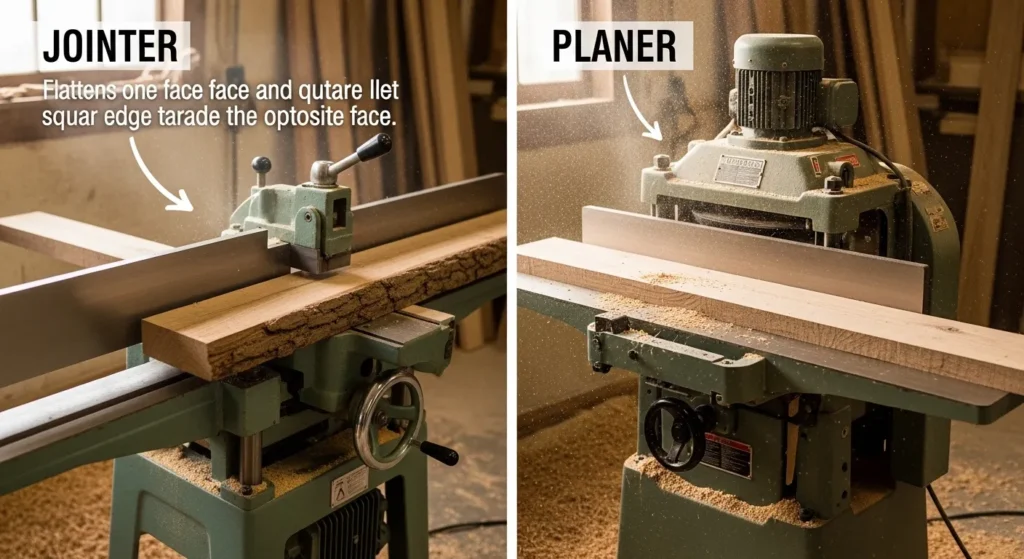
The jointer is designed to flatten one face or straighten one edge of a board, while the planer is used to make the board a consistent thickness across its entire surface.
Why Is Their Difference Necessary to Know for Learners and Experts?
Knowing the difference between jointer and planer is important for both beginners and experienced woodworkers. For learners, it prevents confusion when choosing tools for projects. Many beginners mistakenly try to flatten warped boards using only a planer, which often leads to poor results.
For professionals, understanding their roles improves accuracy, efficiency, and safety in woodworking. Society benefits from skilled woodworking in construction, furniture design, and craftsmanship. Proper tool knowledge ensures quality products, reduces material waste, and preserves traditional woodworking skills.
Difference Between Jointer and Planer
1. Primary Purpose
A jointer is used to flatten one face of a board and straighten its edges.
Example 1: A carpenter flattens a twisted plank using a jointer before building a table.
Example 2: A cabinet maker straightens the edge of a board so two pieces can join perfectly.
A planer is used to reduce thickness and make the board evenly thick.
Example 1: A woodworker passes a board through a planer to reduce it from 1 inch to ¾ inch thickness.
Example 2: Furniture makers use a planer to ensure all boards for a shelf have equal thickness.
2. Working Principle
The jointer cuts wood using rotating blades while the board slides over a flat table.
Example 1: A warped board becomes flat after several passes across the jointer table.
Example 2: An uneven edge becomes perfectly straight for gluing.
The planer pulls the board through rollers and trims the top surface to a set thickness.
Example 1: A thick board becomes thinner and smoother.
Example 2: Multiple boards become identical in thickness.
3. Surface Function
A jointer creates the first flat surface.
Example 1: A rough lumber board gets its first smooth side.
Example 2: A crooked edge becomes straight.
A planer smooths the opposite surface to match thickness.
Example 1: A flattened board gets a smooth parallel top surface.
Example 2: A rough plank becomes uniformly thick.
4. Position of Cutting
In a jointer, cutting blades are beneath the wood.
Example 1: The board slides over blades while the worker pushes it forward.
Example 2: Edges are trimmed from below.
In a planer, blades are above the wood.
Example 1: The board moves through rollers while the top is shaved.
Example 2: Thickness is reduced from the top side.
5. Role in Wood Preparation
A jointer prepares wood for accurate alignment.
Example 1: Preparing edges before gluing boards together.
Example 2: Flattening lumber for cabinet panels.
A planer prepares wood for consistent thickness.
Example 1: Matching board thickness for flooring.
Example 2: Creating evenly sized wooden panels.
6. Accuracy Function
A jointer improves straightness and flatness.
Example 1: Straightening warped boards.
Example 2: Fixing uneven edges.
A planner improves uniform measurement.
Example 1: Making multiple boards identical.
Example 2: Ensuring a tabletop has equal thickness.
7. Type of Wood Problems Solved
A jointer solves twisting, cupping, and edge problems.
Example 1: Flattening twisted lumber.
Example 2: Straightening bowed edges.
A planer solves thickness problems.
Example 1: Reducing thick boards.
Example 2: Matching board thickness for projects.
8. Workflow Order
A jointer is usually used first.
Example 1: Flattening before thicknessing.
Example 2: Straightening before gluing.
A planner is used after joining.
Example 1: Making boards equal thickness after flattening.
Example 2: Smoothing the top side.
9. Shape Result
A jointer produces a flat surface or straight edge.
Example 1: Flat board face.
Example 2: Straight edge for joinery.
A planer produces uniform thickness.
Example 1: Equal thickness boards for furniture.
Example 2: Smooth finished surfaces.
10. Machine Design
A jointer has an open flat table.
Example 1: Workers manually guide boards.
Example 2: Edges are flattened by sliding across the table.
A planer has a closed machine with rollers.
Example 1: Boards feed automatically.
Example 2: Thickness adjustment controls cutting depth.
Nature and Behaviour of Both
Jointer
The jointer focuses on precision flattening and straightening. Its behavior is manual and requires careful control by the woodworker.
Planer
The planer focuses on uniform thickness and smooth surfaces. Its behavior is more automated because the machine pulls the wood through rollers.
Why People Are Confused About Their Use
People often confuse these tools because both smooth wooden boards use rotating blades. Beginners also see similar resultsflat and smooth wood which leads them to believe the tools perform the same job. In reality, they work together in sequence, not as replacements.
Difference and Similarity Table
| Feature | Jointer | Planer | Similarity |
| Main function | Flattens surface | Makes thickness uniform | Both shape wood |
| Blade position | Below board | Above board | Both use cutting blades |
| First step | Yes | No | Both used in preparation |
| Thickness control | No | Yes | Both improve wood quality |
| Edge straightening | Yes | No | Both smooth surfaces |
Which Is Better in What Situation?
Jointer
A jointer is better when the wood is warped, twisted, or uneven. It creates a perfectly flat surface and straight edges, which are necessary before joining boards together. Furniture makers and cabinet builders rely on jointers to prepare lumber for precise construction.
Planer
A planer is better when the wood needs consistent thickness. After one side is flattened by a jointer, the planer ensures both sides are parallel. This is essential for flooring, shelves, doors, and tabletops where uniform size matters.
Metaphors and Similes
Both tools are sometimes used metaphorically to describe processes of refinement and balance.
Examples:
- “Education is like a planner that smooths rough ideas.”
- “A mentor works like a jointer, straightening the path of a learner.”
Connotative Meaning
Jointer
Neutral to positive suggests alignment and correction.
Example:
“A good teacher is a jointer for young minds.”
Planer
Positive suggests refinement and improvement.
Example:
“Experience acts like a planner, shaping a person’s skills.”
Idioms or Proverbs (Conceptual Usage)
- “Straighten the edge before joining.”
Example: Solve problems first before teamwork. - “Smooth the rough edges.”
Example: Improve behavior or communication. - “Level the surface.”
Example: Create fairness in a situation.
Works in Literature (Woodworking References)
- The Complete Manual of Woodworking Practical Guide, Albert Jackson (1973)
- The Essential Woodworker Craft Guide, Robert Wearing (1988)
- Understanding Woodworking Machines Technical Guide, John Feirer (1990)
Movies or Documentaries Related to Woodworking
- The Woodwright’s Shop Documentary TV series (1980, USA)
- Handcrafted America Documentary series (2016, USA)
Frequently Asked Questions
1. Can a planner replace a jointer?
No. A planer cannot flatten warped wood properly. A jointer is required first.
2. Do beginners need both tools?
Yes, if they want accurate woodworking results.
3. Which tool should be used first?
The jointer should be used first to flatten one surface.
4. Can a planer flatten a twisted board?
No, it mainly adjusts thickness.
5. Are jointers and planers used together?
Yes, professionals often use both in sequence.
How Both Are Useful for Surroundings
Both machines help produce high-quality furniture, doors, cabinets, and wooden structures. They reduce waste, improve material efficiency, and support industries like carpentry, interior design, and construction.
Final Words for Both
The jointer and planer are not competitors but partners in woodworking. Together they transform rough lumber into precise and beautiful materials ready for crafting.
Conclusion
Understanding the difference between jointer and planer is essential for anyone involved in woodworking. While both tools smooth wood, their functions are distinct and complementary.
The jointer focuses on flattening surfaces and straightening edges, while the planer ensures consistent thickness and a polished finish. When used together, they allow woodworkers to create accurate, durable, and aesthetically pleasing projects.
For learners, this knowledge prevents mistakes and builds confidence. For professionals, it improves efficiency and craftsmanship. Ultimately, mastering these tools contributes to better woodworking practices and higher-quality wooden products.

I am David, a passionate blog writer who loves creating informative and easy-to-understand content. I write articles that explain the difference between common topics, language concepts, and everyday knowledge. My goal is to help readers learn new things in a simple and clear way. Through research and practical examples, I try to provide useful and reliable information for students, learners, and curious readers around the world.