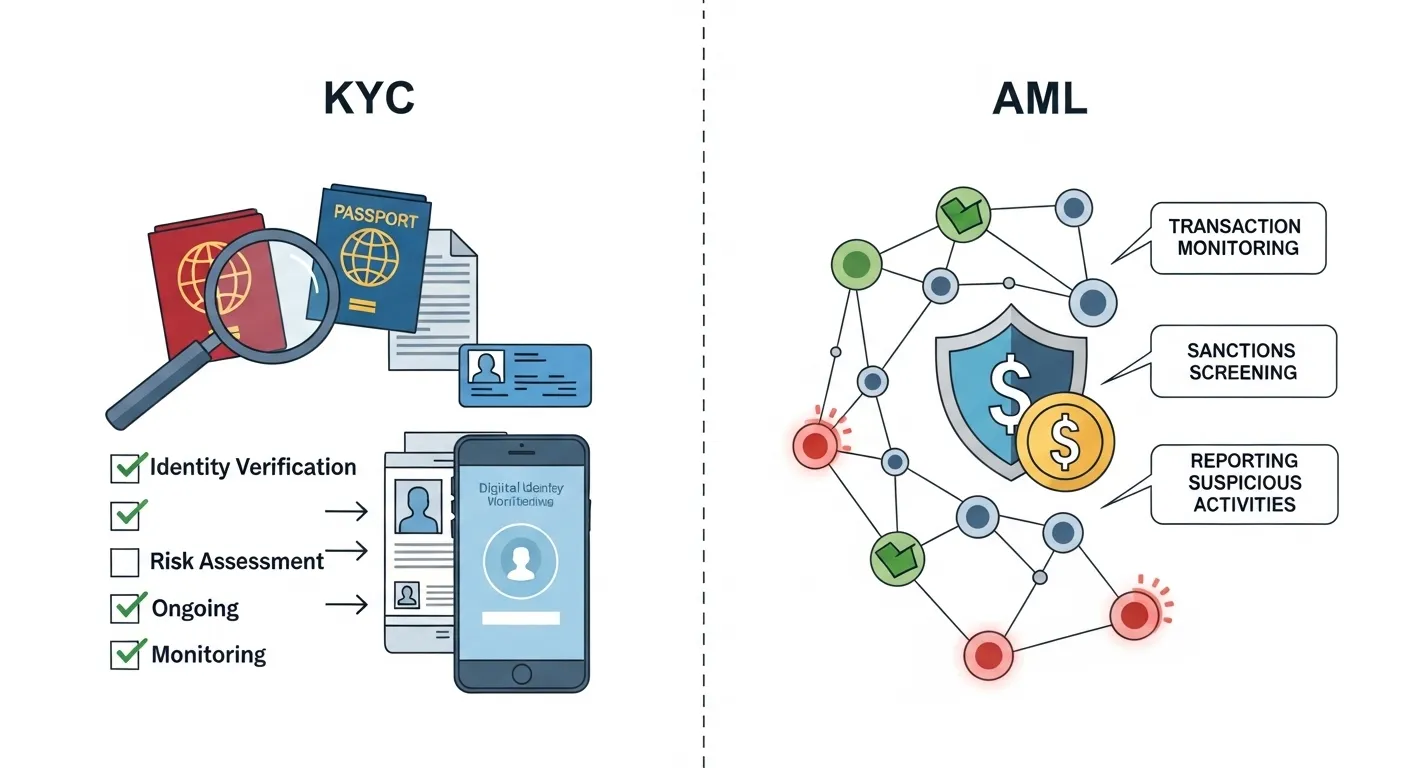
Imagine opening a new bank account. The bank officer asks for your ID card, proof of address, and maybe a photo. This process helps the bank confirm that you are a real person and not someone pretending to be someone else.
This is called Know Your Customer (KYC).Now imagine another situation: a criminal tries to deposit large amounts of illegal money into different accounts to hide its origin. Banks and financial institutions monitor such suspicious activities to prevent financial crimes.
This process is known as Anti-Money Laundering (AML).Understanding the difference between KYC and AML is very important in modern financial systems. Many people confuse the difference between KYC and AML because both are used to prevent fraud and financial crime.
However, the difference between KYC and AML lies in their scope, function, and implementation. By learning the difference between KYC and AML, students, professionals, and businesses can better understand how financial security works in the digital economy.
Key Difference Between the Both
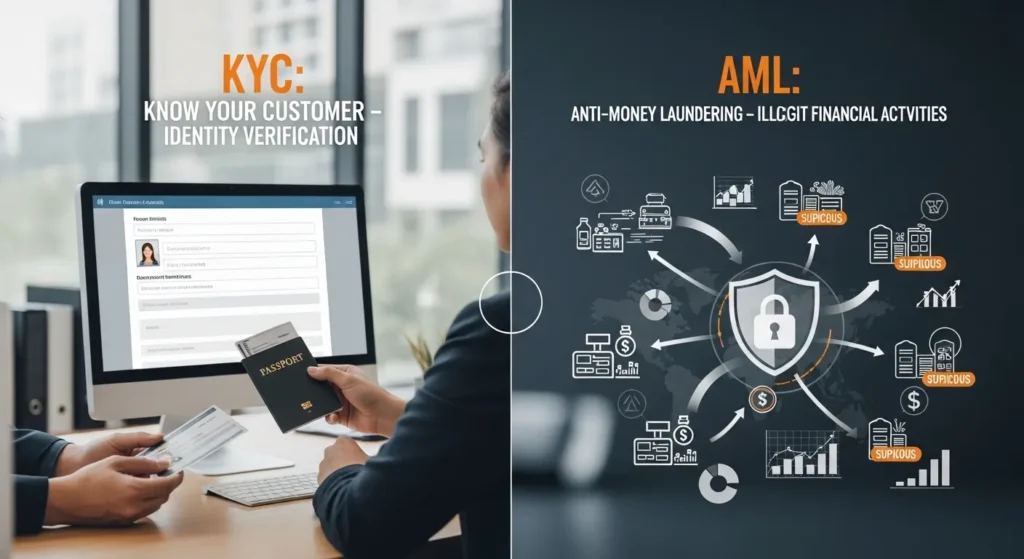
The main difference between KYC and AML is that KYC is a verification process used to identify customers, while AML is a broader system designed to detect and prevent money laundering and financial crimes.
KYC is a part of AML compliance, meaning it works as one of the tools used within the larger AML framework.
Why Is Their Difference Necessary to Know for Learners and Experts?
Understanding the difference between KYC and AML is essential for both learners and professionals. For students studying finance, banking, or business, this knowledge helps them understand how financial institutions maintain trust and transparency.
For experts such as bankers, compliance officers, and fintech professionals, recognizing the difference between KYC and AML is crucial to implement regulations properly. These processes protect society by preventing fraud, terrorism financing, and illegal financial activities. When institutions apply KYC and AML correctly, they create safer financial environments for businesses and individuals.
Pronunciation
KYC
- US: /ˌkeɪ waɪ ˈsiː/
- UK: /ˌkeɪ waɪ ˈsiː/
AML
- US: /ˌeɪ em ˈel/
- UK: /ˌeɪ em ˈel/
Linking Hook
To clearly understand the difference between KYC and AML, we need to explore their roles, functions, and real-world applications in detail.
Difference Between KYC and AML
1. Definition
KYC is the process of verifying a customer’s identity before providing financial services.
AML refers to policies and procedures used to prevent money laundering and financial crimes.
Examples
KYC Example 1: A bank asks for your passport to confirm identity.
KYC Example 2: A crypto exchange verifies your selfie and ID card.
AML Example 1: A bank monitors suspicious large transfers.
AML Example 2: A financial system flags unusual international transactions.
2. Scope
KYC has a narrower scope, focusing mainly on customer identity verification.
AML has a broader scope, covering monitoring, reporting, and preventing financial crime.
Examples
KYC Example 1: Verifying a customer’s date of birth.
KYC Example 2: Confirming address documents.
AML Example 1: Tracking suspicious transaction patterns.
AML Example 2: Reporting illegal financial activity to authorities.
3. Purpose
The purpose of KYC is to identify customers and reduce identity fraud.
The purpose of AML is to stop money laundering and criminal financial networks.
Examples
KYC Example 1: Checking a new customer’s national ID.
KYC Example 2: Verifying business registration documents.
AML Example 1: Monitoring transactions for illegal activity.
AML Example 2: Investigating unusual cash deposits.
4. Process Stage
KYC is usually done at the beginning of a customer relationship.
AML continues throughout the entire financial relationship.
Examples
KYC Example 1: Opening a bank account.
KYC Example 2: Signing up for a digital wallet.
AML Example 1: Monitoring daily transactions.
AML Example 2: Investigating suspicious activity years later.
5. Focus
KYC focuses on customer identity.
AML focuses on financial behavior and transactions.
Examples
KYC Example 1: Checking biometric verification.
KYC Example 2: Validating passport information.
AML Example 1: Detecting repeated large transfers.
AML Example 2: Flagging transactions between risky countries.
6. Regulation
KYC regulations mainly ensure customer identification standards.
AML regulations enforce broader anti-crime financial rules.
Examples
KYC Example 1: Banks verifying identity before opening accounts.
KYC Example 2: Online platforms requiring ID verification.
AML Example 1: Banks reporting suspicious transactions.
AML Example 2: Governments enforcing anti-crime policies.
7. Tools Used
KYC uses identity verification systems.
AML uses monitoring and analytical tools.
Examples
KYC Example 1: Document verification software.
KYC Example 2: Facial recognition systems.
AML Example 1: Transaction monitoring software.
AML Example 2: Risk scoring algorithms.
8. Responsibility
KYC is handled mainly by customer onboarding teams.
AML is handled by compliance and risk departments.
Examples
KYC Example 1: Bank staff verifying documents.
KYC Example 2: Digital platforms validating user identity.
AML Example 1: Compliance officers reviewing suspicious cases.
AML Example 2: Financial analysts investigating irregular activity.
9. Timing
KYC occurs once or occasionally during onboarding.
AML happens continuously.
Examples
KYC Example 1: Identity verification during registration.
KYC Example 2: Periodic document updates.
AML Example 1: Real-time transaction monitoring.
AML Example 2: Continuous financial risk assessment.
10. Relationship
KYC is a component of AML.
AML is the overall regulatory framework.
Examples
KYC Example 1: ID verification as part of compliance.
KYC Example 2: Customer risk assessment.
AML Example 1: National anti-crime financial policies.
AML Example 2: International financial monitoring standards.
Nature and Behaviour
KYC Nature
KYC is preventive and identity-focused. Its behavior is straightforward: verify who the customer is before allowing financial access.
AML Nature
AML is investigative and monitoring-based. Its behavior involves detecting suspicious patterns and preventing illegal financial flows.
Why People Are Confused About Their Use
People often confuse KYC and AML because they are closely connected in banking and finance. Many institutions use both processes together, making them appear identical. In reality, KYC is just one part of the larger AML compliance system.
Table Showing Difference and Similarity
| Aspect | KYC | AML | Similarity |
| Meaning | Customer identity verification | Prevention of money laundering | Both prevent financial crime |
| Scope | Narrow | Broad | Used in financial institutions |
| Focus | Customer identity | Financial activity | Improve security |
| Timing | At onboarding | Continuous | Regulatory compliance |
| Goal | Identify customers | Stop illegal money flow | Protect financial systems |
Which Is Better in What Situation?
When KYC Is Better
KYC is better during the early stage of customer interaction. When someone opens a bank account or joins a digital platform, identity verification is necessary. Without KYC, institutions cannot ensure that customers are genuine individuals.
When AML Is Better
AML is better for ongoing monitoring and crime prevention. Once the account is active, AML systems track transactions to detect suspicious behavior. This helps prevent fraud, terrorism financing, and other financial crimes.
Use in Metaphors and Similes
- KYC is like a security guard checking IDs at the entrance.
- AML is like a surveillance system monitoring the whole building.
Simile Example:
- KYC works like a gatekeeper verifying identity.
- AML operates like a detective tracking suspicious actions.
Connotative Meaning
KYC
- Connotation: Neutral to positive
- Example: “The platform introduced strict KYC to protect users.”
AML
- Connotation: Positive
- Example: “Strong AML policies strengthen financial security.”
Idioms or Proverbs Related to the Concepts
“Trust but verify.”
Example: Banks follow this rule by applying KYC before opening accounts.
“Prevention is better than cure.”
Example: AML systems prevent financial crimes before they grow larger.
Works in Literature (Related Topics)
- Money Laundering: A Guide for Criminal Investigators Nonfiction, John Madinger, 2011
- The Laundrymen Investigative nonfiction, Jeff Leen, 2002
- Financial Crime and Money Laundering Academic text, Jackie Harvey, 2015
Movies Related to Financial Crime
- The Laundromat 2019, USA
- The Wolf of Wall Street 2013, USA
- Inside Job 2010, USA
Frequently Asked Questions
1. Is KYC part of AML?
Yes. KYC is a component within the larger AML compliance framework.
2. Why do banks require KYC?
Banks require KYC to verify customer identity and prevent fraud.
3. Can AML work without KYC?
No. AML systems rely on KYC data to identify suspicious transactions.
4. Is KYC required for online services?
Yes. Many fintech apps and crypto exchanges require KYC verification.
5. Which industries use AML the most?
Banks, fintech companies, insurance firms, and cryptocurrency platforms use AML extensively.
How Both Are Useful for the Surroundings
KYC and AML help maintain financial transparency and security in society. They prevent criminals from misusing financial systems and protect individuals from fraud. By implementing these systems, governments and financial institutions create a safer economic environment.
Final Words for Both
KYC ensures that financial institutions know who their customers are, while AML ensures that those customers do not misuse financial systems for illegal activities.
Conclusion
The difference between KYC and AML lies mainly in their function and scope. KYC focuses on verifying customer identity, while AML focuses on preventing financial crimes through monitoring and investigation.
Although they serve different roles, they work together as part of a comprehensive financial security system. Understanding the difference between KYC and AML is essential for students, professionals, and businesses operating in the modern financial world. When applied correctly, these processes build trust, reduce fraud, and create a safer global financial environment.

I am David, a passionate blog writer who loves creating informative and easy-to-understand content. I write articles that explain the difference between common topics, language concepts, and everyday knowledge. My goal is to help readers learn new things in a simple and clear way. Through research and practical examples, I try to provide useful and reliable information for students, learners, and curious readers around the world.