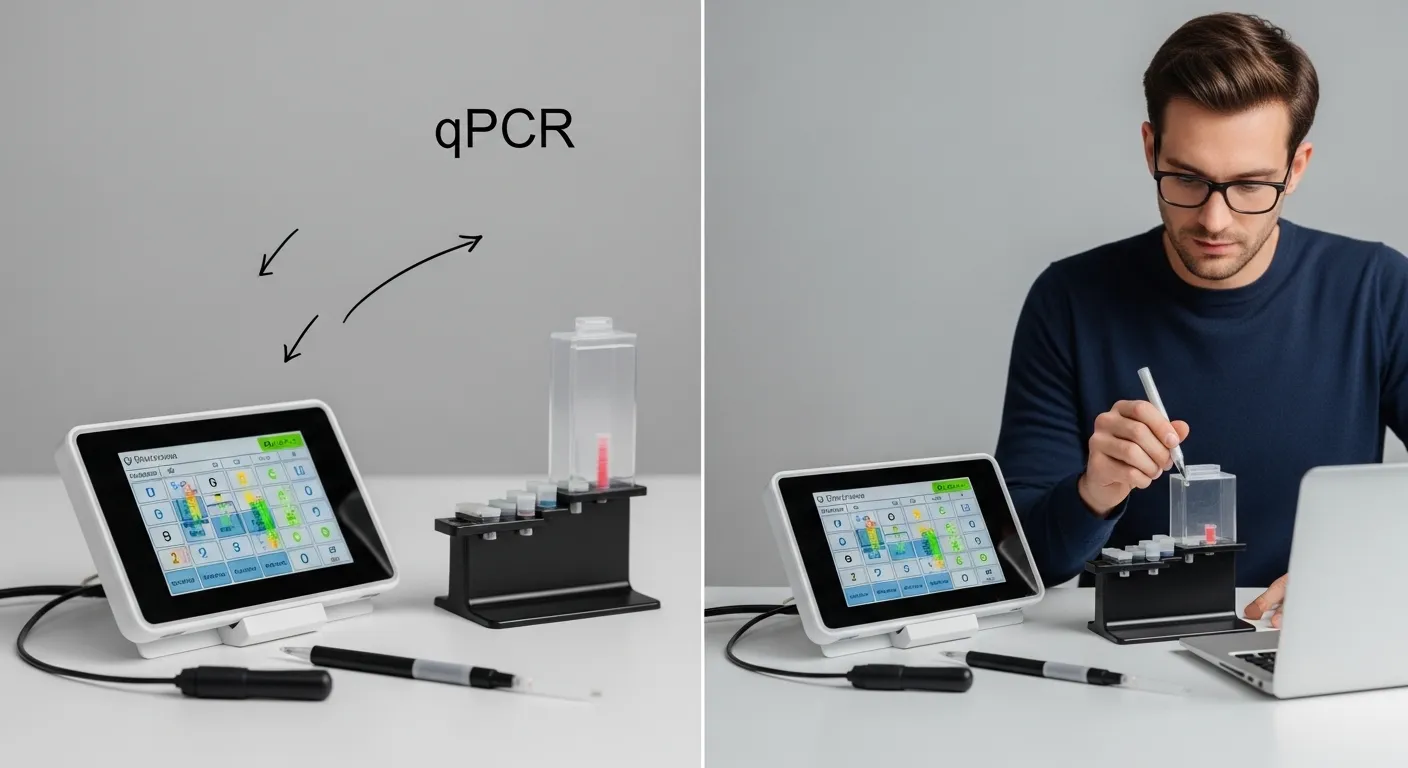
Imagine a doctor trying to find a tiny germ in a patient’s blood. The germ is so small that it cannot be seen easily. Scientists use special tools to copy the germ’s DNA many times so it becomes easy to detect.
Two important tools used in laboratories are PCR and qPCR.Understanding the difference between PCR and qPCR helps students, doctors, and researchers know how these tools work.PCR means making many copies of DNA.
qPCR is a more advanced form that also measures the amount of DNA while copying it. Many people want to learn the difference between PCR and qPCR because these techniques are widely used in medical testing and research.
For example, virus testing and genetic studies often depend on them. In simple words, the difference between PCR and qPCR is about copying DNA versus copying and measuring DNA at the same time.Knowing the difference between PCR and qPCR helps us understand how modern laboratories detect diseases and study genes.
Key Difference Between the Two
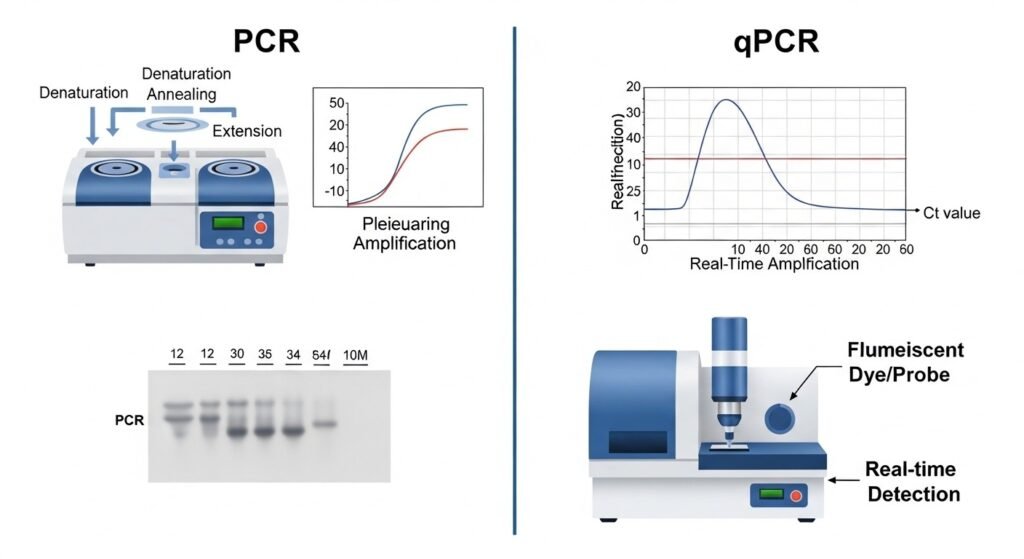
The main difference between PCR and qPCR is that PCR only copies DNA, while qPCR copies DNA and measures the amount of DNA during the process using special fluorescent signals.
Why It Is Important to Know Their Difference
Knowing the difference between PCR and qPCR is important for both learners and experts. Students studying biology need to understand how DNA tests work. Doctors use these methods to detect diseases early. Scientists also rely on them to study genes and develop new medicines.
In society, these techniques help in virus detection, cancer research, and forensic science. For example, during disease outbreaks, qPCR helps measure how much virus is present in a sample. This knowledge improves health care and scientific progress.
Pronunciation of the Words
PCR
- US: /ˌpiː siː ˈɑːr/
- UK: /ˌpiː siː ˈɑː/
qPCR
- US: /ˌkjuː piː siː ˈɑːr/
- UK: /ˌkjuː piː siː ˈɑː/
Linking Hook
Now that we understand the basic idea, let us explore the difference between PCR and qPCR in detail with clear points and examples.
Difference Between PCR and qPCR
1. Purpose
PCR copies DNA only.
Examples
- Scientists copy DNA to study genes.
- A lab copies bacterial DNA for research.
qPCR copies DNA and measures it.
Examples
- Doctors measure virus levels in blood.
- Researchers check how much DNA is in a sample.
2. Detection Method
PCR results are seen at the end.
Examples
- DNA bands appear after gel testing.
- Scientists check results after the process.
qPCR results appear during the process.
Examples
- Fluorescent signals show DNA growth.
- A computer shows data in real time.
3. Data Output
PCR gives a simple yes or no result.
Examples
- DNA present or not present.
- A gene is detected or not detected.
qPCR gives numbers and measurements.
Examples
- Virus quantity in a patient sample.
- Amount of gene expression in cells.
4. Technology Used
PCR uses basic thermal cycling.
Examples
- Heating and cooling steps repeat.
- Standard lab machines are used.
qPCR uses advanced machines with sensors.
Examples
- Fluorescent dyes measure DNA.
- A computer records signals.
5. Speed of Results
PCR results take longer to analyze.
Examples
- Scientists must run gel electrophoresis.
- Extra time is needed for confirmation.
qPCR gives faster analysis.
Examples
- Results appear during the test.
- Computers analyze data instantly.
6. Accuracy
PCR is accurate but less detailed.
Examples
- Detects presence of DNA.
- Useful for simple gene detection.
qPCR is more precise.
Examples
- Measures exact DNA amount.
- Tracks changes in gene activity.
7. Use in Medicine
PCR is used for simple detection.
Examples
- Identifying bacteria.
- Checking genetic mutations.
qPCR is used for detailed testing.
Examples
- Measuring virus load.
- Monitoring disease progression.
8. Cost
PCR machines are cheaper.
Examples
- Used in basic labs.
- Many schools use them.
qPCR machines are more expensive.
Examples
- Advanced research labs use them.
- Hospitals use them for virus testing.
9. Complexity
PCR is simpler.
Examples
- Easy protocol.
- Basic training needed.
qPCR is more complex.
Examples
- Requires special software.
- Needs trained technicians.
10. Research Applications
PCR supports general DNA studies.
Examples
- Cloning genes.
- Identifying organisms.
qPCR supports advanced genetic studies.
Examples
- Studying gene expression.
- Measuring disease markers.
Nature and Behaviour of Both
PCR
PCR is a basic molecular biology method. Its nature is simple and reliable. It copies DNA many times so scientists can study it easily.
qPCR
qPCR is an advanced and smart method. It not only copies DNA but also measures how much DNA is present during the reaction.
Why People Are Confused About Their Use
People often get confused because both techniques copy DNA and have similar names. qPCR is actually an improved version of PCR. Since both use similar steps and machines, beginners think they are the same method.
Table Showing Difference and Similarity
| Feature | PCR | qPCR | Similarity |
| Purpose | Copies DNA | Copies and measures DNA | Both amplify DNA |
| Data | Qualitative | Quantitative | Both give test results |
| Detection | End-point | Real-time | Both use thermal cycles |
| Equipment | Basic machine | Advanced machine | Both used in labs |
| Use | Research and detection | Medical diagnostics | Both study DNA |
Which Is Better in What Situation?
PCR
PCR is better when scientists only need to know whether DNA is present or not. It is useful for basic research, teaching labs, and simple genetic tests. Because the equipment is cheaper and easier to use, PCR is common in many laboratories.
qPCR
qPCR is better when scientists need detailed information. It helps measure how much DNA or virus is present in a sample. Doctors often use qPCR in medical tests because it gives fast and accurate results. It is very useful in disease detection and gene expression studies.
Use in Metaphors and Similes
Sometimes people use these terms metaphorically in science discussions.
Examples
- “His research idea spread like PCR copying DNA.”
- “The data grew like DNA in a qPCR machine.”
Connotative Meaning
PCR
Neutral meaning. It represents scientific testing.
Example:
“The lab used PCR to confirm the genetic sample.”
qPCR
Positive meaning in research and medicine because it shows accuracy.
Example:
“qPCR helped doctors measure the virus level quickly.”
Idioms or Proverbs Related to the Idea
While there are no direct idioms about PCR or qPCR, similar ideas appear in language.
“Truth will come to light.”
Example:
Just like PCR reveals hidden DNA, truth also appears over time.
“Small things grow big.”
Example:
DNA copies in PCR show how small molecules can grow into large amounts.
Works in Literature Mentioning the Terms
- The Double Helix Science Memoir, James D. Watson, 1968
- Genome Science Non-fiction, Matt Ridley, 1999
- The Gene: An Intimate History Science Non-fiction, Siddhartha Mukherjee, 2016
Movies Related to Genetic Science
- Gattaca 1997, USA
- Contagion 2011, USA
- Jurassic Park 1993, USA
Frequently Asked Questions
1. What is PCR used for?
PCR is used to copy DNA so scientists can study it easily.
2. What is qPCR used for?
qPCR copies DNA and measures how much DNA is present.
3. Is qPCR better than PCR?
qPCR is better for measuring DNA quantity, but PCR is good for simple detection.
4. Are PCR and qPCR the same process?
They use similar steps, but qPCR includes real-time measurement.
5. Why are they important in medicine?
They help detect viruses, bacteria, and genetic changes.
How Both Are Useful for Our Surroundings
PCR and qPCR help protect public health. They detect diseases early, support medical research, and help scientists study living organisms. They also help in environmental testing, agriculture, and forensic science.
Final Words for Both
PCR is the foundation of modern DNA testing. qPCR builds on this method and adds powerful measurement ability. Together, they support scientific discovery and medical progress.
Conclusion
Understanding the difference between PCR and qPCR helps us see how modern science studies DNA. PCR is a simple method that copies DNA many times so it can be studied.
qPCR goes further by copying DNA and measuring it during the process. Both techniques play a major role in laboratories, hospitals, and research centers. They help detect diseases, study genes, and improve medical treatments.
Although their names and steps are similar, their purposes are slightly different. Learning the difference between PCR and qPCR allows students, doctors, and scientists to choose the right method for their work and improve health and scientific knowledge.

I am James Anderson an English author known for his insightful and engaging writing in contemporary literature. With a focus on [insert genre, e.g., fiction, non-fiction, or specific themes], he explores complex human emotions and social dynamics, blending thought-provoking ideas with accessible storytelling. His work has earned recognition for its clarity, depth, and ability to connect with a wide audience, establishing him as a respected voice in modern English literature.