A few years ago, a student named Ali finished his bachelor’s degree and started thinking about the next step in his academic journey. Some of his friends suggested a Master’s degree, while others encouraged him to aim for a PhD.
Ali soon realized that understanding the difference between PhD and Masters was not as simple as he first thought. Both degrees belong to higher education and offer valuable opportunities, but they serve different purposes.
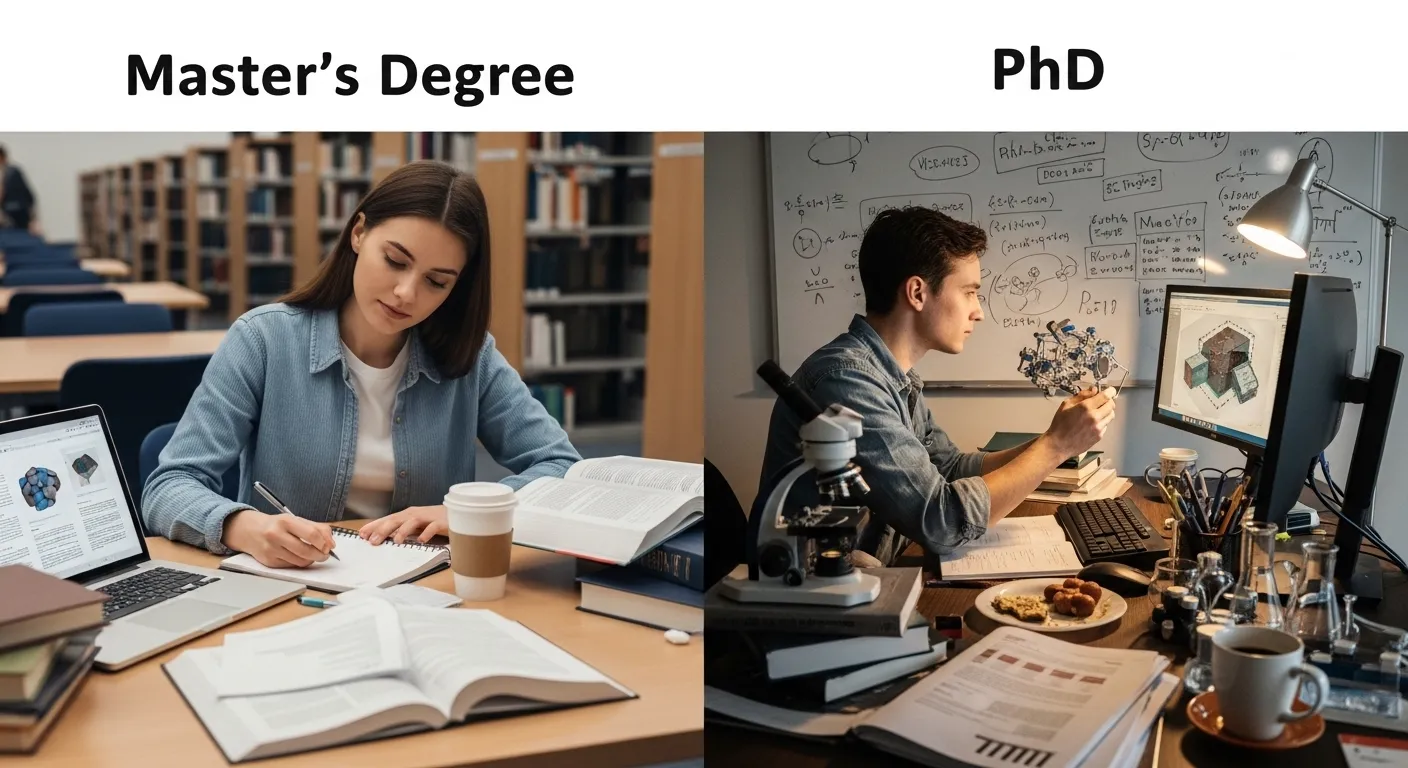
A Master’s degree usually focuses on advanced learning and professional skills in a specific subject. A PhD (Doctor of Philosophy), on the other hand, is the highest academic degree that focuses on deep research and creating new knowledge.
When students explore the difference between PhD and Masters, they learn how these degrees shape careers and academic paths. Understanding the difference between PhD and Masters helps learners choose the right educational direction. In fact, knowing the difference between PhD and Masters is important for students, teachers, and professionals who want to plan their future wisely.
Pronunciation
- PhD
- US: /ˌpiː eɪtʃ ˈdiː/
- UK: /ˌpiː eɪtʃ ˈdiː/
- US: /ˌpiː eɪtʃ ˈdiː/
- Master’s
- US: /ˈmæs.tərz/
- UK: /ˈmɑː.stəz/
- US: /ˈmæs.tərz/
Before exploring deeper ideas, let us clearly understand the difference between PhD and Masters in detail.
Key Difference Between PhD and Masters
The main difference between a PhD and a Master’s degree lies in their purpose and depth. A Master’s degree focuses on gaining advanced knowledge and professional skills in a field.
A PhD focuses on original research and creating new knowledge. While a Master’s degree usually takes 1–2 years to complete, a PhD often requires 3–6 years of intensive research.
Why Is Their Difference Important for Learners and Experts?
Understanding the difference between PhD and Masters is important because it helps students choose the right academic and professional path. A Master’s degree is ideal for individuals who want to specialize in a field and improve their career opportunities in industries such as business, engineering, or education.
A PhD, however, is more suitable for people who are passionate about research, teaching at universities, and contributing new knowledge to society. Experts, scientists, and scholars often hold PhD degrees because their work requires deep research and critical thinking.
For society, both degrees are valuable. Master’s graduates often become skilled professionals who support industries and organizations, while PhD holders drive innovation, scientific discoveries, and academic progress.
Difference Between PhD and Masters
1. Purpose
PhD: Focuses on original research and creating new knowledge.
Example 1: A PhD student studies climate change and publishes new research.
Example 2: A PhD scholar develops a new scientific theory.
Master’s: Focuses on advanced learning and professional development.
Example 1: A student studies advanced marketing strategies.
Example 2: A teacher completes a Master’s in Education to improve teaching skills.
2. Duration
PhD: Usually takes 3–6 years to complete.
Example 1: A physics PhD takes five years of research.
Example 2: A sociology PhD takes four years.
Master’s: Usually takes 1–2 years.
Example 1: MBA programs often take two years.
Example 2: A Master’s in Computer Science may take 18 months.
3. Focus of Study
PhD: Focuses heavily on independent research.
Example 1: Writing a dissertation.
Example 2: Conducting experiments or surveys.
Master’s: Focuses more on coursework and practical learning.
Example 1: Attending lectures and seminars.
Example 2: Completing class projects.
4. Academic Level
PhD: Highest academic qualification.
Example 1: University professors usually have PhDs.
Example 2: Senior researchers hold PhD degrees.
Master’s: A postgraduate degree after a bachelor’s.
Example 1: MBA graduates become managers.
Example 2: MA graduates work in education or media.
5. Research Requirement
PhD: Requires a long research thesis or dissertation.
Example 1: A 300-page research thesis.
Example 2: Multiple published academic papers.
Master’s: May require a short thesis or project.
Example 1: A final research project.
Example 2: A practical internship report.
6. Career Goals
PhD: Often leads to academic or research careers.
Example 1: Becoming a university professor.
Example 2: Working as a scientific researcher.
Master’s: Leads to professional industry roles.
Example 1: Business management jobs.
Example 2: IT specialist roles.
7. Admission Requirements
PhD: Requires strong academic record and research proposal.
Example 1: A student submits a research plan.
Example 2: Interviews with supervisors.
Master’s: Usually requires a bachelor’s degree.
Example 1: Applying with undergraduate transcripts.
Example 2: Standard admission application.
8. Learning Style
PhD: Independent and research-focused learning.
Example 1: Working alone in laboratories.
Example 2: Publishing academic papers.
Master’s: Structured classes and guided learning.
Example 1: Weekly lectures.
Example 2: Group projects.
9. Output
PhD: Produces new knowledge through research.
Example 1: Publishing discoveries.
Example 2: Creating academic theories.
Master’s: Produces skilled professionals.
Example 1: Business managers.
Example 2: Engineers.
10. Academic Title
PhD: Earns the title “Doctor.”
Example 1: Dr. Ahmed, researcher.
Example 2: Dr. Sara, university professor.
Master’s: Does not give the title “Doctor.”
Example 1: MA graduate teacher.
Example 2: MBA graduate manager.
Nature and Behaviour of Both
PhD: Analytical, research-oriented, and discovery-focused. It demands patience, curiosity, and critical thinking.
Master’s: Practical, skill-oriented, and career-focused. It emphasizes professional development and advanced knowledge.
Why People Are Confused About Their Use
People often confuse these degrees because both belong to postgraduate education and involve specialized study.
Many students also assume that a PhD is simply a longer version of a Master’s, but in reality the goals and academic expectations are very different.
Table: Difference and Similarity
| Feature | PhD | Master’s | Similarity |
| Level | Doctoral | Postgraduate | Both advanced degrees |
| Focus | Research | Coursework | Specialized study |
| Duration | 3–6 years | 1–2 years | Require dedication |
| Outcome | New knowledge | Professional skills | Improve career |
| Academic Path | Research/teaching | Professional roles | Higher education |
Which Is Better in What Situation?
A Master’s degree is better for students who want to quickly enter the job market with specialized knowledge. It is suitable for professionals aiming to improve their career, gain practical skills, or move into management roles.
A PhD is better for people who love research, academic writing, and discovery. It is ideal for individuals who want to become university professors, scientists, or experts who contribute new knowledge to their field.
Metaphors and Similes
- A Master’s degree is like a bridge that connects undergraduate study with professional expertise.
- A PhD is like exploring uncharted territory, where the researcher discovers new ideas.
Example:
- “His PhD journey was like climbing a mountain of knowledge.”
- “Her Master’s degree worked like a key that opened many career doors.”
Connotative Meaning
PhD
- Positive: Expertise, innovation
Example: “Her PhD shows her dedication to research.” - Neutral: Academic qualification
- Negative: Sometimes associated with long study periods.
Master’s
- Positive: Professional growth
Example: “His Master’s degree helped him become a manager.” - Neutral: Advanced education
- Negative: May not guarantee top research roles.
Idioms or Proverbs Related to Learning
- “Knowledge is power.”
Example: A PhD researcher believes knowledge leads to innovation. - “Practice makes perfect.”
Example: Master’s students develop skills through practice.
Works in Literature
- The PhD Grind – Academic memoir – Philip Guo – 2015
- Doctoral Education and the Faculty of the Future – Academic nonfiction – Ronald Ehrenberg – 2010
- The Graduate School Mess – Educational nonfiction – Leonard Cassuto – 2015
Movies Related to Academic Research
- The Theory of Everything – 2014 – UK
- A Beautiful Mind – 2001 – USA
- Good Will Hunting – 1997 – USA
Frequently Asked Questions
1. What is the main difference between PhD and Masters?
A PhD focuses on research and new knowledge, while a Master’s focuses on advanced learning and professional skills.
2. Which degree takes longer?
A PhD usually takes 3–6 years, while a Master’s takes about 1–2 years.
3. Can you do a PhD without a Master’s?
In some countries and universities, yes, but many programs prefer a Master’s degree first.
4. Which degree is better for jobs?
A Master’s is often better for industry jobs, while a PhD suits academic and research careers.
5. Do both require hard work?
Yes, both degrees require dedication, discipline, and advanced study.
How Both Are Useful for Society
Master’s graduates contribute to industries by applying advanced skills in business, technology, and education. PhD holders contribute to society through research, innovation, and academic leadership that leads to scientific and intellectual progress.
Final Words
A Master’s degree builds professional expertise, while a PhD builds deep academic knowledge and research abilities. Both degrees play important roles in education and society.
Conclusion
Understanding the difference between PhD and Masters helps students make informed academic decisions.
A Master’s degree focuses on professional development, practical skills, and specialized knowledge that can quickly improve career opportunities. In contrast, a PhD emphasizes deep research, critical thinking, and the creation of new knowledge that contributes to academic and scientific advancement.
Both degrees are valuable in their own ways and serve different purposes in higher education. Students should choose based on their goals, interests, and career plans. By clearly understanding the difference between PhD and Masters, learners can select the path that best matches their ambitions and helps them contribute positively to society.

I am David, a passionate blog writer who loves creating informative and easy-to-understand content. I write articles that explain the difference between common topics, language concepts, and everyday knowledge. My goal is to help readers learn new things in a simple and clear way. Through research and practical examples, I try to provide useful and reliable information for students, learners, and curious readers around the world.