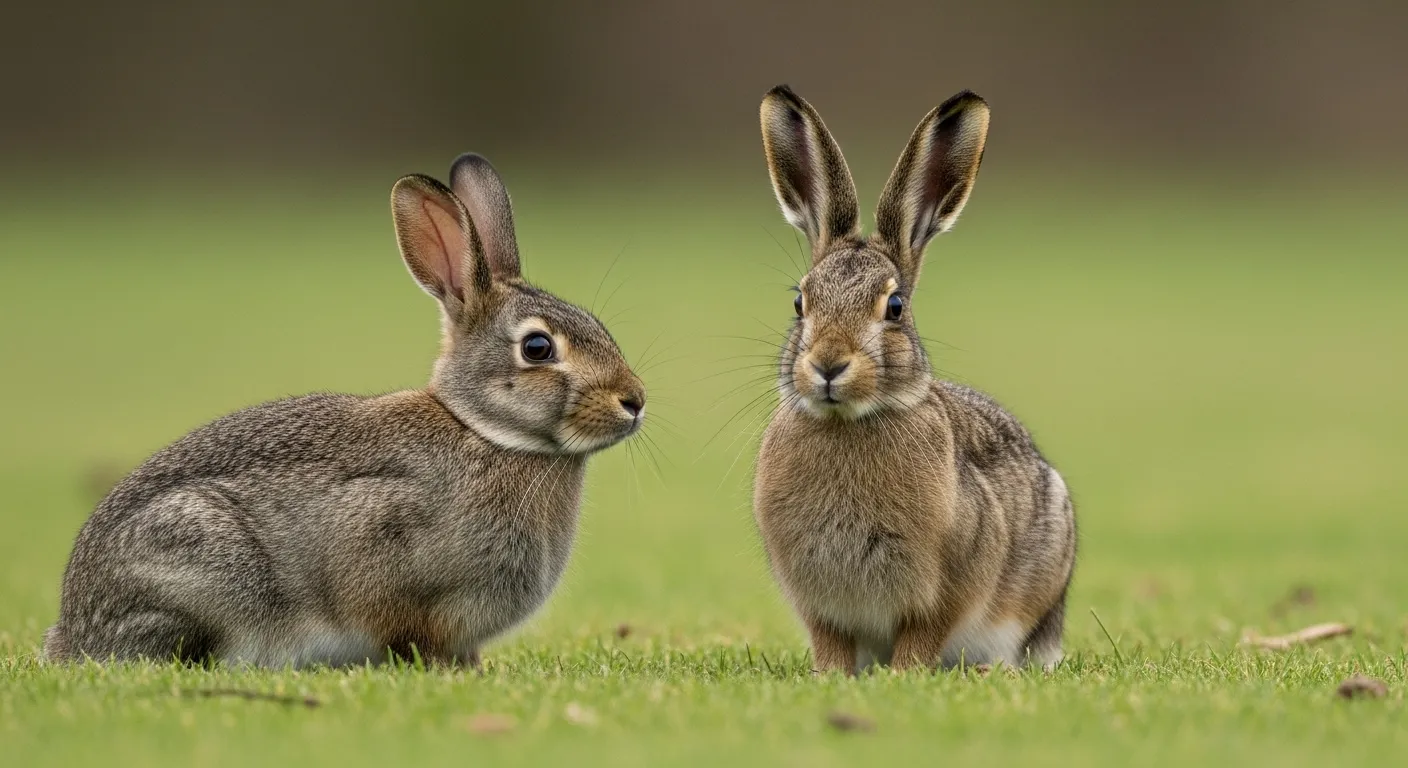
On a quiet morning in the countryside, a farmer noticed two small animals running across his field. One moved quickly with long legs and large ears, while the other hopped gently near a bush.
At first glance, they looked similar, and the farmer wondered about the difference between rabbits and hares. Many people see these animals in nature, stories, or cartoons, yet they rarely know the real difference between rabbits and hares.
In simple terms, rabbits and hares are small mammals belonging to the same family called Leporidae, but they are different species with unique traits. Understanding the difference between rabbits and hares helps people learn more about wildlife and nature. While both animals may appear alike, the difference between rabbits and hares can be seen in their size, behavior, habitat, and way of life.
Key Difference Between the Two
The main difference lies in their physical features, habitat, and behavior. Hares are generally larger, faster, and born with fur and open eyes, while rabbits are smaller, social animals that live in burrows and are born blind and hairless.
Why Their Difference Is Important for Learners and Experts
Knowing the difference between rabbits and hares is valuable for students, researchers, wildlife lovers, and farmers. It helps scientists study animal adaptation and evolution. Farmers can better understand how these animals affect crops and ecosystems. In society, accurate knowledge prevents confusion in education, literature, and environmental discussions. Understanding these animals also encourages respect for wildlife and biodiversity.
Pronunciation
| Word | US Pronunciation | UK Pronunciation |
| Rabbit | /ˈræbɪt/ | /ˈræbɪt/ |
| Hare | /her/ | /heə/ |
Before exploring their unique characteristics, let us look closely at the difference between rabbits and hares in detail.
Difference Between Rabbits and Hares
Size and Body Structure
Hares are generally larger and have longer legs than rabbits.
Example 1: A European hare can grow much larger than a typical domestic rabbit.
Example 2: Lepus have stronger hind legs that help them run faster than Bunny.
Birth Condition
Hares are born fully developed, while rabbits are born helpless.
Example 1: Baby hares are born with fur and open eyes.
Example 2: Baby rabbits are born blind and without fur.
Habitat
Bunny usually live in underground burrows, whileLepus live above ground.
Example 1: Rabbits dig complex tunnels called warrens.
Example 2: Hares rest in shallow nests called forms on the ground.
Speed and Movement
Hares are faster runners than rabbits.
Example 1: A hare can run very fast to escape predators in open fields.
Example 2: Rabbits usually rely on quick zigzag hops to hide in bushes.
Ear Length
Hares have longer ears compared to rabbits.
Example 1: The long ears help hares detect predators from far away.
Example 2: Rabbits have shorter ears suited for living in burrows.
Social Behavior
Rabbits are social animals, while hares are mostly solitary.
Example 1: Rabbits live in groups in underground warrens.
Example 2: Hares prefer living alone in open grasslands.
Habitat Type
Rabbits prefer forests and bushes, while hares prefer open land.
Example 1: Rabbits often live near gardens and wooded areas.
Example 2: Hares are commonly found in fields and plains.
Baby Development
Young rabbits depend on their mothers longer.
Example 1: A baby rabbit stays hidden in the nest for safety.
Example 2: A baby hare can move around shortly after birth.
Running Style
Hares use powerful leaps while rabbits hop quickly.
Example 1: A hare can cover large distances in one leap.
Example 2: A rabbit moves in shorter jumps while hiding.
Domestication
Rabbits can be domesticated, but hares cannot.
Example 1: Rabbits are popular pets around the world.
Example 2: Hares remain wild animals and rarely adapt to domestic life.
Nature and Behaviour
Rabbits
Rabbits are gentle, social, and playful animals. They enjoy living in groups and build underground tunnels for safety. Rabbits are herbivores and eat grass, vegetables, and plants. They are often active during dawn and dusk.
Hares
Hares are more independent and cautious animals. They rely on speed and strong legs to escape predators. Hares prefer open landscapes and are usually seen alone rather than in groups.
Why People Are Confused About Their Use
Many people confuse rabbits and hares because they belong to the same animal family and look similar. Cartoons, stories, and everyday language often use the names interchangeably. For example, some people call all small hopping animals “rabbits,” even if they are actually hares. This similarity in appearance causes confusion in daily conversation.
Difference and Similarity Table
| Feature | Rabbits | Hares | Similarity |
| Size | Smaller | Larger | Both are small mammals |
| Habitat | Burrows underground | Above-ground nests | Both live on land |
| Babies | Blind and hairless | Born with fur and open eyes | Both give birth to live young |
| Social life | Live in groups | Mostly solitary | Both avoid predators |
| Speed | Slower | Faster | Both can run to escape danger |
Which Is Better in What Situation?
Rabbits
Rabbits are better suited for domestication and companionship. They are friendly and can adapt to human environments. Many families keep rabbits as pets because they are calm, easy to care for, and social animals.
Hares
Hares are better adapted to wild environments. Their strong legs and speed allow them to survive in open fields and escape predators quickly. They are ideal examples of animals perfectly adapted to natural ecosystems.
Metaphors and Similes
- “Fast as a hare” used to describe someone who runs very quickly.
- “Quiet as a rabbit” used to describe someone gentle or shy.
Example:
- The athlete ran as fast as a hare during the race.
- The child sat as quiet as a rabbit in the classroom.
Connotative Meanings
Rabbit
- Positive: innocence, gentleness
- Negative: fearfulness
- Neutral: small animal
Example:
- Positive: The rabbit symbolizes kindness in children’s stories.
- Negative: He acted like a rabbit and ran away from the challenge.
Hare
- Positive: speed and alertness
- Neutral: wild animal of the fields
Example:
- The soldier moved quickly like a hare to avoid danger.
Idioms and Proverbs
“Pull a rabbit out of a hat”
Meaning: to produce something surprising.
Example:
- The magician pulled a rabbit out of a hat during the show.
“Mad as a March hare”
strange – behaving in a strange or unusual way.
Example:
- He was acting mad as a March hare during the party.
Works in Literature
- Alice’s Adventures in Wonderland Fantasy, Lewis Carroll, 1865 (features the March Hare)
- The Tale of Peter Rabbit Children’s literature, Beatrix Potter, 1902
- Watership Down Adventure novel about rabbits, Richard Adams, 1972
Movies Based on Rabbits or Hares
- Peter Rabbit 2018, United States
- Peter Rabbit 2: The Runaway 2021, United States
- Rise of the Guardians (features the Easter Bunny) 2012, United States
Frequently Asked Questions
1. Are rabbits and hares the same animal?
No, they belong to the same family but are different species.
2. Which animal is faster?
Hares are faster runners than rabbits.
3. Do rabbits and hares live in the same habitat?
Not usually. Rabbits prefer burrows, while hares live above ground.
4. Can hares be pets like rabbits?
No, hares are wild animals and are difficult to domesticate.
5. Why do people confuse them?
Because they look similar and are often used interchangeably in stories and media.
How Both Are Useful for the Environment
Rabbits and hares play an important role in ecosystems. They help maintain plant growth by grazing on vegetation. They also serve as food for predators like foxes, hawks, and wolves. Their presence supports the balance of nature and biodiversity.
Final Words for Both
Rabbits represent gentleness and companionship, while hares symbolize speed and independence. Both animals contribute to nature in different ways.
Conclusion
The difference between rabbits and hares becomes clear when we examine their physical features, habitats, and behaviors.
Rabbits are smaller, social animals that live in burrows and are commonly kept as pets. Hares are larger, faster, and prefer living alone in open landscapes. Despite belonging to the same animal family, their lifestyles and survival strategies are very different.
Understanding these differences improves our knowledge of wildlife and helps people appreciate the diversity of animals in nature. Whether seen in fields, forests, literature, or films, rabbits and hares continue to capture human interest and curiosity. Learning about them reminds us how fascinating and varied the natural world truly is.

I am E.M. Forster (1879–1970), a renowned English novelist and essayist, famous for A Room with a View, Howards End, and A Passage to India. I explore human relationships, social class, and personal freedom, making my work a key part of 20th-century English literature.