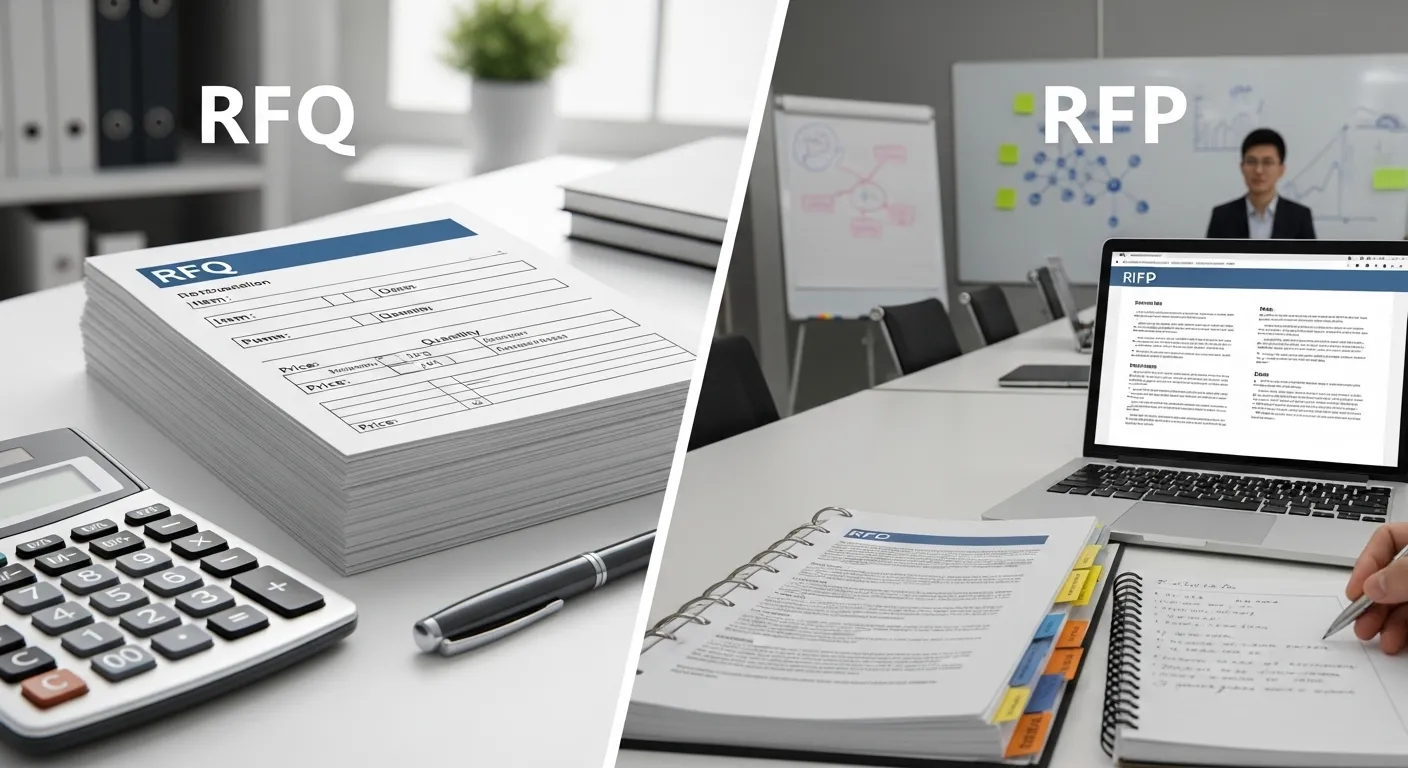
Imagine a company planning to build a new office building. The manager already knows the materials needed for steel, cement, and glass so they ask several suppliers to send prices for these items.
In another situation, a company wants to build a new website but is unsure about the best design, features, or approach. Instead of asking only for prices, they ask agencies to propose solutions and strategies.These two situations show the difference between RFQ and RFP in the business world.
Understanding the difference between RFQ and RFP is important in procurement and project management. The difference between RFQ and RFP lies mainly in what information the buyer needs from suppliers. Some requests focus on price, while others focus on ideas and solutions.
When businesses understand the difference between RFQ and RFP, they can communicate clearly with vendors and choose the best supplier efficiently. Knowing the difference between RFQ and RFP helps organizations save time, reduce costs, and make better decisions.
Key Difference Between the Two
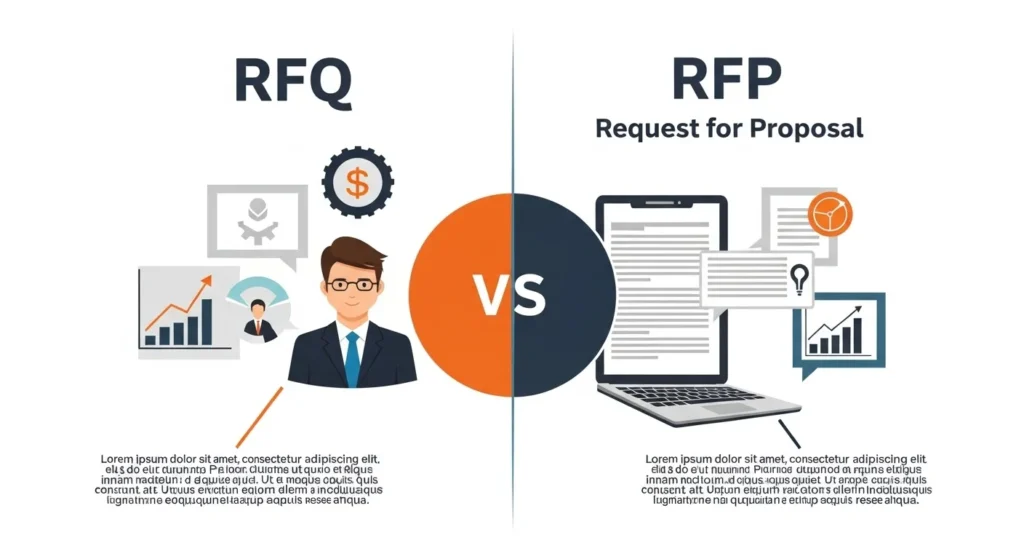
The main difference between RFQ and RFP is that an RFQ (Request for Quotation) asks suppliers mainly for pricing information, while an RFP (Request for Proposal) asks suppliers to provide detailed solutions, strategies, and pricing for a project.
Why Is Their Difference Necessary to Know for Learners and Experts?
Understanding the difference between RFQ and RFP is important for students, professionals, and organizations.
- It helps businesses choose the correct procurement method.
- It improves communication between buyers and suppliers.
- It prevents confusion in project planning.
- It ensures fair competition among vendors.
In modern society, procurement plays a major role in industries such as construction, technology, healthcare, and manufacturing.
Knowing the difference between RFQ and RFP helps professionals manage projects effectively and select the best vendor for their needs.
Pronunciation
RFQ (Request for Quotation)
- US: /ɑːr ɛf kjuː/
- UK: /ɑːr ɛf kjuː/
RFP (Request for Proposal)
- US: /ɑːr ɛf piː/
- UK: /ɑːr ɛf piː/
Linking Hook
Now that we understand their basic meanings and importance, let’s explore the difference between RFQ and RFP in detail through clear comparisons and examples.
Difference Between RFQ and RFP
1. Purpose
RFQ: Used when the buyer knows exactly what product or service they need and wants price quotations.
Examples:
- A company asks suppliers for the price of 500 laptops.
- A hospital requests prices for medical gloves.
RFP: Used when the buyer wants vendors to propose solutions and ideas.
Examples:
- A company asks agencies to propose a marketing campaign.
- A business requests proposals for developing a mobile app.
2. Level of Detail
RFQ: Contains simple product specifications.
Examples:
- Size and quantity of raw materials.
- Technical details of equipment.
RFP: Contains detailed project requirements.
Examples:
- Project goals and timelines.
- Expected outcomes and deliverables.
3. Focus
RFQ: Focuses mainly on price.
Examples:
- Comparing cost from different suppliers.
- Selecting the lowest price for standard goods.
RFP: Focuses on quality, creativity, and expertise.
Examples:
- Evaluating vendor experience.
- Assessing proposed strategies.
4. Complexity
RFQ: Simple and straightforward.
Examples:
- Buying office chairs.
- Ordering printer cartridges.
RFP: More complex and detailed.
Examples:
- Building a company website.
- Developing enterprise software.
5. Evaluation Criteria
RFQ: Price is the main factor.
Examples:
- Choosing the cheapest supplier.
- Comparing delivery costs.
RFP: Multiple factors are considered.
Examples:
- Vendor experience.
- Quality of proposal and timeline.
6. Response Format
RFQ: Vendors usually send price lists.
Examples:
- Unit cost and total cost.
- Delivery time and payment terms.
RFP: Vendors submit detailed proposals.
Examples:
- Project plans.
- Technical solutions.
7. Decision Process
RFQ: Faster decision-making.
Examples:
- Choosing the lowest price supplier.
- Quick purchase of standard goods.
RFP: Slower but more strategic decisions.
Examples:
- Reviewing multiple proposals.
- Conducting vendor interviews.
8. Buyer Knowledge
RFQ: Buyer already knows what they want.
Examples:
- Exact product specifications.
- Fixed quantity and quality standards.
RFP: Buyer seeks ideas from vendors.
Examples:
- Exploring innovative solutions.
- Learning best project approaches.
9. Documentation
RFQ: Short and simple documents.
Examples:
- Price request forms.
- Basic product details.
RFP: Long and structured documents.
Examples:
- Project description.
- Evaluation criteria and deadlines.
10. Typical Industries
RFQ: Common in manufacturing and retail.
Examples:
- Purchasing raw materials.
- Buying office supplies.
RFP: Common in services and technology.
Examples:
- Hiring IT consultants.
- Selecting advertising agencies.
Nature and Behaviour of Both
RFQ Nature
- Price-oriented
- Transactional
- Fast and simple
RFP Nature
- Solution-oriented
- Strategic and analytical
- Detailed and time-consuming
Why People Are Confused About Their Use
Many people confuse RFQ and RFP because both are procurement documents used to request information from vendors. They also appear similar in structure and purpose.
However, the confusion mainly arises because both involve supplier communication and price discussions. The key difference is that RFQ focuses on price quotes, while RFP focuses on complete proposals and project solutions.
Table Showing Difference and Similarity
| Aspect | RFQ | RFP | Similarity |
| Meaning | Request for Quotation | Request for Proposal | Both are procurement tools |
| Focus | Price | Solution and strategy | Used to select vendors |
| Complexity | Simple | Complex | Require vendor responses |
| Response | Price quotes | Detailed proposals | Used in business purchasing |
| Decision Criteria | Lowest price | Multiple factors | Aim to choose best supplier |
Which Is Better in What Situation?
RFQ is better when a buyer clearly knows the exact product or service needed. It is useful when price comparison is the main goal.
For example, purchasing raw materials, office equipment, or standard products. RFQs are quick, efficient, and suitable for routine purchasing decisions.
RFP is better when a buyer needs creative ideas or specialized expertise. It is commonly used in projects like software development, marketing campaigns, or consulting services.
RFPs allow vendors to suggest solutions, making them ideal for complex or strategic projects.
Use in Metaphors and Similes
Though rarely used in everyday speech, these terms can appear metaphorically in business discussions.
Examples:
- “His presentation was like an RFP, full of ideas and strategies.”
- “Her question sounded like an RFQ, focused only on the numbers.”
Connotative Meaning
RFQ – Neutral meaning
Example:
- The company sent an RFQ to suppliers for price comparison.
RFP – Slightly positive or neutral meaning
Example:
- The organization issued an RFP to find innovative solutions.
Idioms or Proverbs (Related Contextually)
- “Cut to the chase”
Meaning: Focus on the important point.
Example: The buyer cut to the chase and issued an RFQ for prices. - “Think outside the box”
Meaning: Be creative.
Example: Vendors were asked to think outside the box when responding to the RFP.
Works in Literature Mentioning the Terms
(These terms mostly appear in business and academic texts rather than traditional literature.)
- “The Procurement and Supply Manager’s Desk Reference” – Fred Sollish & John Semanik (Business, 2012)
- “Strategic Supply Management” – Robert A. Monczka (Business/Management, 2015)
Movies Related to Procurement or Business Projects
(No films are directly titled RFQ or RFP, but procurement concepts appear in business-themed films.)
- “The Founder” – 2016, USA
- “Moneyball” – 2011, USA
Frequently Asked Questions
1. What does RFQ mean?
RFQ stands for Request for Quotation. It asks suppliers mainly for price information.
2. What does RFP mean?
RFP stands for Request for Proposal. It asks vendors to propose solutions along with pricing.
3. When should a company use RFQ?
A company should use RFQ when it knows exactly what product or service it needs.
4. When is RFP used?
RFP is used when businesses need ideas, expertise, and project strategies from vendors.
5. Is RFQ simpler than RFP?
Yes, RFQ is simpler because it mainly focuses on price comparison.
How Both Are Useful for Surroundings
RFQs and RFPs help organizations make transparent and fair purchasing decisions. They encourage competition among suppliers, improve quality, and ensure that businesses receive the best value for their investments. These procurement methods also support economic growth by connecting buyers with reliable vendors.
Final Words for Both
RFQ and RFP are essential tools in the procurement process. Each serves a different purpose, but both help organizations communicate effectively with suppliers and select the best options.
Conclusion
Understanding the difference between RFQ and RFP is crucial in modern business and procurement practices.
RFQ is mainly used when buyers need price quotations for specific products or services, while RFP is used when organizations require detailed proposals and innovative solutions. Although both documents help companies select vendors, their purpose and level of detail differ significantly.
By recognizing the difference between RFQ and RFP, businesses can choose the most appropriate procurement method, reduce confusion, and improve decision-making. Whether purchasing simple goods or planning complex projects, knowing when to use RFQ or RFP leads to better efficiency and stronger partnerships with suppliers.

I am D. H. Lawrence (David Herbert Lawrence) an influential English novelist, poet, essayist, and literary critic born on September 11, 1885, in Eastwood, Nottinghamshire, England. He is widely regarded as one of the most important writers of the 20th century.
I work often explored human relationships, emotional intimacy, industrialization, and the conflict between modern society and natural instincts.