When goods move between countries, governments often charge fees on them. These fees help regulate trade and protect local industries. However, many people confuse the difference between tariff and duty, especially when reading about international trade.
For example, imagine a company in the United States importing cars from Japan. The government may charge a fee on those cars. Some people call this a tariff, while others call it a duty. Because of this, the difference between tariff and duty becomes important for businesses, students, and everyday readers.
Understanding the difference between tariff and duty also helps when comparing taxes on imports and exports. Although they sound similar, their meaning and use can vary in trade discussions.
Featured Snippet Answer
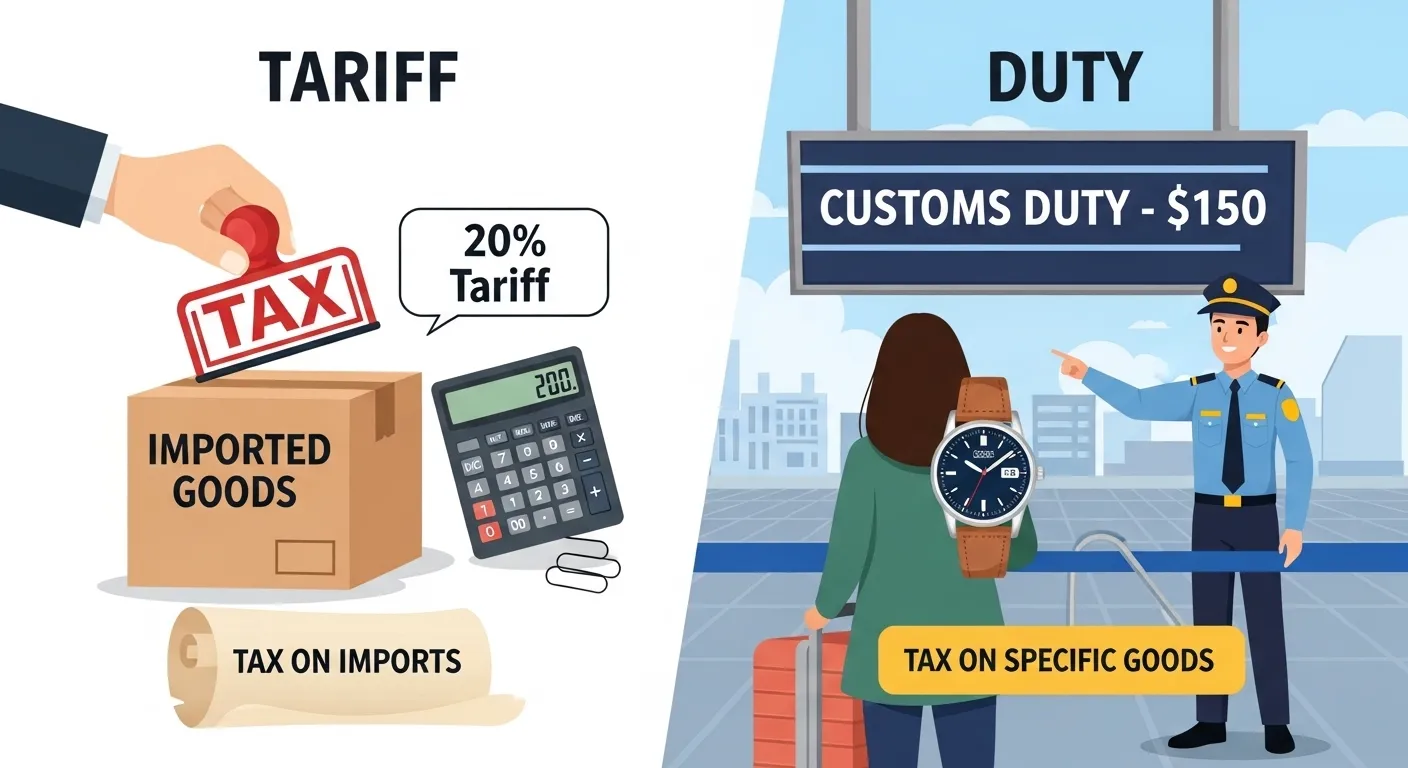
The difference between tariff and duty is mainly about scope and usage. A tariff is a type of tax placed specifically on imported or exported goods. A duty, however, is a broader term that includes many kinds of taxes on goods, including tariffs.
What Is Tariff
A tariff is a tax placed on goods traded between countries. Governments usually apply tariffs to imported goods.
Tariffs increase the price of foreign products. Therefore, local products may become more competitive.
Key Features of Tariffs
- Applied mainly to imports
- Used to protect domestic industries
- Helps governments control international trade
For example, a country may place a tariff on imported steel. This makes local steel cheaper for buyers.
What Is Duty
A duty is a tax charged by a government on goods during import or export.
The term duty is broader than tariff. In fact, tariffs are often considered a type of duty.
Types of Duties
- Import duty
- Export duty
- Excise duty
- Customs duty
For example, travelers may pay duty on expensive goods bought abroad.
Key Difference Between Both
The main difference between tariff and duty is their scope. A tariff refers only to taxes on international trade goods. A duty can include tariffs and other taxes on goods.
Comparison Table
| Feature | Tariff | Duty |
| Definition | Tax on imported or exported goods | General tax on goods |
| Scope | Narrow term | Broad term |
| Usage | Mainly trade policy | Customs and taxation |
| Example | Import tariff on cars | Customs duty on electronics |
| Purpose | Protect local industries | Generate government revenue |
Quick Summary
Tariffs are specific trade taxes. Duties are broader charges on goods.
Therefore, every tariff is a duty, but not every duty is a tariff.
This simple idea explains the difference between tariff and duty.
Why Their Difference Is Important
Understanding the difference between tariff and duty helps businesses plan trade costs.
For example, importers must know how much tax they will pay. Therefore, knowing tariff rates becomes essential.
Students studying economics also compare tariff vs duty concepts. This helps them understand global trade policies.
Pronunciation (US and UK)
Tariff
US: /ˈter-ɪf/
UK: /ˈtær-ɪf/
Duty
US: /ˈdoo-tee/
UK: /ˈdyoo-tee/
Pronunciation differences are small, but accents change slightly between regions.
Difference Between Tariff and Duty
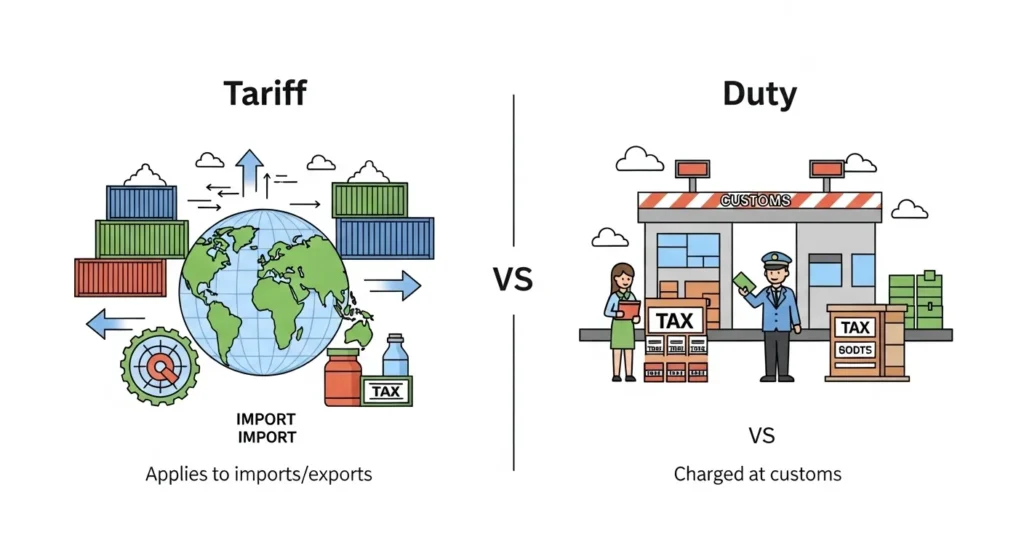
Here are ten clear differences showing the difference between tariff and duty.
1. Definition
Tariff means a tax on imports or exports.
Duty is a broader tax category.
2. Scope
Tariff has a narrow meaning.
Duty covers many types of taxes on goods.
3. Use in Trade
Tariffs are common in trade policy discussions.
Duties appear in customs and tax systems.
4. Economic Role
Tariffs protect local industries.
Duties mainly raise government revenue.
5. Application
Tariffs apply mostly to international trade.
Duties can apply to both trade and domestic taxes.
6. Example
A country may set a tariff on imported rice.
Travelers may pay duty on luxury items.
7. Policy Purpose
Tariffs control imports.
Duties regulate taxation on goods.
8. Government Strategy
Tariffs often support national industries.
Duties support general government income.
9. Use in Law
Trade agreements mention tariffs.
Customs laws mention duties.
10. Practical Meaning
In practice, tariffs are a specific type of duty.
Therefore, this shows the difference between tariff and duty clearly.
Similarities Between Tariff and Duty
Although they differ, they also share some similarities.
- Both are taxes on goods.
- Governments collect both at borders.
- Both affect the price of products.
- Both influence international trade decisions.
- Both appear in customs regulations.
Therefore, many people confuse tariff vs duty because of these shared features.
Nature and Behaviour
Tariffs usually focus on economic protection. Governments use them to control imports.
Duties behave differently. They act as regular taxes on goods.
However, both influence product prices and trade flows.
Why People Are Confused About Their Use
Many people ask: are tariffs and duties the same?
The confusion exists because tariffs are included inside duties. Therefore, both terms sometimes appear together.
Also, news articles often use tariff vs duty comparison without explaining the difference.
As a result, readers may struggle to understand the difference between tariff and duty.
Which Is Better in Different Situations
The answer depends on the goal.
If a government wants to protect local businesses, tariffs work well.
However, if the goal is collecting tax revenue, duties may be more useful.
Therefore, economists often compare tariff and duty when studying trade policy.
Metaphors and Similes
Understanding trade terms becomes easier with simple comparisons.
A tariff is like a gate fee for foreign goods.
A duty is like a general tax box that collects many types of fees.
Therefore, tariffs fit inside the larger duty system.
Connotative Meaning
The word tariff often suggests trade protection or political policy.
Meanwhile, duty sounds more administrative and tax-related.
Because of this, the emotional tone of each word can differ slightly.
Idioms or Proverbs
Although no direct idioms exist for tariffs, trade language often uses related sayings.
For example:
- “Nothing is certain except death and taxes.”
- “Every rule has its cost.”
These sayings highlight how taxes affect everyday life.
Works in Literature
Economic topics appear in many books.
Adam Smith, The Wealth of Nations (Economics, 1776) discusses trade taxes and tariffs.
The book explains how taxes influence international markets and government policy.
Movies
Trade and economics also appear in films.
Wall Street (1987, United States) explores finance and economic power.
Although not about tariffs directly, it shows how economic policies affect business.
Another example is The Big Short (2015, United States). The film explains financial systems and government influence on markets.
FAQ Section
What is tariff vs duty meaning?
Tariff means a specific tax on imported or exported goods. Duty is a broader tax category that includes tariffs.
Are tariffs and duties the same?
No. A tariff is a type of duty, but not every duty is a tariff.
Why do governments impose tariffs?
Governments use tariffs to protect domestic industries and control foreign trade.
What is an example of a duty?
Travelers may pay customs duty on expensive items purchased abroad.
What is the main difference between tariff and duty?
The difference between tariff and duty lies in scope. Tariffs are specific trade taxes, while duties include many goods taxes.
Usefulness in Our Surroundings
Even ordinary people encounter tariffs and duties.
For example, online shoppers may pay import duty on international orders.
Similarly, businesses consider tariff rates before importing goods.
Therefore, understanding the difference between tariff and duty helps people make better financial decisions.
Final Words About Both
Tariffs and duties are important tools in global trade.
Although they sound similar, their meanings differ in economic discussions.
Learning the difference between tariff and duty helps readers understand trade policies and taxes more clearly.
Key Takeaways
- Tariffs are taxes on imports or exports.
- Duties are broader taxes on goods.
- Every tariff is a type of duty.
- Governments use tariffs to protect industries.
- Duties mainly generate tax revenue.
- Understanding both helps explain international trade.
Conclusion
The difference between tariff and duty becomes clearer when we look at their purpose and scope. A tariff is a specific tax placed on imported or exported goods. Meanwhile, a duty is a wider term that includes tariffs and other taxes on goods.
This distinction matters in economics, trade policy, and everyday commerce. Businesses must understand these charges when moving goods between countries. Students and readers also benefit from knowing how governments regulate trade.
In simple terms, tariffs are a special category within duties. Therefore, learning this relationship makes the tariff vs duty comparison much easier to understand.

I am D. H. Lawrence (David Herbert Lawrence) an influential English novelist, poet, essayist, and literary critic born on September 11, 1885, in Eastwood, Nottinghamshire, England. He is widely regarded as one of the most important writers of the 20th century.
I work often explored human relationships, emotional intimacy, industrialization, and the conflict between modern society and natural instincts.