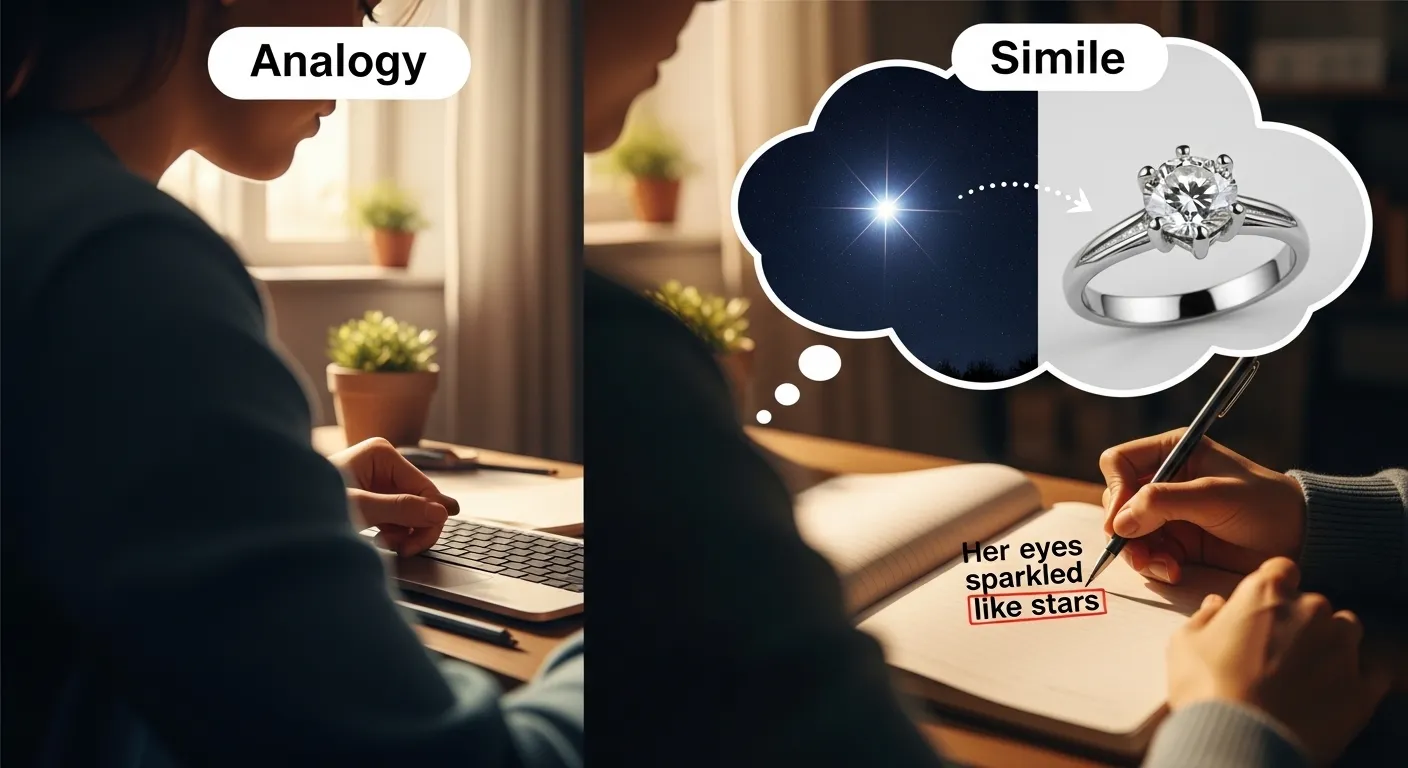
Imagine a teacher explaining electricity to students. She says, “Electricity flows like water in pipes.”
In that moment, she uses a simile to make the idea simple. Then she continues by explaining how wires are like pipes, voltage is like water pressure, and resistance is like blockage.
Now she is building an analogy. This real-life classroom scene perfectly explains the difference between analogy and simile.
Understanding the difference between analogy and simile helps learners write clearly and think deeply. While both compare two things, they work differently.
The difference between analogy and simile is not just about grammar; it shapes how ideas are explained. If you truly understand the difference between analogy and simile, you can improve essays, speeches, and even daily conversations.
Before we explore deeper, let’s clarify their sounds and structure.
Pronunciation (US & UK)
- Analogy
- US: /əˈnæl.ə.dʒi/
- UK: /əˈnæl.ə.dʒi/
- US: /əˈnæl.ə.dʒi/
- Simile
- US: /ˈsɪm.ə.li/
- UK: /ˈsɪm.ə.li/
- US: /ˈsɪm.ə.li/
Now that we know what they sound like, let’s connect this understanding to their deeper meaning and purpose.
Key Difference Between the Both
A simile is a direct comparison using words like “like” or “as.”
An analogy is a broader explanation that compares two things to show similarity in structure, function, or reasoning.
In short:
- Simile = Short comparison
- Analogy = Detailed explanation through comparison
Why Is Their Difference Necessary to Know for Learners and Experts?
Understanding the difference between analogy and simile is important in education, communication, and society.
Writers, teachers, lawyers, and speakers use analogies to explain complex ideas clearly. Students use similes to make creative writing more interesting.
In society, analogies help explain scientific, political, and social issues in simple ways. Similes improve storytelling and emotional expression.
Knowing when to use each strengthens communication, prevents misunderstanding, and improves critical thinking skills.
Difference Between Analogy and Simile
Here are 10 clear points of difference with examples:
1. Length
- Simile: Short and brief.
- Example 1: She runs like the wind.
- Example 2: His face was as white as snow.
- Example 1: She runs like the wind.
- Analogy: Longer and detailed.
- Example 1: The brain is like a computer because it processes and stores information.
- Example 2: Life is like a journey with roads, turns, and destinations.
- Example 1: The brain is like a computer because it processes and stores information.
2. Purpose
- Simile: Creates imagery.
- Example 1: The baby slept like an angel.
- Example 2: The night was as dark as coal.
- Example 1: The baby slept like an angel.
- Analogy: Explains an idea logically.
- Example 1: A teacher is like a gardener who nurtures growth.
- Example 2: Arguments are like math problems; they need logic.
- Example 1: A teacher is like a gardener who nurtures growth.
3. Structure
- Simile: Uses “like” or “as.”
- Example 1: Busy as a bee.
- Example 2: Strong like an ox.
- Example 1: Busy as a bee.
- Analogy: Does not require “like” or “as.”
- Example 1: The heart functions as a pump in the body.
- Example 2: The government works as the steering wheel of a country.
- Example 1: The heart functions as a pump in the body.
4. Depth
- Simile: Surface comparison.
- Example 1: Her smile is like sunshine.
- Example 2: He is as brave as a lion.
- Example 1: Her smile is like sunshine.
- Analogy: Deep structural comparison.
- Example 1: Just as roots support a tree, values support a person.
- Example 2: Time management is like budgeting money.
- Example 1: Just as roots support a tree, values support a person.
5. Usage Area
- Simile: Mostly poetry and storytelling.
- Example 1: Clouds like cotton balls.
- Example 2: Eyes shining like stars.
- Example 1: Clouds like cotton balls.
- Analogy: Education, science, debate.
- Example 1: DNA is like a blueprint.
- Example 2: The internet is like a highway.
- Example 1: DNA is like a blueprint.
6. Logical Function
- Simile: Decorative.
- Example 1: Loud as thunder.
- Example 2: Cold like ice.
- Example 1: Loud as thunder.
- Analogy: Persuasive.
- Example 1: Smoking is like slowly poisoning yourself.
- Example 2: Ignorance is like darkness.
- Example 1: Smoking is like slowly poisoning yourself.
7. Complexity
- Simile: Simple.
- Example 1: Light as a feather.
- Example 2: Sweet like honey.
- Example 1: Light as a feather.
- Analogy: Complex reasoning.
- Example 1: Running a business is like managing a team sport.
- Example 2: Learning language is like building a house step by step.
- Example 1: Running a business is like managing a team sport.
8. Emotional Effect
- Simile: Emotional imagery.
- Example 1: Sad as a rainy day.
- Example 2: Happy like a child.
- Example 1: Sad as a rainy day.
- Analogy: Intellectual clarity.
- Example 1: Democracy is like a shared responsibility.
- Example 2: Memory works like a filing system.
- Example 1: Democracy is like a shared responsibility.
9. Independence
- Simile: Can stand alone.
- Example 1: He is like a rock.
- Example 2: She shines like gold.
- Example 1: He is like a rock.
- Analogy: Often part of longer explanation.
- Example 1: Just as a captain guides a ship, a leader guides people.
- Example 2: As muscles need exercise, the brain needs study.
- Example 1: Just as a captain guides a ship, a leader guides people.
10. Academic Use
- Simile: Creative writing exams.
- Example 1: The wind howled like a wolf.
- Example 2: Her voice was as soft as silk.
- Example 1: The wind howled like a wolf.
- Analogy: Essays and arguments.
- Example 1: Climate change is like a ticking clock.
- Example 2: Education is like planting seeds for the future.
- Example 1: Climate change is like a ticking clock.
Nature and Behaviour of Both
- Analogy: Logical, explanatory, structured, persuasive.
- Simile: Poetic, expressive, emotional, decorative.
Why Are People Confused About Their Use?
People confuse them because both compare two things. Also, analogies sometimes include similes inside them.
Since both create similarities, many learners think they are the same. However, one focuses on beauty, and the other focuses on explanation.
Table: Difference and Similarity Between Analogy and Simile
| Feature | Analogy | Simile | Similarity |
| Length | Long explanation | Short phrase | Both compare |
| Purpose | Clarifies idea | Creates imagery | Show similarity |
| Structure | Flexible | Uses like/as | Figurative language |
| Usage | Academic & logic | Poetry & storytelling | Improve writing |
| Depth | Deep reasoning | Surface comparison | Based on comparison |
Which Is Better in What Situation?
When Analogy Is Better
An analogy is better when you want to explain complex ideas clearly. Teachers, speakers, and writers use analogies to make difficult topics easy to understand.
In debates, analogies help persuade the audience logically. In science and philosophy, analogies simplify abstract concepts. When your goal is clarity and reasoning, analogy is the better choice.
When Simile Is Better
A simile is better in creative writing, poetry, and storytelling. It quickly creates strong images in the reader’s mind. Similes make language lively and emotional.
When writing stories, speeches, or descriptive essays, similes add beauty and color. If your goal is emotional impact and artistic expression, a smile works best.
How the Keywords Are Used in Metaphors and Similes
A simile is different from a metaphor because a metaphor directly says something is something else. An analogy may include metaphors and similes within it to strengthen explanation.
Example:
- Simile: Life is like a game.
- Metaphor: Life is a game.
- Analogy: Life is like a game because it has rules, players, risks, and rewards.
Connotative Meaning
- Analogy: Neutral to positive
- Positive: “Her analogy made the lesson clear.”
- Neutral: “He used an analogy in his speech.”
- Positive: “Her analogy made the lesson clear.”
- Simile: Positive and creative
- Positive: “Her simile made the poem beautiful.”
- Neutral: “The author used a simple simile.”
- Positive: “Her simile made the poem beautiful.”
Neither word usually carries a negative meaning.
Idioms and Proverbs Related to Comparison
- “As busy as a bee” (simile)
- She was as busy as a bee preparing for exams.
- She was as busy as a bee preparing for exams.
- “Like two peas in a pod” (simile structure)
- The twins are like two peas in a pod.
- The twins are like two peas in a pod.
- “Life is not a bed of roses” (metaphorical comparison)
- The analogy shows life has struggles.
- The analogy shows life has struggles.
Works in Literature Using Analogy and Simile
- Romeo and Juliet Tragedy William Shakespeare 1597
- Paradise Lost Epic Poetry John Milton 1667
- The Old Man and the Sea Fiction Ernest Hemingway 1952
Movies Related to Figurative Expression
- Dead Poets Society 1989 USA
- Freedom Writers 2007 USA
Frequently Asked Questions
1. Is a simile a type of analogy?
Yes, a simile can be part of an analogy.
2. Do analogies always use “like” or “as”?
No, they do not always require those words.
3. Which is more detailed?
An analogy is more detailed.
4. Are both figurative languages?
Yes, both are forms of figurative language.
5. Can analogies be used in exams?
Yes, especially in essays and arguments.
How Both Are Useful for Surroundings
In daily surroundings, similes make conversations lively.Analogies help explain social, scientific, and political matters clearly. Together, they improve understanding, empathy, and communication.
Final Words for Both
Simile beautifies language.
Analogy strengthens understanding.
Both are powerful tools in communication.
Conclusion
Understanding the difference between analogy and simile improves both creative and academic writing.
While a simile adds beauty through short comparisons using “like” or “as,” an analogy explains complex ideas through deeper reasoning.
The difference between analogy and simile lies mainly in purpose, length, and depth. Learners, teachers, and professionals benefit greatly from mastering both.
When used correctly, they make communication clearer, stronger, and more engaging. By recognizing the difference between analogy and simile, you can express ideas more effectively and confidently in every area of life.

I am James Anderson an English author known for his insightful and engaging writing in contemporary literature. With a focus on [insert genre, e.g., fiction, non-fiction, or specific themes], he explores complex human emotions and social dynamics, blending thought-provoking ideas with accessible storytelling. His work has earned recognition for its clarity, depth, and ability to connect with a wide audience, establishing him as a respected voice in modern English literature.