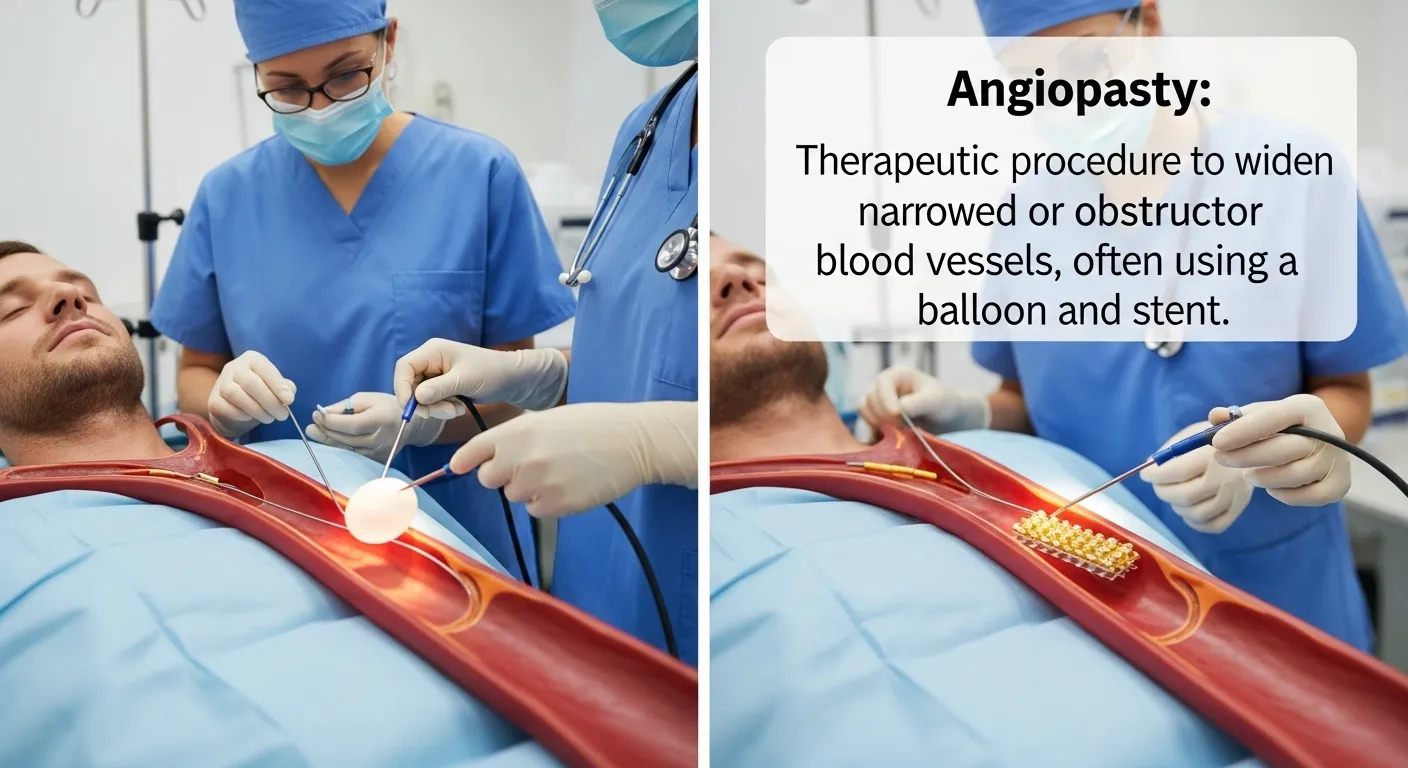
Imagine a middle-aged man who suddenly feels tightness in his chest while walking. His doctor suspects a blockage in the heart arteries and recommends tests.
First, the doctor performs an angiogram to see what is happening inside the blood vessels.After the test reveals a blockage, the doctor decides to perform angioplasty to open the narrowed artery.
This real-life scenario clearly explains the difference between angiogram and angioplasty.An angiogram is a medical imaging test that helps doctors see blood vessels, while angioplasty is a treatment used to open blocked or narrowed arteries.
Many people confuse these two procedures because they are often performed together in heart hospitals.Understanding the difference between angiogram and angioplasty helps patients make better healthcare decisions and reduces fear about medical procedures.
In simple terms, the difference between angiogram and angioplasty lies in their purpose: one diagnoses the problem and the other treats it. Learning the difference between angiogram and angioplasty is useful for both medical learners and everyday readers.
Key Difference Between the Two
The main difference is that angiogram is a diagnostic test, while angioplasty is a medical treatment used to restore blood flow in blocked arteries.
Why Is Their Difference Necessary to Know for Learners and Experts?
Understanding the difference between angiogram and angioplasty is important for medical students, healthcare professionals, and patients.
For learners, it clarifies the sequence of cardiovascular procedures and improves their clinical knowledge.For experts and doctors, clear communication about these procedures helps patients understand their treatment plan.
In society, heart disease is one of the leading health problems. When people know the difference between diagnostic tests and treatments, they can better understand medical advice and avoid unnecessary fear. This awareness also promotes trust between patients and healthcare providers.
Pronunciation of Both Words
Angiogram
- US: /ˈæn.dʒi.oʊˌɡræm/
- UK: /ˈæn.dʒi.əʊˌɡræm/
Angioplasty
- US: /ˈæn.dʒi.oʊˌplæs.ti/
- UK: /ˈæn.dʒi.əʊˌplɑː.sti/
Linking Hook
Now that we understand their basic meanings and importance, let us explore the difference between angiogram and angioplasty in detail through clear comparisons.
Difference Between Angiogram and Angioplasty
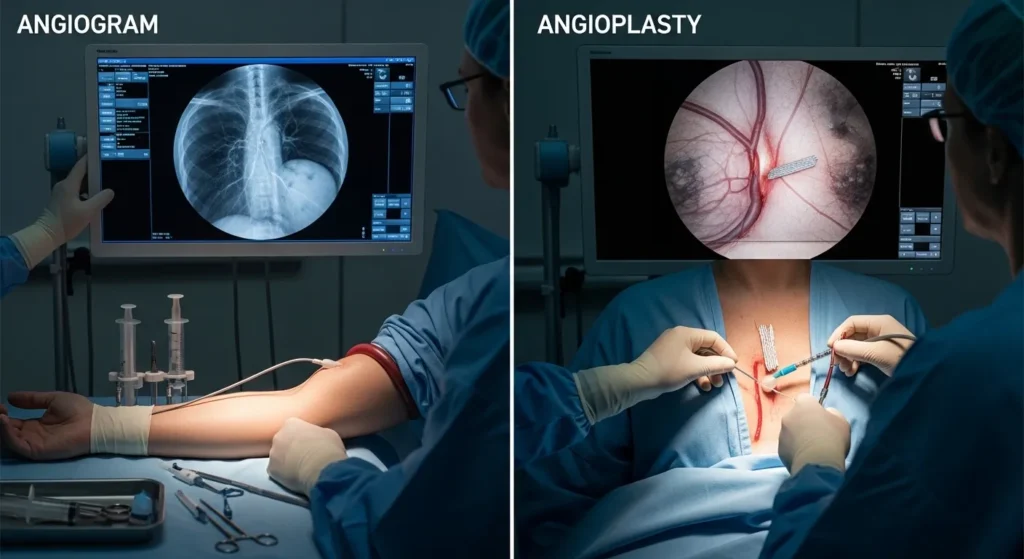
1. Purpose
Angiogram: Used to diagnose blockages in arteries.
Examples:
- Doctors perform an angiogram to check blocked heart arteries.
- An angiogram can detect narrowing in brain blood vessels.
Angioplasty: Used to treat blocked or narrowed arteries.
Examples:
- A patient receives angioplasty to open a blocked coronary artery.
- Angioplasty restores blood flow in leg arteries.
2. Nature of Procedure
Angiogram: Imaging or diagnostic procedure.
Examples:
- It uses contrast dye and Xray imaging.
- Doctors insert a catheter to observe arteries.
Angioplasty: Therapeutic surgical procedure.
Examples:
- A balloon catheter expands the artery.
- A stent may be placed to keep the artery open.
3. Goal
Angiogram: To identify the location and severity of blockage.
Examples:
- Doctors examine coronary arteries.
- Physicians locate damaged vessels.
Angioplasty: To remove or reduce blockage.
Examples:
- Balloon inflation widens the artery.
- Stents support the vessel walls.
4. Outcome
Angiogram: Provides images and diagnosis.
Examples:
- Shows narrowing in arteries.
- Helps doctors plan treatment.
Angioplasty: Improves blood flow immediately.
Examples:
- Reduces chest pain symptoms.
- Prevents heart damage.
5. Use of Tools
Angiogram: Uses dye and imaging equipment.
Examples:
- Contrast dye highlights vessels.
- Xray machines capture images.
Angioplasty: Uses balloons and stents.
Examples:
- The balloon catheter opens the artery.
- A metal stent keeps the artery open.
6. Treatment vs Test
Angiogram: A test.
Examples:
- Used for diagnosis.
- Often performed before treatment.
Angioplasty: A treatment.
Examples:
- Done after detecting blockage.
- Can save lives during a heart attack.
7. Duration
Angiogram: Usually shorter.
Examples:
- Often completed in 30 minutes.
- Quick observation procedure.
Angioplasty: Takes longer.
Examples:
- May last 12 hours.
- Requires additional medical steps.
8. Risk Level
Angiogram: Lower risk.
Examples:
- Minimal complications.
- Mostly diagnostic observation.
Angioplasty: Slightly higher risk due to intervention.
Examples:
- Risk of artery damage.
- Possibility of blood clot.
9. Frequency of Use
Angiogram: Done whenever diagnosis is required.
Examples:
- Before heart surgery.
- To check unexplained chest pain.
Angioplasty: Done only when blockage is confirmed.
Examples:
- After angiogram results.
- During heart attack emergencies.
10. Medical Role
Angiogram: Helps doctors decide treatment.
Examples:
- Determines need for surgery.
- Guides further medical steps.
Angioplasty: Directly improves patient health.
Examples:
- Opens blocked arteries.
- Prevents heart complications.
Nature and Behaviour of Both
Angiogram
Angiogram behaves as a diagnostic investigative tool in medicine. It helps doctors visualize arteries without immediately changing them. It is mainly used to observe and analyze blood vessel conditions.
Angioplasty
Angioplasty is an active treatment procedure. It physically alters the artery by widening it, restoring proper blood circulation and preventing severe heart complications.
Why People Are Confused About Their Use
People often confuse angiogram and angioplasty because both procedures involve catheters, hospitals, and heart arteries.
They are frequently performed in the same medical session. Since doctors may conduct an angiogram first and immediately follow it with angioplasty, patients sometimes think they are the same procedure. Their similar names also contribute to the confusion.
Table Showing Difference and Similarity
| Feature | Angiogram | Angioplasty | Similarity |
| Purpose | Diagnosis | Treatment | Both related to arteries |
| Procedure Type | Imaging test | Surgical intervention | Both use catheter |
| Outcome | Detect blockage | Remove blockage | Improve heart care |
| Duration | Shorter | Longer | Done in hospital |
| Tools | Dye & Xray | Balloon & stent | Performed by cardiologists |
Which Is Better in What Situation?
Angiogram
An angiogram is better when doctors need to identify the problem inside blood vessels. If a patient experiences chest pain or abnormal heart test results, doctors perform an angiogram to examine arteries.
It is essential for accurate diagnosis before planning treatment. Without it, doctors may not know the exact location of blockage.
Angioplasty
Angioplasty is better when a blockage has already been confirmed and blood flow needs to be restored. It is often performed during or after a heart attack to save heart muscle.
In emergency situations, angioplasty can quickly reopen blocked arteries and significantly reduce the risk of severe heart damage.
Use in Metaphors and Similes
- “The investigation worked like an angiogram, revealing hidden problems.”
- “The solution acted like angioplasty, clearing the obstacles in the system.”
These figurative uses compare problem solving to diagnosing and fixing blockages.
Connotative Meaning
Angiogram Neutral
Examples:
- “The angiogram revealed important medical information.”
- “Doctors ordered an angiogram for diagnosis.”
Angioplasty Positive
Examples:
- “Angioplasty saved the patient’s life.”
- “Successful angioplasty restored healthy blood flow.”
Idioms or Proverbs (Conceptually Related)
- “Prevention is better than cure.”
Example: Regular checkups may lead to an angiogram before serious disease develops. - “A stitch in time saves nine.”
Example: Early angioplasty can prevent major heart complications.
Works in Literature (Medical Themes)
- The Emperor of All Maladies Genre: Medical History Writer: Siddhartha Mukherjee Year: 2010
- Complications Genre: Medical Memoir Writer: Atul Gawande Year: 2002
- The Heart Genre: Science Writing Writer: Bill Schutt Year: 2018
Movies Related to Heart and Medical Procedures
- Something the Lord Made 2004 USA
- Patch Adams 1998 USA
- Awakenings 1990 USA
Frequently Asked Questions
1. Is angiogram painful?
Usually no. It is performed under local anesthesia and causes minimal discomfort.
2. Can angioplasty be done without an angiogram?
Normally no. Doctors need angiogram results to locate the blockage.
3. How long does recovery take after angioplasty?
Most patients recover within a few days, though full recovery may take a week.
4. Is angioplasty a surgery?
It is considered a minimally invasive procedure rather than open surgery.
5. Why do doctors perform angiograms first?
Because they must identify the blockage before deciding on treatment.
How Both Are Useful for Surroundings
Angiograms and angioplasty procedures improve public health by helping doctors detect and treat heart diseases early.
They reduce mortality rates from cardiovascular diseases and allow people to live longer, healthier lives. Hospitals rely on these procedures to provide modern cardiac care to communities.
Final Words for Both
Angiogram and angioplasty are closely connected but serve very different roles in cardiovascular medicine. One identifies the problem, while the other fixes it.
Conclusion
Understanding the difference between angiogram and angioplasty is essential for both medical learners and the general public.An angiogram works as a diagnostic tool that helps doctors see inside blood vessels and detect blockages.
Angioplasty, on the other hand, is a treatment that opens those blocked arteries and restores blood flow.Although the two procedures are often performed together, their purposes are distinct.
Recognizing their differences helps patients understand medical advice, reduces confusion during treatment, and highlights the importance of modern cardiac care. Ultimately, both procedures play a crucial role in diagnosing and treating heart disease, saving countless lives worldwide.

I am Stephen King is a spiritual writer and digital creator dedicated to exploring the deeper meaning behind numbers, synchronicity, and divine guidance. Through his platform, spiritualdigits.com he shares insights on angel numbers, spiritual symbolism, and personal awakening to help readers align with their higher purpose. His work blends intuition, research, and practical wisdom to make spiritual concepts clear, accessible, and transformative.