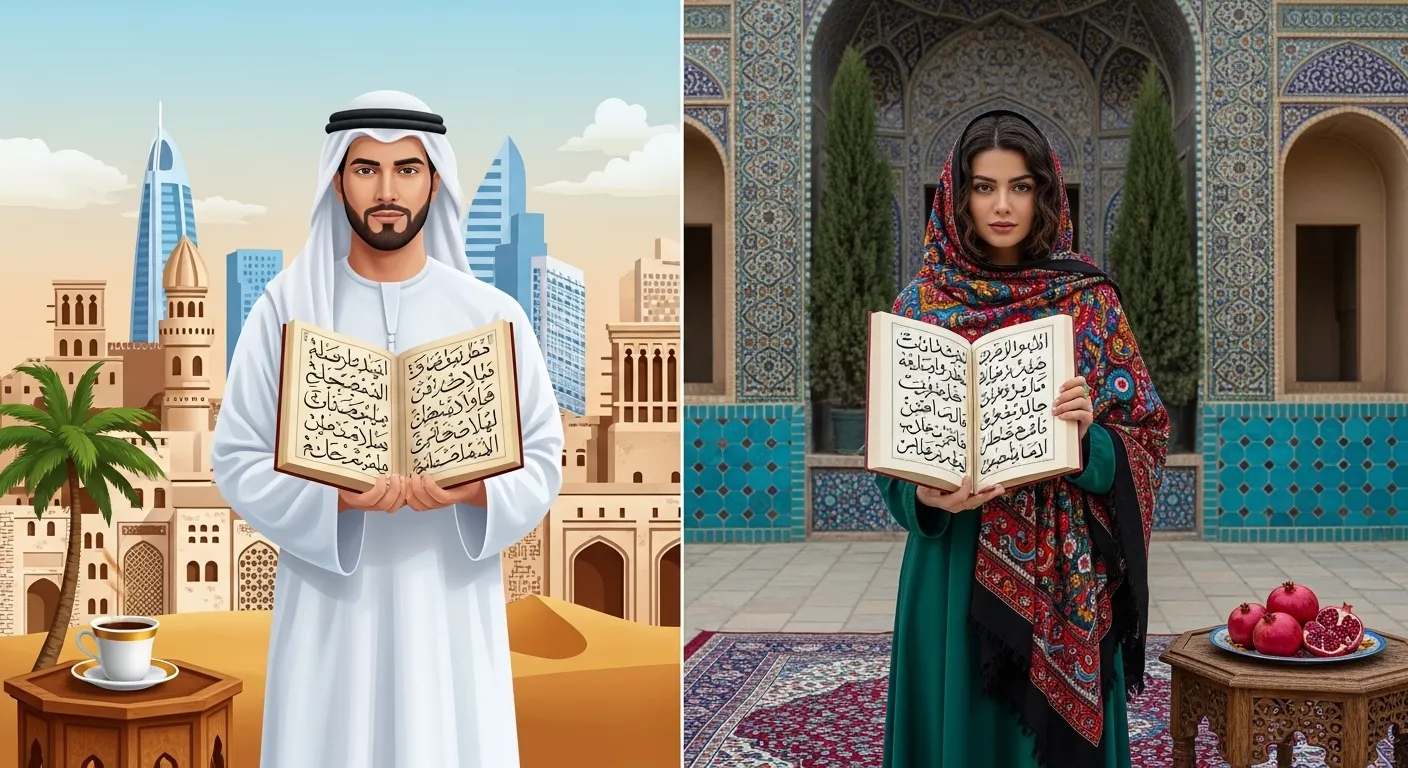
Imagine walking through a busy market in Dubai and hearing conversations that sound similar yet slightly different.
A traveler might assume everyone is speaking the same language, but in reality, some are speaking Arabic while others are speaking Farsi.
Understanding the difference between Arabic and Farsi becomes important in such moments. Although both languages share a script and have influenced each other for centuries, the difference between Arabic and Farsi lies in grammar, pronunciation, vocabulary, and cultural roots.
Many learners confuse them because of visual similarities in writing. However, the difference between Arabic and Farsi becomes clear when you study their origins and usage. Knowing the difference between Arabic and Farsi helps students, linguists, and professionals communicate more effectively in global society.
Pronunciation (US & UK)
- Arabic
- US: /ˈær.ə.bɪk/
- UK: /ˈær.ə.bɪk/
- US: /ˈær.ə.bɪk/
- Farsi
- US: /ˈfɑːr.si/
- UK: /ˈfɑː.si/
- US: /ˈfɑːr.si/
Before diving deeper, let’s explore what truly separates these two influential languages.
Key Difference Between Arabic and Farsi
The main difference is their language family.
- Arabic belongs to the Semitic language family.
- Farsi (Persian) belongs to the Indo-European language family.
This core distinction shapes their grammar, vocabulary, and sentence structure.
Why Is Their Difference Necessary to Know for Learners and Experts?
Understanding the difference between Arabic and Farsi is important because:
- It prevents translation mistakes in diplomacy and business.
- It improves cultural sensitivity in multicultural societies.
- It helps researchers study Middle Eastern history accurately.
- It supports language learners in choosing the right study path.
- It strengthens international communication and academic research.
In society, language represents identity. Confusing Arabic with Farsi can unintentionally ignore cultural uniqueness.
Difference Between Arabic and Farsi
1. Language Family
Arabic is Semitic.
Example 1: It is related to Hebrew.
Example 2: It shares roots with Aramaic.
Farsi is Indo-European.
Example 1: It is related to English distantly.
Example 2: It shares roots with Hindi.
2. Script
Arabic uses the Arabic script.
Example 1: 28 letters.
Example 2: No letters like “پ” or “چ”.
Farsi uses a modified Arabic script.
Example 1: 32 letters.
Example 2: Adds “پ”, “چ”, “ژ”, “گ”.
3. Grammar Structure
Arabic grammar is complex.
Example 1: Uses gender for nouns.
Example 2: Verbs change by gender.
Farsi grammar is simpler.
Example 1: No grammatical gender.
Example 2: Verb conjugation is more regular.
4. Vocabulary Source
Arabic vocabulary comes from Semitic roots.
Example 1: Three-letter root system.
Example 2: Words built from patterns.
Farsi vocabulary includes Indo-European roots.
Example 1: “Mother” = “Madar”.
Example 2: Similar sound to Sanskrit words.
5. Countries of Use
Arabic is spoken in countries like Saudi Arabia and Egypt.
Farsi is mainly spoken in Iran.
6. Dialects
Arabic has many dialects.
Example 1: Egyptian Arabic.
Example 2: Gulf Arabic.
Farsi has fewer major variations.
Example 1: Iranian Persian.
Example 2: Dari (Afghanistan).
7. Religious Association
Arabic is the language of the Quran.
Example 1: Islamic prayers.
Example 2: Religious scholarship.
Farsi is used in Persian literature and poetry.
Example 1: Sufi poetry.
Example 2: Cultural storytelling.
8. Sound System
Arabic includes deep throat sounds.
Example 1: “ع” sound.
Example 2: “خ” sound.
Farsi pronunciation is softer.
Example 1: Fewer throat sounds.
Example 2: Smoother vowel sounds.
9. Sentence Order
Arabic often uses Verb-Subject-Object.
Example 1: “Wrote Ahmed the letter.”
Example 2: Flexible order.
Farsi uses Subject-Object-Verb.
Example 1: “Ahmed the letter wrote.”
Example 2: Similar to Japanese structure.
10. Cultural Influence
Arabic influenced Islamic civilization.
Example 1: Religious texts.
Example 2: Legal systems.
Farsi influenced poetry and art.
Example 1: Classical literature.
Example 2: Court poetry traditions.
Nature and Behaviour of Both
Arabic is structured, root-based, and highly formal in classical form. It carries a strong religious and historical identity.
Farsi is poetic, expressive, and rhythmical. It is often associated with art, romance, and philosophy.
Why Are People Confused About Their Use?
- Similar writing system
- Shared vocabulary
- Geographic closeness
- Islamic cultural overlap
However, they are completely different languages linguistically.
Table: Difference and Similarity Between Arabic and Farsi
| Feature | Arabic | Farsi | Similarity |
| Family | Semitic | Indo-European | Both ancient |
| Script | 28 letters | 32 letters | Similar script |
| Grammar | Gendered | No gender | Verb-based |
| Sound | Throat sounds | Softer tones | Some shared sounds |
| Region | Arab countries | Iran | Middle East presence |
Which Is Better in What Situation?
Arabic is better for careers in Middle Eastern diplomacy, Islamic studies, and oil-rich Gulf markets. It is essential for understanding religious texts and for communication in over 20 Arab countries.
Farsi is better for studying Persian poetry, Iranian culture, and Central Asian history. It is useful in cultural research, literature, and regional trade with Iran and Afghanistan.
Use in Metaphors and Similes
- “Her speech flowed like Farsi poetry.”
- “His words were sharp like classical Arabic verses.”
Connotative Meaning
Arabic
- Positive: Sacred, classical, authoritative
- Example: Arabic calligraphy is admired worldwide.
- Example: Arabic calligraphy is admired worldwide.
- Neutral: Official language
- Negative: Difficult grammar (for learners)
Farsi
- Positive: Romantic, poetic, artistic
- Example: Farsi poetry expresses deep emotions.
- Example: Farsi poetry expresses deep emotions.
- Neutral: Cultural language
- Negative: Limited global reach compared to Arabic
Idioms or Proverbs
Arabic proverb: “Patience is the key to relief.”
Example: In learning Arabic, patience is the key to relief.
Persian proverb: “Drop by drop, a river is made.”
Example: While studying Farsi, drop by drop, knowledge grows.
Works in Literature
- Shahnameh Epic poetry, by Ferdowsi (1010)
- Masnavi Spiritual poetry, by Rumi (13th century)
- One Thousand and One Nights Folk tales, Arabic origin (compiled 8th14th century)
Movies
- A Separation 2011, Iran
- The Message 1976, UK/Libya
Frequently Asked Questions
- Are Arabic and Farsi the same language?
No, they belong to different language families. - Do they use the same alphabet?
They share a script, but Farsi adds extra letters. - Is Farsi easier than Arabic?
Many learners find Farsi grammar simpler. - Where is Farsi mainly spoken?
Mainly in Iran and parts of Afghanistan. - Why do they look similar in writing?
Because Farsi adopted the Arabic script.
How Both Are Useful for Surroundings
Arabic connects people across North Africa and the Middle East in religion, politics, and trade.
Farsi preserves Persian heritage, poetry, and regional diplomacy.
Final Words for Both
Arabic reflects religious depth and historical authority.
Farsi reflects poetic elegance and cultural richness.
Conclusion
The difference between Arabic and Farsi goes beyond script similarities. While Arabic belongs to the Semitic family and plays a major role in religion and global diplomacy, Farsi belongs to the Indo-European family and shines in poetry and culture.
Their grammar, pronunciation, vocabulary, and cultural influence clearly distinguish them. Understanding their differences helps learners avoid confusion and appreciate linguistic diversity. Both languages are powerful in their own way and continue to shape societies, literature, and global communication.

I am Stephen King is a spiritual writer and digital creator dedicated to exploring the deeper meaning behind numbers, synchronicity, and divine guidance. Through his platform, spiritualdigits.com he shares insights on angel numbers, spiritual symbolism, and personal awakening to help readers align with their higher purpose. His work blends intuition, research, and practical wisdom to make spiritual concepts clear, accessible, and transformative.