Imagine walking into a vintage home with elegant wooden furniture. On one side stands a tall, ornate armoire, its doors intricately carved, and on the other, a simple wardrobe, neatly storing everyday clothes.
Many people often confuse these two pieces of furniture. Understanding the difference between armoire and wardrobe is essential for interior designers, homeowners, and enthusiasts alike.
While both are designed for clothing storage, an armoire often conveys elegance and antique charm, whereas a wardrobe is more practical and modern. In this article, we will explore the difference between armoire and wardrobe, their pronunciations (US & UK), uses, and even cultural significance. By the end, you’ll never mix them up again.
Pronunciation:
- Armoire: /ɑːrˈmwɑːr/ (US & UK very similar)
- Wardrobe: /ˈwɔːr.droʊ/ (US), /ˈwɔː.drəʊ/ (UK)
Linking Hook:
Before diving into the detailed differences, let’s first understand their unique characteristics and why this distinction matters.
Difference Between Armoire and Wardrobe
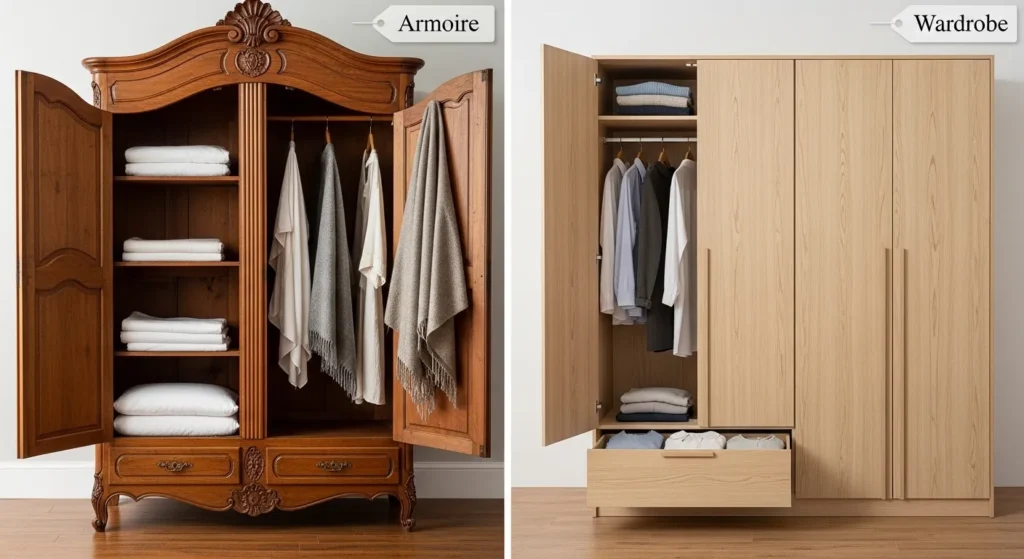
1. Origin and History
- Armoire: Originated in France in the 17th century, primarily as an elegant storage solution.
- Example 1: Antique French armoire in Versailles palace.
- Example 2: Handcrafted armoire in a Parisian boutique hotel.
- Example 1: Antique French armoire in Versailles palace.
- Wardrobe: Originated in England around the 18th century as practical clothing storage.
- Example 1: Modern bedroom wardrobe in a suburban home.
- Example 2: Office wardrobe for uniform storage.
- Example 1: Modern bedroom wardrobe in a suburban home.
2. Design and Aesthetics
- Armoire: Ornate, carved, sometimes with mirrors or decorative panels.
- Example 1: Armoire with gold leaf detailing.
- Example 2: Rustic wooden armoire with floral carvings.
- Example 1: Armoire with gold leaf detailing.
- Wardrobe: Simple, functional, usually plain surfaces.
- Example 1: Sliding-door wardrobe in a minimalist bedroom.
- Example 2: MDF wardrobe with shelves and drawers.
- Example 1: Sliding-door wardrobe in a minimalist bedroom.
3. Size and Structure
- Armoire: Typically taller, bulkier, often freestanding.
- Example 1: Antique armoire measuring 7 feet in height.
- Example 2: Bedroom armor used for seasonal clothing.
- Example 1: Antique armoire measuring 7 feet in height.
- Wardrobe: Often smaller or modular, can fit compact spaces.
- Example 1: Wardrobe with 3 sliding doors.
- Example 2: Wardrobe for kids’ bedroom storage.
- Example 1: Wardrobe with 3 sliding doors.
4. Functionality
- Armoire: More than storage; sometimes holds valuables or electronics.
- Example 1: Armoire storing a television.
- Example 2: Armoire with hidden jewelry compartments.
- Example 1: Armoire storing a television.
- Wardrobe: Primarily for clothing and accessories.
- Example 1: Wardrobe for everyday outfits.
- Example 2: Wardrobe with built-in shoe racks.
- Example 1: Wardrobe for everyday outfits.
5. Mobility
- Armoire: Heavy, not easy to move.
- Example 1: Antique armoire requires 2-3 people to relocate.
- Example 2: Hotel armor placed permanently in a suite.
- Example 1: Antique armoire requires 2-3 people to relocate.
- Wardrobe: Lightweight, often modular and portable.
- Example 1: Flat-pack wardrobe assembly for apartments.
- Example 2: Wardrobe moved easily during home renovation.
- Example 1: Flat-pack wardrobe assembly for apartments.
6. Materials Used
- Armoire: Solid wood, often expensive materials like oak or mahogany.
- Example 1: Mahogany armoire with polished finish.
- Example 2: Oak armoire in a historic home.
- Example 1: Mahogany armoire with polished finish.
- Wardrobe: Can be wood, MDF, metal, or composite.
- Example 1: Metal wardrobe in a college dorm.
- Example 2: MDF wardrobe with laminate coating.
- Example 1: Metal wardrobe in a college dorm.
7. Cultural Connotation
- Armoire: Conveys luxury, vintage style, elegance.
- Example 1: French armoire in a classic novel setting.
- Example 2: Armoire as a showpiece in a designer home.
- Example 1: French armoire in a classic novel setting.
- Wardrobe: Conveys practicality, utility, everyday use.
- Example 1: Office wardrobe storing uniforms.
- Example 2: Minimalist wardrobe in modern apartments.
- Example 1: Office wardrobe storing uniforms.
8. Types of Doors
- Armoire: Usually hinged doors, sometimes double doors.
- Example 1: Double-door armoire with carvings.
- Example 2: Hinged armoire with mirror inside.
- Example 1: Double-door armoire with carvings.
- Wardrobe: Hinged or sliding doors, mostly functional.
- Example 1: Sliding wardrobe in a modern bedroom.
- Example 2: Wardrobe with single hinged door.
- Example 1: Sliding wardrobe in a modern bedroom.
9. Customization
- Armoire: Limited, often handcrafted and bespoke.
- Example 1: Custom armoire with family crest.
- Example 2: Antique armoire restored by artisan.
- Example 1: Custom armoire with family crest.
- Wardrobe: Highly customizable with shelves, drawers, compartments.
- Example 1: Wardrobe with modular shelves for shoes.
- Example 2: Wardrobe with pull-out drawers and hanging rods.
- Example 1: Wardrobe with modular shelves for shoes.
10. Price Range
- Armoire: Generally more expensive due to craftsmanship and material.
- Example 1: Vintage armor costing $2,000+.
- Example 2: Luxury armor in boutique furniture stores.
- Example 1: Vintage armor costing $2,000+.
- Wardrobe: Affordable, mass-produced options available.
- Example 1: IKEA wardrobe under $300.
- Example 2: Compact wardrobe in local furniture stores.
- Example 1: IKEA wardrobe under $300.
Nature and Behavior of Both
- Armoire: Elegant, classic, luxurious; often a centerpiece in a room.
- Wardrobe: Practical, modern, versatile; blends with functional interiors.
Why People Are Confused
Many confuse armoire and wardrobe because both store clothes. The difference lies in design, purpose, and historical context, which is subtle to a casual observer.
Comparison Table: Armoire vs Wardrobe
| Feature | Armoire | Wardrobe | Similarity |
| Origin | France, 17th century | England, 18th century | Both store clothing |
| Design | Ornate, decorative | Simple, functional | Both have doors |
| Size | Large, bulky | Compact, modular | Freestanding |
| Material | Solid wood | Wood, MDF, metal | Can be made of wood |
| Function | Storage + decor | Storage | Hold clothes |
| Doors | Hinged, double | Hinged or sliding | Both have doors |
| Mobility | Heavy, less portable | Lightweight, portable | Moveable |
| Price | Expensive | Affordable | Furniture type |
| Connotation | Luxury, antique | Practical, modern | Household furniture |
| Customization | Limited, bespoke | Modular, versatile | Can be customized |
Which is Better in What Situation?
- Armoire: Perfect for luxurious bedrooms, antique decor, or showrooms. Its aesthetic appeal enhances interiors, making it ideal for formal spaces.
- Wardrobe: Best for modern homes, apartments, or small spaces. Offers functional storage, easy customization, and affordable options.
Use in Metaphors and Similes
- Armoire: “As grand as an armoire” to describe elegance.
- Wardrobe: “Organized like a wardrobe” to describe practicality.
Connotative Meaning
- Armoire: Positive elegance, sophistication.
- Wardrobe: Neutral utility, functionality.
Idioms / Proverbs
- “Open a wardrobe of possibilities” suggests discovering potential.
- “Store secrets like an armoire” keeping valuables hidden.
Works in Literature
- “The Armoire” Short Story, Jane Smith, 2005 (Fiction)
- “The Wardrobe Chronicles” Novel, Michael Brown, 2010 (Drama)
Movies Related
- The Armoire 2018, France
- The Wardrobe 2021, UK
Frequently Asked Questions
- Is an armoire always antique? Mostly yes, but modern versions exist.
- Can a wardrobe be ornate? Rarely, it’s mostly simple.
- Which is heavier? Armoire is heavier.
- Are armoires more expensive than wardrobes? Generally yes.
- Can both store electronics? Armoire can, wardrobe usually cannot.
How Both Are Useful for Surroundings
- Armoire: Enhances aesthetics, adds vintage charm, and serves as a decorative piece.
- Wardrobe: Organizes clothes efficiently, saves space, and maintains order.
Final Words
Understanding the difference between armoire and wardrobe helps in choosing the right furniture for functionality and style.
Both serve their unique purposes, and knowing when to use each improves interior planning and lifestyle convenience.
Conclusion
In essence, while both an armoire and wardrobe are designed for clothing storage, their distinctions are significant.
The armoire carries elegance, history, and decorative charm, whereas the wardrobe offers practicality, affordability, and modern utility.
For collectors, designers, and homeowners, recognizing the difference between armoire and wardrobe ensures better decisions in furniture selection.
Appreciating these differences not only enhances interior decor but also enriches cultural understanding of household furniture. By blending functionality with style, each plays a unique role in daily life and design aesthetics.

I am James Anderson an English author known for his insightful and engaging writing in contemporary literature. With a focus on [insert genre, e.g., fiction, non-fiction, or specific themes], he explores complex human emotions and social dynamics, blending thought-provoking ideas with accessible storytelling. His work has earned recognition for its clarity, depth, and ability to connect with a wide audience, establishing him as a respected voice in modern English literature.