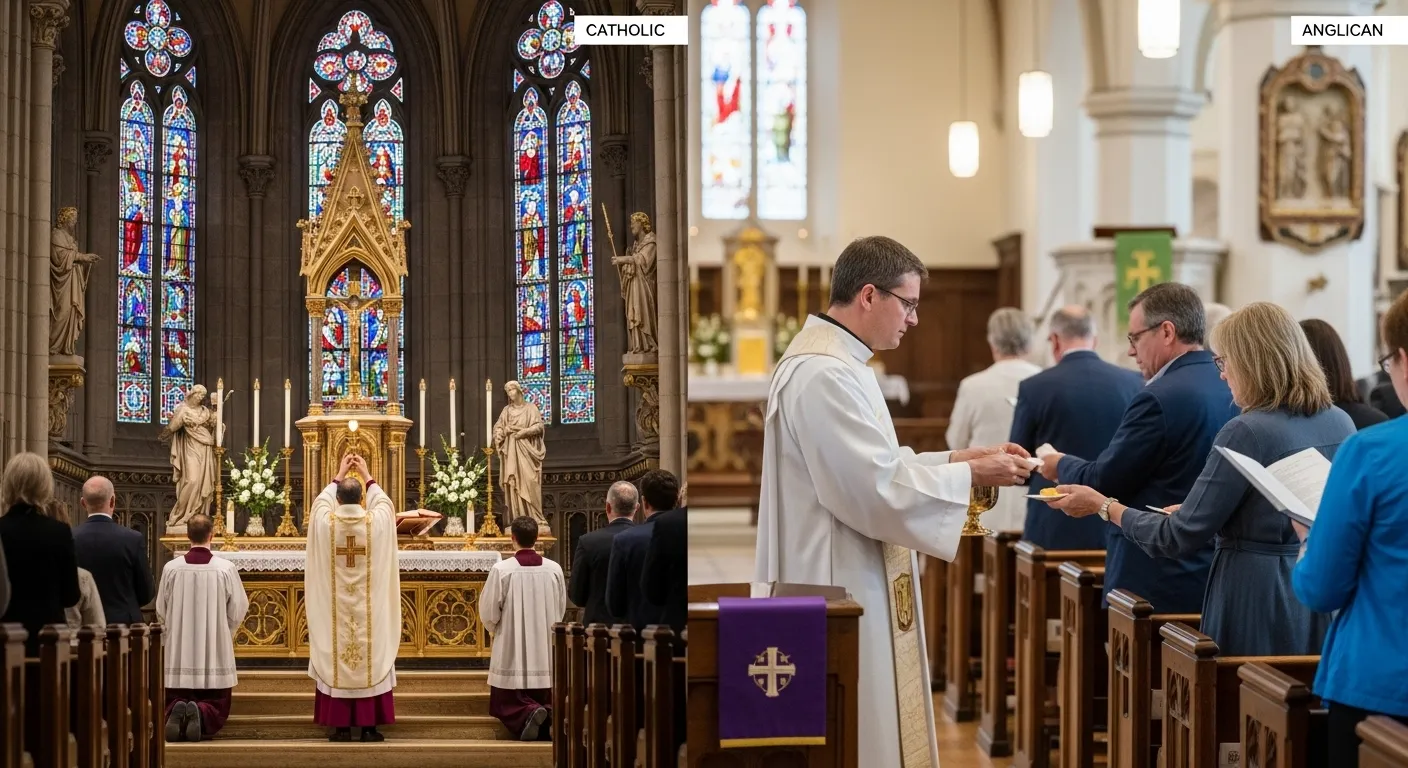
On a Sunday morning in many parts of the world, you might see two churches that look very similar from the outside. Both have crosses, hymns, priests, and worship services.Yet inside, the beliefs and traditions can be quite different.
These churches often belong to two major Christian traditions: Catholic and Anglican. Understanding the difference between Catholic and Anglican helps people recognize how history, authority, and worship shape religious communities.
The difference between Catholic and Anglican mainly developed during the 16th century when the Church of England separated from the Roman Catholic Church. Since then, both traditions have shared many similarities while maintaining distinct identities.
Many students and readers often search for the difference between Catholic and Anglican to understand their teachings, leadership, and religious practices. Learning the difference between Catholic and Anglican is useful for anyone studying religion, history, or culture.
Pronunciation of Both Words
Catholic
- US: /ˈkæθ.ə.lɪk/ (KATH-uh-lik)
- UK: /ˈkæθ.ə.lɪk/
Anglican
- US: /ˈæŋ.ɡlɪ.kən/ (ANG-gli-kan)
- UK: /ˈæŋ.ɡlɪ.kən/
Linking Hook
Although Catholic and Anglican churches share Christian roots and many traditions, their leadership structures, doctrines, and historical backgrounds reveal important differences worth exploring.
Difference Between Catholic and Anglican
1. Leadership Authority
Catholic:
Catholics recognize the Pope as the supreme spiritual leader of the church.
Examples:
- Catholics around the world follow the authority of the Pope in Rome.
- Church decisions are often guided by Vatican leadership.
Anglican:
Anglican churches do not accept the Pope’s authority. Leadership is independent.
Examples:
- The Archbishop of Canterbury is a symbolic leader in Anglicanism.
- Each Anglican church province governs itself.
2. Historical Origin
Catholic:
The Catholic Church traces its roots directly to the early Christian church.
Examples:
- Catholics believe their church began with the apostles.
- The Vatican has guided Catholic traditions for centuries.
Anglican:
Anglicanism started in England during the 16th century.
Examples:
- The Church of England separated from Rome during the English Reformation.
- Anglican traditions developed from both Catholic and Protestant ideas.
3. Religious Authority Sources
Catholic:
Authority comes from the Bible and Church tradition.
Examples:
- Church teachings interpret scripture for believers.
- Tradition plays a central role in doctrine.
Anglican:
Anglicans rely on scripture, tradition, and reason.
Examples:
- Many Anglican theologians emphasize personal understanding.
- Church decisions often consider modern reasoning.
4. View of the Pope
Catholic:
The Pope is the spiritual head of the church worldwide.
Examples:
- Catholics look to the Pope for doctrinal guidance.
- Papal statements influence church policies.
Anglican:
Anglicans respect the Pope but do not follow his authority.
Examples:
- Anglican churches make their own doctrinal decisions.
- Leadership remains decentralized.
5. Clergy Marriage
Catholic:
Priests usually take a vow of celibacy.
Examples:
- Catholic priests normally cannot marry.
- Celibacy is seen as spiritual dedication.
Anglican:
Anglican clergy are allowed to marry.
Examples:
- Many Anglican priests have families.
- Marriage does not prevent someone from becoming a priest.
6. Worship Style
Catholic:
Catholic services follow a highly structured liturgy.
Examples:
- The Mass includes formal rituals and prayers.
- Traditional ceremonies are important.
Anglican:
Anglican worship can be traditional or modern.
Examples:
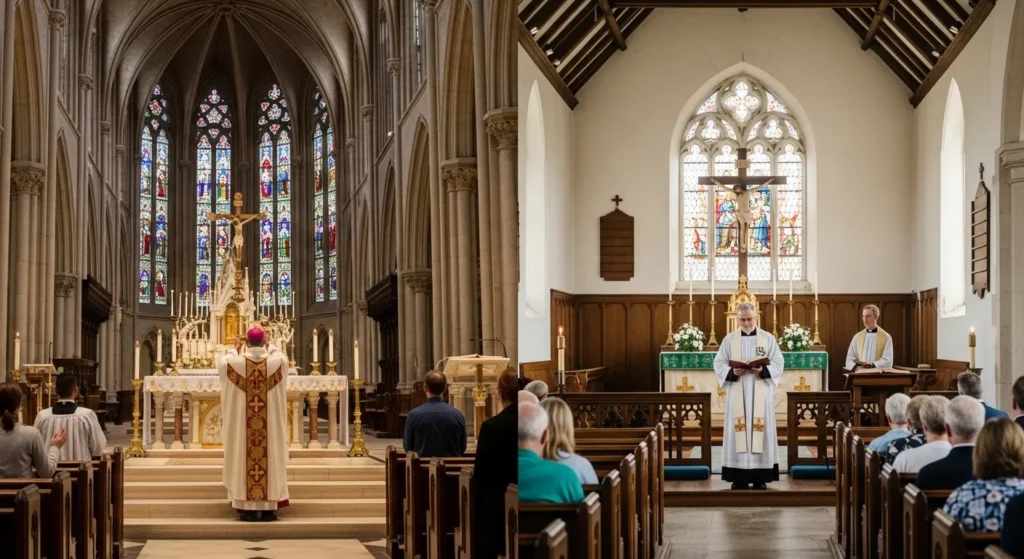
- Some Anglican churches resemble Catholic services.
- Others have more contemporary worship styles.
7. Sacraments
Catholic:
Catholics recognize seven official sacraments.
Examples:
- Baptism and Eucharist are central ceremonies.
- Marriage and confession are also sacraments.
Anglican:
Anglicans emphasize two main sacraments.
Examples:
- Baptism is important in Anglican practice.
- Communion is widely practiced.
8. Role of Women
Catholic:
Women cannot become priests.
Examples:
- Leadership roles are mostly male.
- Women serve in supportive church roles.
Anglican:
Many Anglican churches allow female priests and bishops.
Examples:
- Women can serve as priests in several Anglican countries.
- Some Anglican dioceses have female bishops.
9. Church Structure
Catholic:
The church has a centralized global structure.
Examples:
- The Vatican oversees Catholic administration.
- Global decisions often come from Rome.
Anglican:
Anglicanism is a collection of independent churches.
Examples:
- The Anglican Communion includes many national churches.
- Each region manages its own leadership.
10. Approach to Social Issues
Catholic:
Catholic teachings tend to follow long-established traditions.
Examples:
- Official teachings often emphasize traditional doctrine.
- Church leaders guide moral discussions.
Anglican:
Anglican churches often adapt to social changes.
Examples:
- Some Anglican churches support modern reforms.
- Policies may vary between regions.
Nature and Behaviour of Both
Catholic Church:
The Catholic Church emphasizes unity, tradition, and centralized authority. It values continuity with historical teachings and structured rituals.
Anglican Church:
Anglicanism focuses on balance between tradition and flexibility. It allows more diversity in worship styles and theological interpretation.
Why Are People Confused About Their Use?
People often confuse Catholic and Anglican churches because their services, buildings, and symbols can look very similar.Both traditions use liturgy, clergy robes, and sacraments such as communion.
Additionally, Anglicanism historically developed from Catholic traditions, which makes their practices appear alike. Without understanding their history and leadership structures, many people assume they are the same denomination.
Table Showing Difference and Similarity
| Feature | Catholic | Anglican | Similarity |
| Leadership | Pope leads worldwide | Independent leadership | Both have bishops |
| Origin | Early Christian church | England in 16th century | Both Christian |
| Sacraments | Seven | Two main | Both practice baptism |
| Clergy Marriage | Mostly celibate | Marriage allowed | Both have ordained clergy |
| Worship | Highly traditional | Traditional or modern | Both hold church services |
Which Is Better in What Situation?
Catholic Tradition
The Catholic tradition may be preferred by people who value strong historical continuity, centralized authority, and consistent global doctrine. Its structured rituals and unified teachings provide stability and a deep connection with centuries of religious history.
Anglican Tradition
Anglicanism may appeal to individuals who appreciate flexibility, local leadership, and diverse interpretations of faith. Because Anglican churches can adapt to cultural changes, they often provide a broader range of worship styles and theological perspectives.
Use in Metaphors and Similes
Although religious terms are rarely used metaphorically, they sometimes appear in expressions.
Examples:
- “His discipline was **as strict as a Catholic school.”
- “The meeting was **as orderly as an Anglican service.”
Connotative Meaning
Catholic
- Positive: tradition, unity, universality
- Negative: strict or conservative (in some contexts)
- Neutral example: “She studied Catholic history.”
Anglican
- Positive: balanced, moderate, adaptable
- Negative: sometimes viewed as divided because of differing views
- Neutral example: “He attends an Anglican church.”
Idioms or Proverbs
These words rarely form idioms, but they appear in expressions:
- “Catholic taste” meaning broad or wide interests
Example: She has Catholic taste in music and art.
Works in Literature
Catholic
- The Power and the Glory Novel, Graham Greene, 1940
- The Canterbury Tales Poetry collection, Geoffrey Chaucer, 1400s
Anglican
- The Anglican Spirit Religious essays, Michael Ramsey, 1992
- Anglican Theology Theology study, Mark Chapman, 2012
Movies Related to the Topics
Catholic
- The Two Popes 2019, United Kingdom/USA
- The Mission 1986, United Kingdom
Anglican
- Elizabeth 1998, United Kingdom
- Elizabeth: The Golden Age 2007, United Kingdom
Frequently Asked Questions
1. Are Catholics and Anglicans Christians?
Yes, both belong to the Christian faith.
2. Do Anglicans follow the Pope?
No, Anglicans do not recognize the Pope’s authority.
3. Can Anglican priests marry?
Yes, Anglican clergy can marry.
4. How many sacraments do Catholics have?
Catholics recognize seven sacraments.
5. Why did Anglicanism separate from Catholicism?
It separated during the English Reformation in the 16th century.
How Both Are Useful for Society
Both Catholic and Anglican communities contribute to education, charity, and social welfare.
They run schools, hospitals, and humanitarian organizations around the world. Their teachings encourage compassion, moral values, and community support.
Final Words for Both
Catholicism represents centuries of tradition and global unity within Christianity.
Anglicanism reflects a balance between historical roots and modern adaptability. Together, they illustrate how religious traditions evolve while maintaining shared beliefs.
Conclusion
Understanding the difference between Catholic and Anglican helps people appreciate the diversity within Christianity.
While both traditions share similar foundations such as belief in Jesus Christ, sacraments, and church worship, they differ in leadership, history, and theological approach.
The Catholic Church emphasizes centralized authority and longstanding traditions, whereas the Anglican Church focuses on flexibility and independent governance.
Despite these distinctions, both communities play important roles in society through charity, education, and spiritual guidance. Recognizing their similarities and differences allows learners and scholars to better understand religious history and cultural development.

I am James Anderson an English author known for his insightful and engaging writing in contemporary literature. With a focus on [insert genre, e.g., fiction, non-fiction, or specific themes], he explores complex human emotions and social dynamics, blending thought-provoking ideas with accessible storytelling. His work has earned recognition for its clarity, depth, and ability to connect with a wide audience, establishing him as a respected voice in modern English literature.