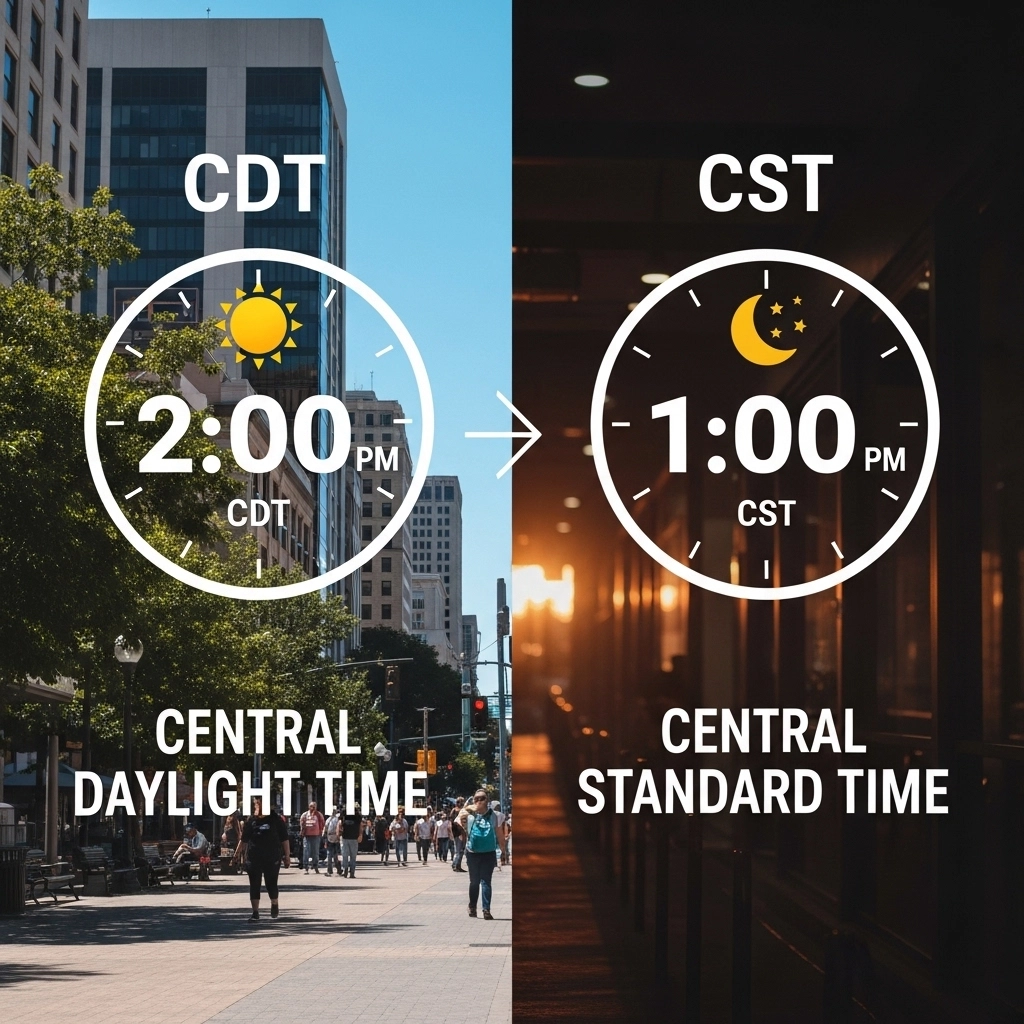
Last year, a project manager in the United States scheduled a virtual meeting for 10:00 AM CST. Half of the team joined an hour late because they were following CDT instead. This simple confusion clearly shows the difference between CDT and CST and why it matters in everyday life.
CST stands for Central Standard Time, while CDT stands for Central Daylight Time. Both are time zones used in parts of North America, especially the central region of the United States. However, the difference between CDT and CST lies in daylight saving adjustments.
Understanding the difference between CDT and CST helps businesses, students, and professionals avoid scheduling mistakes. In fact, the difference between CDT and CST becomes especially important during seasonal clock changes.
Time, after all, is not just numbers it shapes our daily routines and global connections. Let’s explore how.
Pronunciation (US & UK)
- CDT
- US: /ˌsiː diː ˈtiː/
- UK: /ˌsiː diː ˈtiː/
- US: /ˌsiː diː ˈtiː/
- CST
- US: /ˌsiː es ˈtiː/
- UK: /ˌsiː es ˈtiː/
- US: /ˌsiː es ˈtiː/
Both are spelled out letter by letter when spoken.
Now that we understand the basics, let’s dive deeper into the structured difference between CDT and CST.
Key Difference Between the Both
The main difference is seasonal adjustment:
- CST (Central Standard Time) is UTC −6 hours.
- CDT (Central Daylight Time) is UTC −5 hours.
CDT is used during daylight saving months (spring and summer), while CST is used during standard time (fall and winter).
Why Is Their Difference Necessary to Know for Learners and Experts?
Understanding time zones is essential in today’s global society. Businesses schedule international meetings. Airlines manage departures. Students attend online classes across regions. A one-hour mistake can lead to missed opportunities.
For experts in technology, aviation, healthcare, and finance, knowing whether it is CDT or CST ensures accuracy. For learners, it builds awareness of how time systems function socially and economically. In short, understanding time differences strengthens communication and coordination in society.
H2: Difference Between CDT and CST
Here are 10 clear points explaining the difference:
1. UTC Offset
- CST: UTC −6
- Example 1: 12:00 PM CST = 6:00 PM UTC
- Example 2: 8:00 AM CST = 2:00 PM UTC
- Example 1: 12:00 PM CST = 6:00 PM UTC
- CDT: UTC −5
- Example 1: 12:00 PM CDT = 5:00 PM UTC
- Example 2: 8:00 AM CDT = 1:00 PM UTC
- Example 1: 12:00 PM CDT = 5:00 PM UTC
2. Seasonal Use
- CST: Used in winter
- Example 1: January schedules use CST
- Example 2: December flights follow CST
- Example 1: January schedules use CST
- CDT: Used in summer
- Example 1: July meetings follow CDT
- Example 2: June school timetables use CDT
- Example 1: July meetings follow CDT
3. Daylight Saving Time
- CST: No daylight saving adjustment
- Example 1: Clocks remain unchanged
- Example 2: Sunrise happens earlier
- Example 1: Clocks remain unchanged
- CDT: Applies daylight saving
- Example 1: Clocks move forward one hour
- Example 2: Evenings stay brighter longer
- Example 1: Clocks move forward one hour
4. Months Active
- CST: November to March
- CDT: March to November
Examples:
- Winter holiday events follow CST.
- Summer festivals follow CDT.
5. Impact on Business
- CST: Shorter daylight hours
- CDT: Extended business hours due to longer daylight
6. Energy Use
- CST: More artificial lighting in evenings
- CDT: Less electricity use during long daylight
7. Geographic Coverage
Both are used in central states like Texas and Illinois.
- Winter: Texas uses CST
- Summer: Texas uses CDT
8. International Coordination
- CST differs by 6 hours from UTC
- CDT differs by 5 hours from UTC
Example: A London call differs by 6 hours in winter and 5 hours in summer.
9. Clock Adjustment
- CST: Standard clock time
- CDT: Clock moves forward one hour
10. Abbreviation Meaning
- CST: Central Standard Time
- CDT: Central Daylight Time
Nature and Behaviour of Both
CST represents stability and standardization. It reflects regular time without seasonal shifts.
CDT represents flexibility and adaptation. It adjusts to maximize daylight usage.
Why Are People Confused About Their Use?
The confusion happens because:
- Both apply to the same region.
- The difference is only one hour.
- Abbreviations look similar.
- Not all countries observe daylight saving time.
Table: Difference and Similarity Between CDT and CST
| Feature | CST | CDT | Similarity |
| Full Form | Central Standard Time | Central Daylight Time | Both Central Time |
| UTC Offset | −6 | −5 | Based on UTC |
| Season | Winter | Summer | Same region |
| Clock Change | No | Yes (+1 hr) | 1-hour difference |
| Purpose | Standard timing | Daylight saving | Improve time management |
Which Is Better in What Situation?
CST is better during winter months when natural daylight is shorter. It keeps mornings brighter and aligns schedules naturally with sunrise. Industries that rely on early morning operations prefer CST stability.
CDT is better during summer because it extends daylight into the evening. Retail businesses, outdoor events, and tourism benefit from longer daylight hours. It encourages productivity and outdoor activity.
Neither is permanently better; each serves a seasonal purpose.
Metaphors and Similes
- “Switching from CST to CDT is like turning the page to a brighter chapter.”
- “CDT stretches the evening like elastic.”
- “CST stands firm like a clock tower in winter.”
Connotative Meanings
- CST: Neutral and stable
- Example: “CST keeps things traditional and steady.”
- Example: “CST keeps things traditional and steady.”
- CDT: Positive and energetic
- Example: “CDT brings lively summer evenings.”
- Example: “CDT brings lively summer evenings.”
Idioms or Proverbs (Time-Related)
- “Time waits for no one.”
- Example: Missing a CDT meeting proves time waits for no one.
- Example: Missing a CDT meeting proves time waits for no one.
- “Better late than never.”
- Example: Arriving one hour late due to CST confusion is still better than missing it.
- Example: Arriving one hour late due to CST confusion is still better than missing it.
Works in Literature (Time Themes)
- “A Brief History of Time” – Science, Stephen Hawking, 1988
- “The Time Machine” – Science Fiction, H. G. Wells, 1895
Movies Related to Time
- In Time – 2011, USA
- Back to the Future – 1985, USA
Five Frequently Asked Questions
1. Is CDT ahead of CST?
Yes, CDT is one hour ahead of CST.
2. When does CDT start?
It starts in spring when clocks move forward.
3. Is CST used all year?
No, it is used only during standard time months.
4. Why is there only a one-hour difference?
Because daylight saving adds one hour.
5. Do all US states follow CDT and CST?
No, some states do not observe daylight saving time.
How Both Are Useful for Surroundings
CST helps maintain consistent schedules in winter.
CDT supports longer outdoor activities in summer.
Both improve seasonal adaptation and economic efficiency.
Final Words for Both
CST provides balance and stability.
CDT offers flexibility and brightness.
Together, they create a practical seasonal time system.
Conclusion
The difference between CDT and CST may seem small, but its impact is significant. One hour can change meeting schedules, business profits, and even travel plans. CST represents standard winter time, while CDT reflects summer daylight adjustment.
Understanding their distinction helps learners, professionals, and global organizations function efficiently. In today’s interconnected world, knowing the correct time zone is more than a detail it is a necessity for coordination and clarity.

I am Stephen King is a spiritual writer and digital creator dedicated to exploring the deeper meaning behind numbers, synchronicity, and divine guidance. Through his platform, spiritualdigits.com he shares insights on angel numbers, spiritual symbolism, and personal awakening to help readers align with their higher purpose. His work blends intuition, research, and practical wisdom to make spiritual concepts clear, accessible, and transformative.