Imagine a small shop owner who keeps customer names in a computer database. Some names are very short, like “Ali,” while others are longer, like “Muhammad.”
If the system always keeps the same space for every name, even the short ones, it may waste storage. But if the system allows flexible space depending on the name length, it can save memory.
This idea helps us understand the difference between char and varchar in databases. In simple words, CHAR and VARCHAR are data types used to store text in database systems such as SQL.
The difference between char and varchar mainly lies in how they store characters and manage storage space. When developers design tables, they must understand the difference between char and varchar to store data correctly. Learning the difference between char and varchar helps programmers build faster and more efficient databases.
Key Difference Between Both
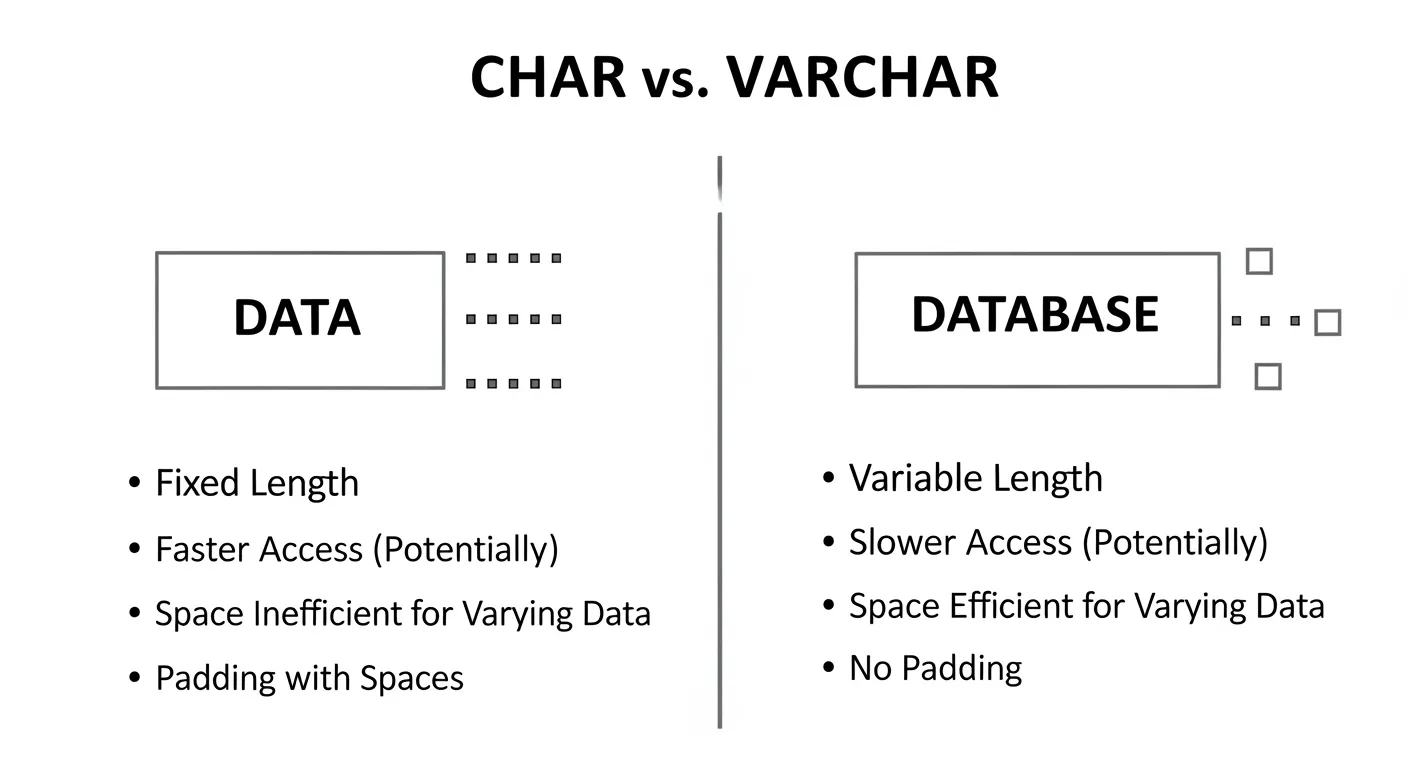
The main difference between char and varchar is that CHAR stores a fixed number of characters, while VARCHAR stores a variable number of characters.
CHAR always keeps the same length, even if the text is shorter. VARCHAR changes its length depending on the text stored.
Why Their Difference Is Important
Understanding the difference between char and varchar is very important for both learners and experts.
For learners, it helps them understand how databases store text and manage memory. When students learn SQL or database design, knowing which data type to use makes their programs better.
For experts, choosing the correct data type improves database speed and performance. Companies store huge amounts of information such as names, addresses, and product codes. If developers select the wrong data type, storage space may be wasted and queries may run slower.
Therefore, understanding the difference between char and varchar is important for building efficient systems used in schools, businesses, hospitals, and online platforms.
Pronunciation
- CHAR
- US: /tʃɑːr/
- UK: /tʃɑː/
- US: /tʃɑːr/
- VARCHAR
- US: /ˈvɑːr.kɑːr/
- UK: /ˈvɑː.kɑː/
- US: /ˈvɑːr.kɑːr/
Linking Hook
Now that we understand the basic idea, let us explore the difference between char and varchar in detail.
Difference Between the Keywords
1. Storage Type
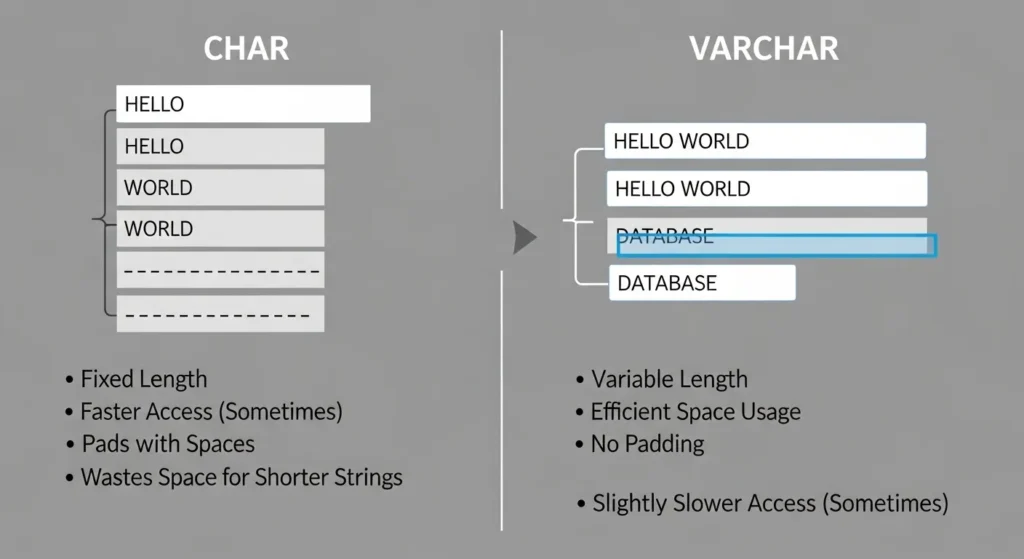
CHAR stores a fixed number of characters.
VARCHAR stores a variable number of characters.
Examples:
- CHAR example: A column defined as CHAR(10) always stores 10 characters.
- CHAR example: The word “Cat” becomes “Cat”.
- VARCHAR example: VARCHAR(10) stores only the characters used.
- VARCHAR example: “Cat” remains “Cat”.
2. Space Usage
CHAR uses the same amount of space for every value.
VARCHAR uses only the space needed.
Examples:
- CHAR example: CHAR(10) uses 10 characters even for “Dog”.
- CHAR example: A short word still takes full space.
- VARCHAR example: VARCHAR(10) stores “Dog” using only 3 characters.
- VARCHAR example: Longer words use more space.
3. Data Length
CHAR is best for fixed-length data.
VARCHAR is best for variable-length data.
Examples:
- CHAR example: Country codes like “USA”.
- CHAR example: Gender codes like “M” or “F”.
- VARCHAR example: Names like “Ahmed”.
- VARCHAR example: Email addresses.
4. Performance
CHAR can be faster in some databases.
VARCHAR may take slightly more processing.
Examples:
- CHAR example: Fixed-length data is easy for the system to read.
- CHAR example: Searching may be quicker.
- VARCHAR example: The system checks the length each time.
- VARCHAR example: It may slow down large queries slightly.
5. Padding
CHAR adds spaces to reach the fixed length.
VARCHAR does not add extra spaces.
Examples:
- CHAR example: “Hi” stored in CHAR(5) becomes “Hi”.
- CHAR example: Extra spaces fill the field.
- VARCHAR example: “Hi” stays “Hi”.
- VARCHAR example: No extra spaces are added.
6. Flexibility
CHAR is less flexible.
VARCHAR is more flexible.
Examples:
- CHAR example: All entries must match the same length.
- CHAR example: Extra characters are added automatically.
- VARCHAR example: Text length can change.
- VARCHAR example: Short and long text both fit.
7. Storage Efficiency
CHAR may waste space.
VARCHAR saves space.
Examples:
- CHAR example: Short words still use full length.
- CHAR example: Storage may grow quickly.
- VARCHAR example: Stores only what is needed.
- VARCHAR example: Saves memory.
8. Use in Databases
CHAR is used for codes.
VARCHAR is used for text data.
Examples:
- CHAR example: Product code “A12”.
- CHAR example: Country code.
- VARCHAR example: User name.
- VARCHAR example: Address.
9. Length Definition
CHAR requires fixed length during creation.
VARCHAR allows variable length up to a limit.
Examples:
- CHAR example: CHAR(5) always stores five characters.
- CHAR example: Even short text fills the space.
- VARCHAR example: VARCHAR(50) can store 150 characters.
- VARCHAR example: Length changes for each value.
10. Common Usage
CHAR is used when data size never changes.
VARCHAR is used when text length varies.
Examples:
- CHAR example: Status code like “YES”.
- CHAR example: Two-letter state code.
- VARCHAR example: Full names.
- VARCHAR example: Messages or comments.
Nature and Behaviour
CHAR
CHAR behaves in a strict and fixed way. It always stores the exact number of characters defined. If the data is shorter, the system fills the remaining space with blank spaces.
VARCHAR
VARCHAR behaves more flexibly. It adjusts its size depending on the length of the stored text. It stores only the characters needed.
Why People Are Confused About Their Use
Many people confuse CHAR and VARCHAR because both store text. At first glance, they seem similar. However, the difference appears in how they manage storage and space.
Beginners often choose one without thinking about data length. This causes confusion and sometimes wastes database storage.
Comparison Table
| Feature | CHAR | VARCHAR |
| Storage type | Fixed length | Variable length |
| Space usage | Always full length | Only needed space |
| Flexibility | Low | High |
| Padding | Adds spaces | No extra spaces |
| Best for | Codes and fixed text | Names and long text |
| Performance | Sometimes faster | Slightly slower |
| Storage efficiency | Less efficient | More efficient |
| Length | Always same | Changes per value |
Which Is Better in Different Situations?
The choice between CHAR and VARCHAR depends on the type of data being stored. CHAR works best when the text length is always the same.
For example, country codes, gender codes, and product IDs usually have a fixed number of characters. Using CHAR for such data makes the database simple and sometimes faster.
VARCHAR is better when text length changes often. Names, emails, addresses, and comments are different in size. VARCHAR allows flexible storage and saves space in large databases.
For most modern applications, developers prefer VARCHAR because it handles variable text easily and reduces storage waste.
Metaphors and Similes
CHAR is like a fixed-size box. No matter how small the item is, it must fill the box.
VARCHAR is like a stretchable bag. It grows or shrinks depending on what you put inside.
Connotative Meaning
Both words have mostly neutral meanings because they are technical terms.
- CHAR: Neutral meaning related to fixed character storage.
Example: The database uses CHAR for product codes. - VARCHAR: Neutral meaning related to variable character storage.
Example: The system stores names using VARCHAR.
Idioms or Proverbs
These words are technical, so there are no traditional idioms. However, they can appear in technical sayings.
- “Use CHAR for fixed data.”
Example: The developer said, “Use CHAR for fixed data like country codes.” - “VARCHAR saves space.”
Example: The teacher reminded students, “VARCHAR saves space in large databases.”
Works in Literature
Although these are technical terms, they appear in programming books.
- SQL in 10 Minutes Ben Forta, Programming Guide, 2012
- Learning SQL Alan Beaulieu, Technology Book, 2009
- Database System Concepts Abraham Silberschatz, Computer Science Textbook, 2019
Movies
Technology and database topics appear in many computer-related movies.
- The Social Network 2010, USA
- Hackers 1995, USA
- The Matrix 1999, USA
FAQ Section
1. What is the main difference between CHAR and VARCHAR?
CHAR stores fixed-length text, while VARCHAR stores variable-length text.
2. Which one saves more space?
VARCHAR usually saves more space because it stores only the characters used.
3. When should I use CHAR?
Use CHAR when the text length is always the same, such as country codes.
4. When should I use VARCHAR?
Use VARCHAR for names, addresses, and other text that changes in length.
5. Are CHAR and VARCHAR used in SQL?
Yes, both are common text data types used in SQL databases.
Usefulness in Our Surroundings
CHAR and VARCHAR are used in many systems around us. Banks store account codes, schools store student names, and websites store usernames and emails.
Developers use these data types to organize information correctly. Without them, storing and managing text data in databases would be difficult.
Final Words About Both
CHAR and VARCHAR are basic but powerful tools in database design. Each has its own role. CHAR provides stability with fixed length, while VARCHAR offers flexibility for changing text.
Conclusion
In summary, the difference between char and varchar is mainly about how they store text data. CHAR stores a fixed number of characters and often adds spaces to fill the length.
VARCHAR stores a variable number of characters and uses only the space needed. Both data types are important in database systems. Developers choose CHAR when data length is constant and VARCHAR when text length changes.
Understanding this difference helps programmers design efficient databases and improve system performance. For beginners, learning these concepts is an important step toward mastering SQL and database management.

I am D. H. Lawrence (David Herbert Lawrence) an influential English novelist, poet, essayist, and literary critic born on September 11, 1885, in Eastwood, Nottinghamshire, England. He is widely regarded as one of the most important writers of the 20th century.
I work often explored human relationships, emotional intimacy, industrialization, and the conflict between modern society and natural instincts.