Understanding the difference between fascism and dictatorship is crucial for anyone studying history, politics, or social sciences.
Imagine living in a country where a single leader controls every aspect of life. That could either be a dictatorship, where power is concentrated in one person, or a fascist state, where extreme nationalism shapes the government.
Both fascism and dictatorship limit freedom and impose strict control, but their motivations and methods differ. Learning the difference between fascism and dictatorship helps us recognize historical patterns, prevent political misuse, and better understand societal dynamics. In real-world examples, Benito Mussolini led a fascist Italy, while Saddam Hussein’s Iraq was a dictatorship, illustrating how both systems operate differently.
Pronunciation:
- Fascism: US /ˈfæʃɪzəm/, UK /ˈfæʃɪz(ə)m/
- Dictatorship: US /dɪkˈteɪtərʃɪp/, UK /dɪkˈteɪtəʃɪp/
Let’s dive deeper to clearly understand the difference between fascism and dictatorship.
Difference Between Fascism and Dictatorship
Here are 10 key points that highlight the difference between fascism and dictatorship with examples:
- Definition:
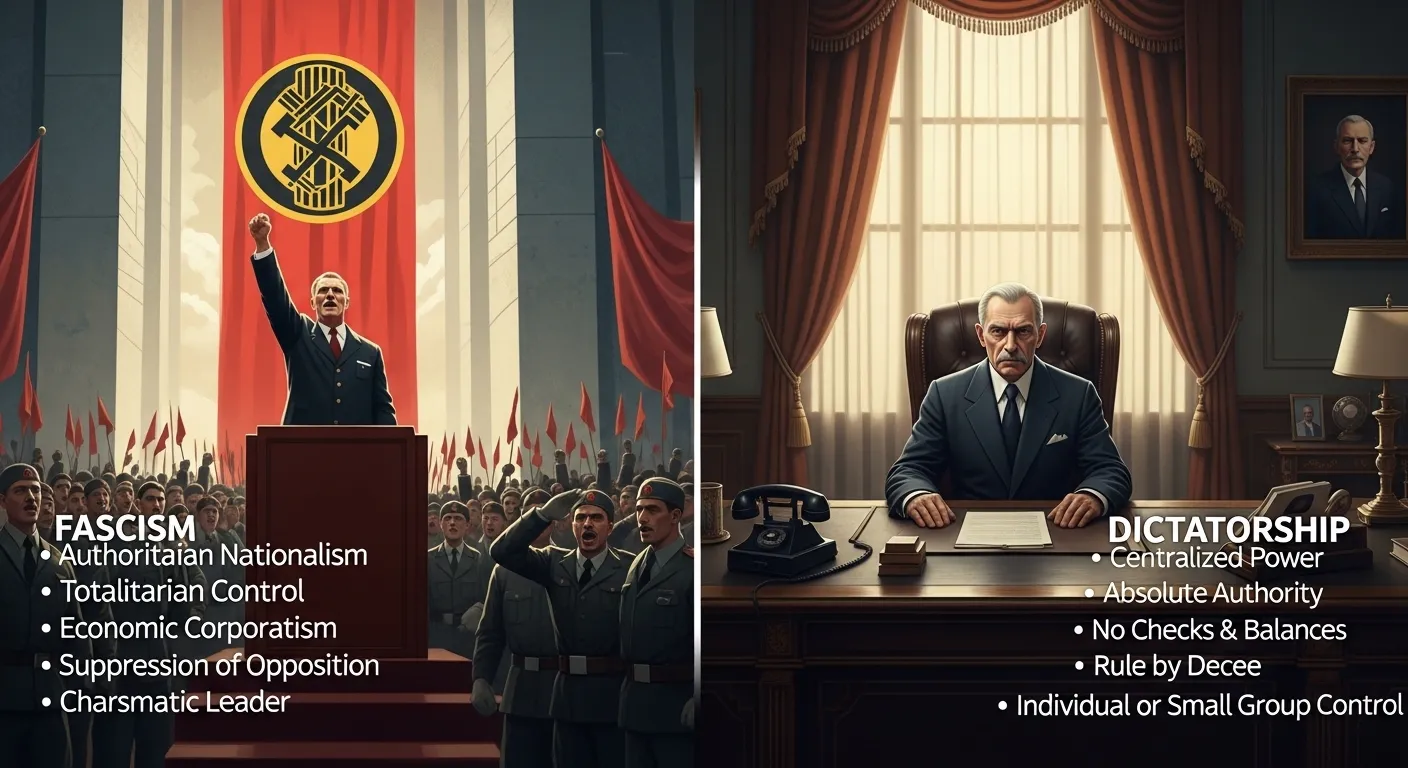
- Fascism: A political ideology emphasizing extreme nationalism and authoritarian rule.
- Example 1: Mussolini’s Italy focused on pride, militarism, and the state over individual rights.
- Example 2: Franco’s Spain promoted fascist principles to unify the nation under nationalism.
- Example 1: Mussolini’s Italy focused on pride, militarism, and the state over individual rights.
- Dictatorship: A government ruled by one person with absolute power, without needing an ideology.
- Example 1: Kim Jong-un’s North Korea is a dictatorship focusing on control rather than ideology.
- Example 2: Mobutu Sese Seko’s Zaire ruled as a personal dictatorship.
- Example 1: Kim Jong-un’s North Korea is a dictatorship focusing on control rather than ideology.
- Fascism: A political ideology emphasizing extreme nationalism and authoritarian rule.
- Political Motivation:
- Fascism thrives on ideology and national pride.
- Dictatorship may not require a political ideology; power and control are primary motives.
- Fascism thrives on ideology and national pride.
- Economic Control:
- Fascism often merges state with corporations, controlling economic activity.
- Dictatorship may allow private businesses as long as loyalty is ensured.
- Fascism often merges state with corporations, controlling economic activity.
- Use of Propaganda:
- Fascism uses mass propaganda to instill national pride and obedience.
- Dictatorships focus on suppressing dissent and promoting the leader personally.
- Fascism uses mass propaganda to instill national pride and obedience.
- Military Influence:
- Fascist regimes glorify the military as part of ideology.
- Dictatorships use the military mainly to maintain control.
- Fascist regimes glorify the military as part of ideology.
- Social Policies:
- Fascism imposes strict societal norms to unify people ideologically.
- Dictatorship may only intervene when society threatens the ruler’s power.
- Fascism imposes strict societal norms to unify people ideologically.
- International Relations:
- Fascist states pursue aggressive expansionism (example: Nazi Germany).
- Dictatorships may isolate or engage depending on strategy, not ideology.
- Fascist states pursue aggressive expansionism (example: Nazi Germany).
- Leadership Style:
- Fascist leaders are charismatic symbols of ideology.
- Dictators are authoritarian figures prioritizing control.
- Fascist leaders are charismatic symbols of ideology.
- Citizen Participation:
- Fascism mobilizes citizens for state purposes (parades, rallies).
- Dictatorships discourage participation except for obedience.
- Fascism mobilizes citizens for state purposes (parades, rallies).
- Historical Examples:
- Fascism: Mussolini (Italy, 19221943), Hitler (Germany, 19331945)
- Dictatorship: Kim Il-Sung (North Korea, 19481994), Idi Amin (Uganda, 19711979)
- Fascism: Mussolini (Italy, 19221943), Hitler (Germany, 19331945)
Nature and Behaviour
- Fascism: Highly nationalistic, aggressive, and propagandist; often glorifies war and unity.
- Dictatorship: Autocratic, self-serving, and control-focused; survival of the ruler is main priority.
Why People Are Confused
People confuse them because both limit freedoms, use authoritarian control, and involve a single powerful leader. However, fascism is ideologically motivated, while dictatorship is power-motivated.
Table: Difference and Similarity
| Feature | Fascism | Dictatorship | Similarity |
| Ideology | Yes, extreme nationalism | Not necessarily | Both centralize power |
| Leader Role | Charismatic symbol of ideology | Absolute ruler | Both have one dominant leader |
| Economy | State-controlled with corporates | May allow private business | Both control opposition |
| Social Control | Enforces cultural norms | Focus on obedience | Limited personal freedoms |
| Military | Glorified and ideological | Used for control | Strong military presence |
| Propaganda | Mass ideological campaigns | Leader-focused | Both use propaganda |
| Expansionism | Often aggressive | Optional | Both may control neighboring states |
| Citizen Role | Mobilized for state | Suppressed except for loyalty | Both limit democracy |
| Examples | Mussolini, Hitler | Kim Jong-un, Idi Amin | Both have historical global impact |
| Nature | Ideological, nationalistic | Autocratic, personal power | Both authoritarian |
Which Is Better in What Situation?
- Fascism can unify a country under a strong ideology during crises, like war or economic collapse, but it often leads to extreme oppression.
- Dictatorship may stabilize a nation under a single ruler, especially in politically unstable regions, but it risks corruption and abuse of power.
Metaphors and Similes
- Fascism: “The iron fist of nationalism” metaphor for authoritarian control.
- Dictatorship: “Like a lone wolf in the government” simile showing absolute personal power.
Connotation:
- Fascism: Negative (example: Nazi Germany, WWII)
- Dictatorship: Mostly negative (example: oppressive regimes)
Idioms/Proverbs
- “Absolute power corrupts absolutely” applies to dictatorships.
- “Marching to the same drum” applies to fascist mass obedience.
Works in Literature
- The Doctrine of Fascism Benito Mussolini, 1932, Political Essay
- 1984 George Orwell, 1949, Dystopian Fiction
Movies
- Downfall Germany, 2004, about Nazi dictatorship
- The Last King of Scotland UK/US, 2006, about Idi Amin’s dictatorship
Frequently Asked Questions
- Is fascism a type of dictatorship? Sometimes, yes, but it’s ideologically driven.
- Are all dictators fascists? No, many dictators rule without ideology.
- Can fascism exist without a dictator? Rarely, because leadership is central.
- Do both limit freedoms? Yes, both restrict civil liberties.
- Which is more dangerous? Depends; fascism can mobilize masses aggressively.
How Both Are Useful for Surroundings
- Fascism can unify citizens during national crises but is risky.
- Dictatorships can maintain order in unstable regions but must be checked to prevent abuse.
Final Words
Understanding the difference between fascism and dictatorship equips learners, historians, and citizens to analyze power structures, prevent oppression, and recognize warning signs in politics.
Conclusion
While both fascism and dictatorship involve authoritarian control, the key difference lies in ideology versus personal power.
Fascism seeks nationalistic unity and mass mobilization, while dictatorship focuses on the ruler’s absolute control.
Recognizing this distinction is essential for students, historians, and citizens to understand political history, prevent misuse of power, and safeguard democratic values.
Historical examples like Mussolini’s Italy (fascism) and Kim Jong-un’s North Korea (dictatorship) illustrate the practical differences in governance and societal impact.
By knowing these differences, we can make informed evaluations of governments and their policies, ultimately contributing to a more politically aware society.
I am Stephen King is a spiritual writer and digital creator dedicated to exploring the deeper meaning behind numbers, synchronicity, and divine guidance. Through his platform, spiritualdigits.com he shares insights on angel numbers, spiritual symbolism, and personal awakening to help readers align with their higher purpose. His work blends intuition, research, and practical wisdom to make spiritual concepts clear, accessible, and transformative.