Understanding the difference between feudalism and manorialism is key to studying medieval history and the social structures that shaped Europe.
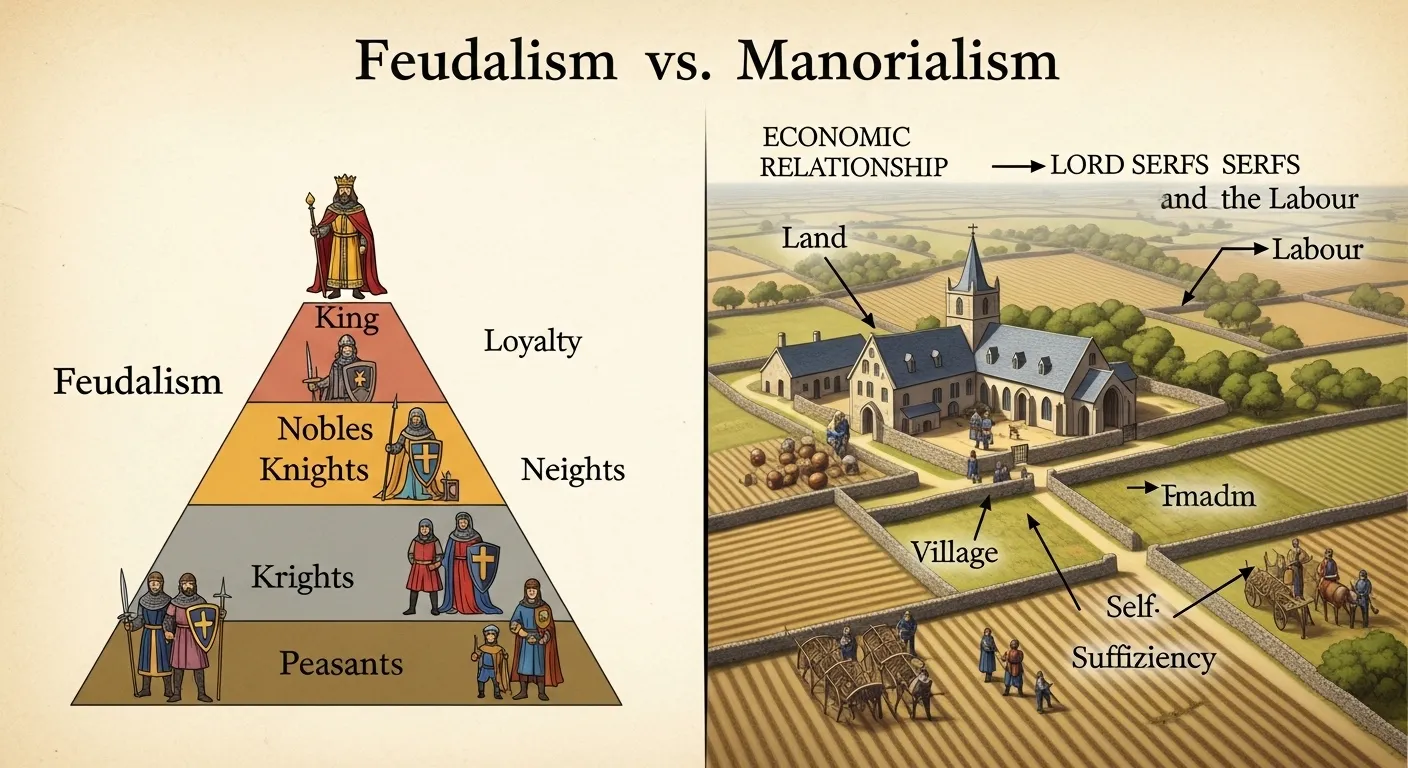
Imagine walking through a medieval village: knights patrol the lands while peasants work the fields. This picture reflects feudalism, the system that organized political and military power.
At the same time, the peasants’ daily life revolved around the manor, showcasing manorialism, the economic and agricultural framework supporting society.
By exploring the difference between feudalism and manorialism, learners can understand how power, land, and labor interconnected during medieval times. Knowing these systems helps experts in history, sociology, and literature analyze medieval societies more deeply.
Pronunciation:
- Feudalism: US /ˈfjuː.dəl.ɪ.zəm/, UK /ˈfjʊə.dəl.ɪ.zəm/
- Manorialism: US /məˈnɔːr.i.ə.lɪ.zəm/, UK /məˈnɒr.i.ə.lɪ.zəm/
Let’s now dive into the detailed comparison and explore why these systems, while connected, are not the same.
Difference Between Feudalism and Manorialism
1. Definition
- Feudalism is a political and military system where lords grant land to vassals in exchange for loyalty and military service.
Example 1: A lord giving land to a knight for protection.
Example 2: A king granting a fief to a baron to defend the kingdom. - Manorialism is an economic system organizing rural life where peasants work land owned by the lord.
Example 1: Peasants farming a manor in exchange for housing.
Example 2: Villagers providing grain to the lord as rent.
2. Focus
- Feudalism: Focuses on power, loyalty, and military obligations.
- Manorialism: Focuses on agriculture, economy, and daily sustenance.
3. Main Participants
- Feudalism: King, nobles, knights.
- Manorialism: Lords, peasants, serfs.
4. Type of System
- Feudalism: Political and military.
- Manorialism: Economic and social.
5. Land Ownership
- Feudalism: Land is granted temporarily to vassals.
- Manorialism: Land is controlled and cultivated by peasants under lord’s ownership.
6. Social Hierarchy
- Feudalism: Structured around ranks of loyalty (king → nobles → knights → vassals).
- Manorialism: Structured around economic role (lord → peasants → serfs).
7. Geographical Spread
- Feudalism: Europe, particularly France and England.
- Manorialism: Rural areas throughout medieval Europe.
8. Duration of Obligation
- Feudalism: Obligations last as long as the fief exists.
- Manorialism: Peasant duties are ongoing, often lifelong.
9. Source of Wealth
- Feudalism: Wealth comes from land grants and military support.
- Manorialism: Wealth comes from agricultural production.
10. Nature of Power
- Feudalism: Power is decentralized and military-based.
- Manorialism: Power is localized and economic-based.
Nature and Behaviour
- Feudalism: Hierarchical, militaristic, and formal; loyalty and honor are essential.
- Manorialism: Agricultural, stable, and community-focused; survival and labor dominate.
Why People Are Confused
The confusion arises because both involve land and social hierarchy, but feudalism is political, while manorialism is economic. They coexist but serve different functions.
Comparison Table: Feudalism vs Manorialism
| Feature | Feudalism | Manorialism | Similarity |
| Focus | Political & military | Economic & agricultural | Both organize medieval society |
| Participants | King, nobles, knights | Lords, peasants, serfs | Land and labor involved |
| Land | Granted as fief | Cultivated under lord | Land central to system |
| Hierarchy | Loyalty-based | Economic role-based | Social structure exists |
| Wealth | Military & land grants | Agriculture & produce | Land generates wealth |
| Obligation | Time-limited | Lifelong | Both have duties |
| Power | Decentralized | Localized | Lords exercise authority |
| Spread | France, England | Rural Europe | Europe-centered |
| Nature | Militaristic | Agrarian | Structured system |
| Examples | Fiefdoms, vassalage | Serf farming, manor estates | Medieval Europe context |
Which is Better in What Situation?
Feudalism: Ideal for maintaining political stability and defense in times of invasions. Military loyalty is crucial to protect kingdoms.
Manorialism: Best for sustaining local economies and ensuring daily survival of rural communities. It provides food and stability for the population.
Metaphors, Similes, and Connotation
- Feudalism is often used metaphorically for hierarchical systems (“Corporate feudalism dominates the office like medieval lords”). Positive-neutral connotation.
- Manorialism symbolizes hard work and agrarian life (“Life in the office is a modern manorialism”). Neutral-connotation.
Idioms/Proverbs:
- “Power begets responsibility” Feudalism example
- “Many hands make light work” Manorialism example
Works in Literature
- “Ivanhoe” (Historical Novel, Sir Walter Scott, 1820) Feudalism
- “The Canterbury Tales” (Poetry/Story, Geoffrey Chaucer, 1400) Manorialism
Movies
- “A Knight’s Tale” (2001, USA) Feudalism
- “The Name of the Rose” (1986, Italy/France) Manorialism
Frequently Asked Questions
- Is feudalism the same as manorialism?
No, feudalism is political, manorialism is economic. - Did both exist together?
Yes, often in medieval Europe simultaneously. - Which system is older?
Feudalism developed earlier in response to invasions; manorialism evolved as a supporting economic structure. - Were peasants part of feudalism?
Indirectly, as their work supported the lords. - Which system influenced modern society?
Feudalism influenced political hierarchies; manorialism influenced rural land management.
Usefulness for Surroundings
Both systems shaped local economies, defense, and community life.
They stabilized societies and ensured survival during turbulent times. Feudalism provided security; manorialism provided sustenance.
Final Words
Understanding feudalism and manorialism enriches historical knowledge. While closely linked, recognizing their differences clarifies medieval life’s political and economic aspects.
Conclusion
The difference between feudalism and manorialism lies in their function: one governs loyalty and military duty, the other sustains economic life and labor.
Both shaped Europe profoundly, influencing social hierarchy, land use, and local economies. Learners and experts benefit from understanding these distinctions because they highlight how power and productivity intertwined in medieval society.
Feudalism gave structure and protection, while manorialism ensured the survival of rural communities. Together, they paint a complete picture of medieval life, providing insights into political strategies and economic sustainability.
I am D. H. Lawrence (David Herbert Lawrence) an influential English novelist, poet, essayist, and literary critic born on September 11, 1885, in Eastwood, Nottinghamshire, England. He is widely regarded as one of the most important writers of the 20th century.
I work often explored human relationships, emotional intimacy, industrialization, and the conflict between modern society and natural instincts.