Last summer at a local food festival, I watched two vendors arguing playfully. One proudly sold traditional German sausages, grilled slowly and served with mustard.
The other handed out classic American hotdogs in soft buns with ketchup and relish. Many visitors thought both were the same.
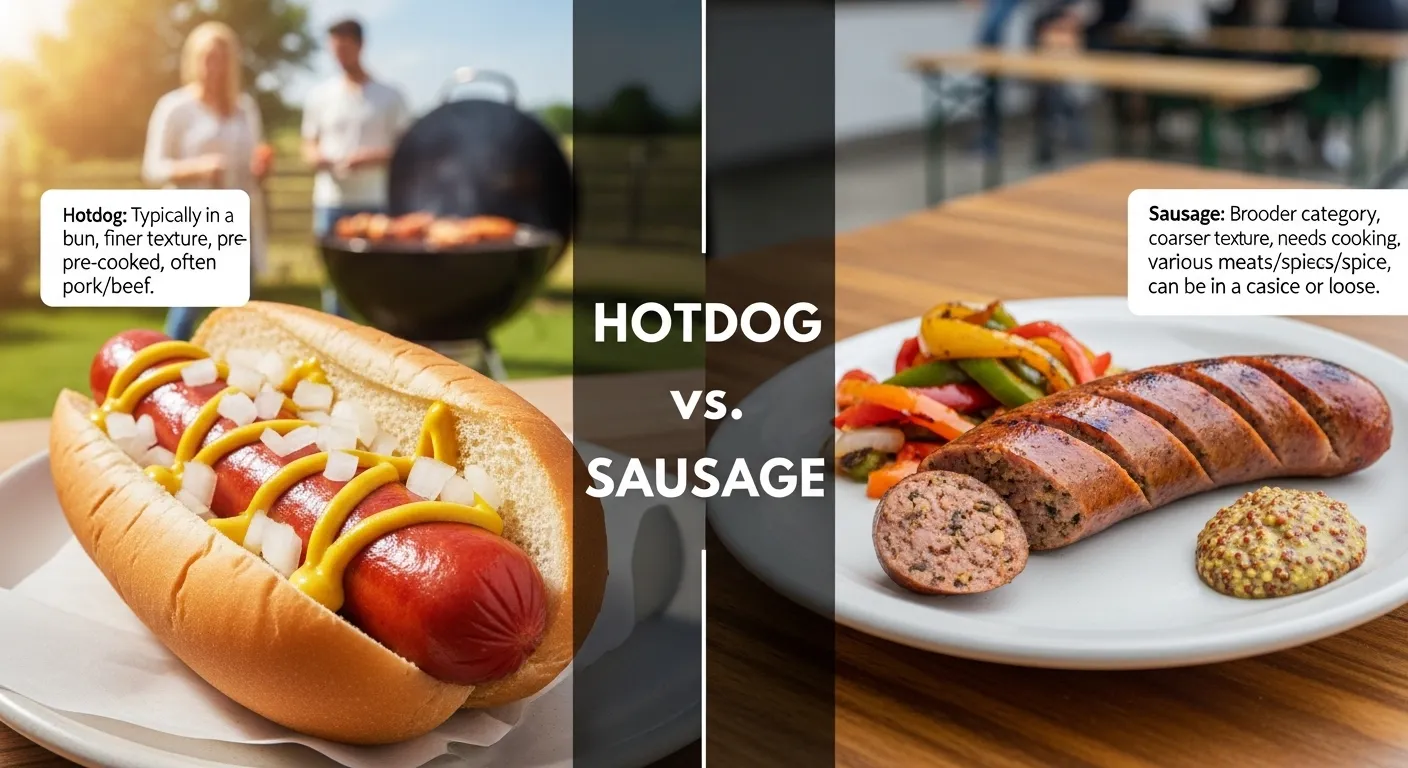
That simple moment clearly showed the difference between hotdog and sausage. A sausage is a broad category of seasoned ground meat stuffed into a casing.
A hotdog is a specific type of sausage, usually smooth and pre-cooked. The difference between hotdog and sausage often confuses people because they look similar.
However, the difference between hotdog and sausage becomes clear when we examine preparation, origin, texture, and cultural meaning. Understanding the difference between hotdog and sausage helps both casual eaters and culinary experts appreciate food diversity.
Pronunciation
Hotdog
US: ˈhɑːtdɔːɡ
UK: ˈhɒtdɒɡ
Sausage
US: ˈsɔːsɪdʒ
UK: ˈsɒsɪdʒ
Now that we understand the sounds and basic meanings, let us explore their differences in detail.
Key Difference Between the Both
A sausage is a general meat product made from ground meat, fat, and spices inside a casing.
A hotdog is a specific type of finely ground sausage, usually pre-cooked and served in a bun.
In simple words, all hotdogs are sausages, but not all sausages are hotdogs.
Why Is Their Difference Necessary to Know for Learners and Experts in Society
Understanding the difference matters in cooking, food studies, and hospitality industries. Culinary students must know categories of meat products.
Nutrition experts analyze ingredients differently. Chefs select the correct product for recipes. In society, food knowledge improves cultural awareness.
Traditional sausages represent heritage in countries like Germany and Italy, while hotdogs symbolize fast food culture in the United States. Clear understanding prevents misinformation and helps people make informed dietary choices.
Difference Between the Keywords
1. Category
Sausage is a broad category.
Example 1 Italian sausage used in pasta.
Example 2 Bratwurst served with sauerkraut.
Hotdog is a specific type of sausage.
Example 1 Classic American hotdog with ketchup.
Example 2 Chili hotdog at a baseball game.
2. Texture
Sausage may be coarse or chunky.
Example 1 Breakfast sausage with visible herbs.
Example 2 Spicy sausage with pepper pieces.
Hot dogs are usually smooth and fine.
Example 1 Smooth beef hotdog.
Example 2 Chicken hotdog with soft texture.
3. Preparation
Some sausages are raw and need cooking.
Example 1 Raw pork sausage for grilling.
Example 2 Fresh lamb sausage.
Hotdogs are pre cooked.
Example 1 Boiled hotdog reheated at home.
Example 2: Steamed hotdog at a stall.
4. Serving Style
Sausages are served in many ways.
Example 1 Sliced into pasta.
Example 2 Served with mashed potatoes.
Hotdogs are typically served in buns.
Example 1 Hotdog in a soft roll.
Example 2 Hotdog with mustard and onions.
5. Origin
Sausages have ancient origins in Europe.
Example 1 German bratwurst.
Example 2 Spanish chorizo.
Hotdogs became popular in the United States.
Example 1 New York street hotdog.
Example 2 Chicago style hotdog.
6. Flavor Variety
Sausages vary greatly in flavor.
Example 1 Garlic sausage.
Example 2 Spicy smoked sausage.
Hotdogs have a milder flavor.
Example 1 Classic beef hotdog.
Example 2 Turkey hotdog.
7. Casing
Sausages may use natural casing.
Example 1 Pork intestine casing.
Example 2 Collagen casing.
Hotdogs often use artificial casing or are skinless.
Example 1 Skinless hotdog.
Example 2 Processed hotdog pack.
8. Cultural Symbol
Sausage represents tradition.
Example 1 Oktoberfest celebrations.
Example 2 Family barbecue in Europe.
Hot dogs represent fast food culture.
Example 1 Baseball stadium snack.
Example 2 Street food festivals.
9. Size and Shape
Sausages vary in size.
Example 1: Large kielbasa.
Example 2 Small cocktail sausages.
Hotdogs are usually uniform in size.
Example 1 Standard beef hotdog.
Example 2 Jumbo hotdog.
10. Nutritional Content
Sausages differ in fat and spice levels.
Example 1 Lean chicken sausage.
Example 2 High fat pork sausage.
Hotdogs are usually processed and contain preservatives.
Example 1 Packaged supermarket hotdog.
Example 2: Frozen hotdog product.
Nature and Behaviour of Both
Sausage behaves as a flexible food category. It adapts to regional flavors and cooking methods. It can be fresh, smoked, dried, or cured.
Hotdog behaves as a standardized fast food item. It is designed for convenience, quick serving, and uniform taste.
Why People Are Confused About Their Use
Hotdogs look like sausages. Many people use the words interchangeably. Marketing and fast food culture blur the distinction. Lack of culinary education also adds to confusion.
Table Showing Difference and Similarity
| Aspect | Sausage | Hotdog | Similarity |
| Category | Broad type | Specific type | Both made of ground meat |
| Texture | Coarse or fine | Smooth | Both cylindrical |
| Cooking | Often raw | Pre cooked | Both grilled or boiled |
| Serving | Many styles | Usually in bun | Both eaten as main food |
| Origin | European roots | American popularity | Both global today |
Which Is Better in What Situation
Sausage is better when you want variety and rich flavor. It works well in traditional meals, pasta dishes, breakfast plates, and cultural festivals. Chefs prefer sausages for creative cooking because they come in many forms and spice levels. If you are preparing a family dinner or a gourmet meal, sausage offers more flexibility and authenticity.
Hot dogs are better for quick meals and social events. It is perfect for picnics, sports events, and street food stalls. It requires less preparation and is easy to serve in large numbers. For casual gatherings or fast snacks, hotdogs are practical and convenient.
Use in Metaphors and Similes
Hotdog as metaphor
He was packed tightly like a hotdog in a bun.
Sausage as metaphor
The city streets were linked like sausages in a chain.
Connotative Meaning
Hotdog often has a neutral or playful connotation.
For example, the children enjoyed hotdogs at the fair.
Sausage usually has a neutral connotation connected to tradition.
For example: The family prepared homemade sausages for the festival.
Idioms and Expressions
Hot dog meaning excitement
For example, hot dogs, we won the match.
Like sausages meaning tightly packed
For example: The passengers were packed like sausages in the bus.
Works in Literature
• The Jungle Genre Social Novel Writer Upton Sinclair Year 1906
• Tender Is the Night Genre Fiction Writer F Scott Fitzgerald Year 1934
Movies Related to the Keywords
• Sausage Party Released 2016 Country United States
• The Great American Fourth of July and Other Disasters Released 1982 Country United States
Frequently Asked Questions
- Is a hotdog a sausage
Yes, it is a type of sausage. - Are all sausages hotdogs
No, sausages include many varieties. - Which is healthier
It depends on ingredients and preparation. - Why are hotdogs smooth
Because they are finely ground and processed. - Can sausages be eaten without buns
Yes, sausages are served in many ways.
How Both Are Useful for Surroundings
Both provide affordable protein options. They support food industries and street vendors. They also represent cultural traditions and social gatherings.
Final Words for Both
Sausage represents variety and heritage.
Hot dogs represent convenience and modern culture.
Conclusion
The difference between hotdog and sausage becomes clear when we understand category, preparation, and cultural meaning. Sausage is a broad traditional food with many regional forms.
Hotdog is a specific, processed variety popular in fast food culture. Both have their own place in kitchens and social events. By recognizing their differences, we appreciate food diversity and make better choices as consumers and learners.

I am D. H. Lawrence (David Herbert Lawrence) an influential English novelist, poet, essayist, and literary critic born on September 11, 1885, in Eastwood, Nottinghamshire, England. He is widely regarded as one of the most important writers of the 20th century.
I work often explored human relationships, emotional intimacy, industrialization, and the conflict between modern society and natural instincts.