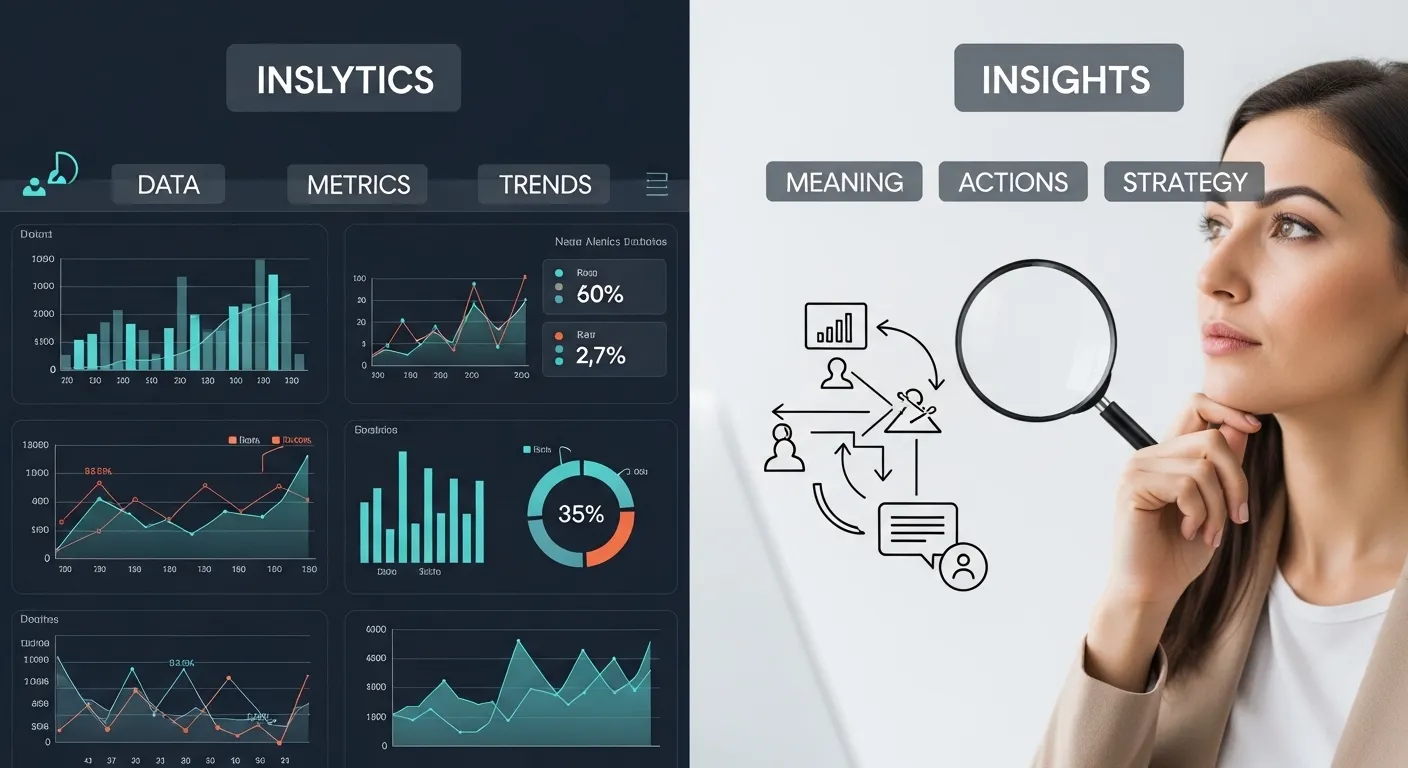
Imagine a small online store owner checking the sales dashboard at the end of the week. The dashboard shows numbers how many visitors came, which products were clicked, and how many purchases were made.
These numbers represent analytics, the systematic process of collecting and analyzing data. But when the owner notices that customers buy more products on weekends and decides to launch weekend promotions, that realization becomes insights.
Understanding the difference between insights and analytics helps people move from raw data to meaningful decisions. In simple terms, analytics organizes and studies data, while insights interpret that data to guide action.
The difference between insights and analytics is essential for businesses, researchers, and digital marketers who rely on data to make smart choices.When we clearly grasp the difference between insights and analytics, we begin to see how data transforms into knowledge and strategy. Ultimately, recognizing the difference between insights and analytics allows individuals and organizations to use information more effectively in real-life situations.
Key Difference Between the Two
Analytics focuses on examining and processing data, while insights focus on understanding the meaning behind that data and deciding what to do next.
Why Is Their Difference Necessary to Know for Learners and Experts?
Knowing the difference between insights and analytics is important for both beginners and professionals in today’s data-driven society. Analytics provides the technical foundation for studying data patterns, while insights convert those patterns into practical knowledge.
For learners, understanding this difference helps them build strong analytical thinking and decision-making skills. For experts in fields like business, marketing, healthcare, and technology, distinguishing analytics from insights ensures that data is not only collected but also used wisely.
In society, data influences almost everything from public policy to online shopping recommendations. Recognizing how analytics produces information and how insights turn that information into meaningful conclusions helps individuals and organizations make better decisions that benefit communities and industries alike.
Pronunciation of the Words
Insights
- US pronunciation: /ˈɪn.saɪts/
- UK pronunciation: /ˈɪn.saɪts/
Analytics
- US pronunciation: /ˌæn.əˈlɪ.tɪks/
- UK pronunciation: /ˌæn.əˈlɪ.tɪks/
Linking Hook
Now that we understand the basic idea, let us explore the difference between insights and analytics in detail through practical comparisons.
Difference Between Insights and Analytics
1. Definition
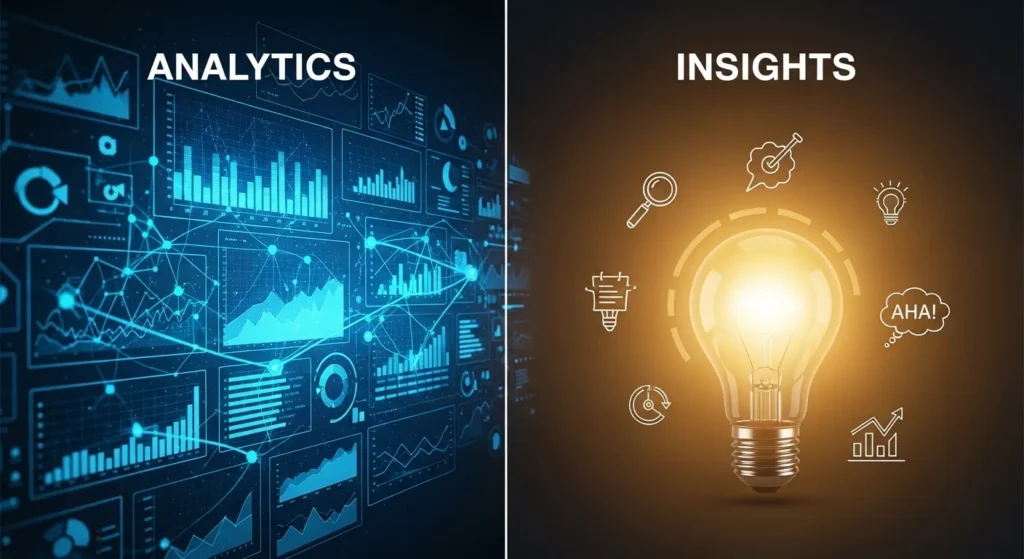
Analytics refers to the process of examining data using tools and methods. Insights refer to the meaningful understanding gained from that analysis.
Examples for Analytics:
- A company studies website traffic data.
- A teacher analyzes student test scores.
Examples for Insights:
- The company realizes that most visitors come from social media.
- The teacher discovers that students struggle more with algebra than geometry.
2. Purpose
Analytics aims to analyze and organize information. Insights aim to explain what the information means.
Analytics Examples:
- Tracking daily website visitors.
- Studying sales numbers for each month.
Insights Examples:
- Recognizing that marketing campaigns increase traffic.
- Realizing that winter sales are higher than summer sales.
3. Nature of Information
Analytics provides raw or processed data. Insights provide interpretation and understanding.
Analytics Examples:
- A report showing 500 visitors per day.
- Data showing 40% conversion rate.
Insights Examples:
- Weekends attract more customers.
- Discounts increase purchase rates.
4. Role in Decision Making
Analytics supports decision-making indirectly. Insights directly influence decisions.
Analytics Examples:
- Graphs of customer age groups.
- Data about product views.
Insights Examples:
- Younger customers prefer digital products.
- Popular items should be restocked.
5. Tools Used
Analytics often requires tools like data software. Insights rely more on human thinking and interpretation.
Analytics Examples:
- Using spreadsheets to analyze sales.
- Running statistical reports.
Insights Examples:
- Understanding customer behavior patterns.
- Creating marketing strategies based on data.
6. Complexity
Analytics can be technical and mathematical. Insights are usually simpler and easier to understand.
Analytics Examples:
- Regression analysis of market trends.
- Statistical modeling.
Insights Examples:
- Customers buy more during holidays.
- Email promotions increase engagement.
7. Output
Analytics produces charts, graphs, and reports. Insights produce conclusions and recommendations.
Analytics Examples:
- A dashboard showing daily sales.
- Monthly performance reports.
Insights Examples:
- Increase advertising in high-performing regions.
- Improve product quality for better ratings.
8. Focus
Analytics focuses on data examination. Insights focus on meaning and implications.
Analytics Examples:
- Measuring website bounce rate.
- Calculating average purchase value.
Insights Examples:
- High bounce rate indicates poor website design.
- Customers prefer bundle offers.
9. Timing
Analytics often happens before insights. Insights appear after analysis.
Analytics Examples:
- Collecting customer survey results.
- Processing sales data.
Insights Examples:
- Customers prefer fast delivery.
- Pricing affects customer loyalty.
10. Value
Analytics creates informational value. Insights create strategic value.
Analytics Examples:
- Data reports for management.
- Monthly statistics.
Insights Examples:
- Launching new products based on trends.
- Changing marketing strategy.
Nature and Behaviour of Both
Insights
Insights are interpretative and strategic. They focus on understanding patterns and guiding decisions.
Analytics
Analytics is systematic and technical. It focuses on collecting, organizing, and studying data.
Why People Are Confused About Their Use
People often confuse these terms because they are closely connected. Analytics produces the information that insights depend on.
In many workplaces, the two terms are used interchangeably even though they serve different purposes. Additionally, modern digital tools often combine analytics dashboards with insights suggestions, making the distinction less obvious.
Table Showing Differences and Similarities
| Aspect | Insights | Analytics | Similarity |
| Definition | Meaning derived from data | Process of analyzing data | Both relate to data |
| Purpose | Guide decisions | Study information | Both support decision-making |
| Nature | Interpretive | Analytical | Both rely on data |
| Output | Conclusions | Reports and charts | Both produce knowledge |
| Focus | Understanding | Examination | Both improve strategies |
Which Is Better in What Situation?
When Analytics Is Better
Analytics is better when large amounts of data must be organized and studied. Businesses rely on analytics tools to track website traffic, customer behavior, and financial performance.
Researchers also depend on analytics to identify patterns in scientific data. Without analytics, raw information would remain scattered and difficult to understand.
When Insights Are Better
Insights are better when decisions must be made. Leaders, marketers, and strategists rely on insights to understand what the data truly means.
For example, recognizing customer preferences or market trends allows organizations to take effective action. Insights transform information into meaningful strategies.
How the Words Are Used in Metaphors and Similes
Insights
- “Her insight was like a flashlight in the dark.”
- “His insight opened a window to new ideas.”
Analytics
- “Analytics works like a microscope for data.”
- “Analytics is the engine that powers data understanding.”
Connotative Meaning
Insights
Connotation: Mostly positive
Examples:
- “Her insights improved the company strategy.”
- “The teacher’s insight helped students succeed.”
Analytics
Connotation: Usually neutral to positive
Examples:
- “The analytics report revealed new trends.”
- “Advanced analytics improved decision making.”
Idioms or Proverbs Related to the Words
- “Read between the lines.”
Meaning: Understand hidden meaning (similar to insight).
Example: The manager read between the lines of the report and found the real problem. - “Numbers don’t lie.”
Meaning: Data shows the truth (similar to analytics).
Example: The analytics results proved the campaign worked.
Works in Literature Containing the Keywords
Insights
- Insight Philosophy / Essay collection, various authors, 20th century
- Gaining Insight Academic psychology writing, 1990s
Analytics
- Competing on Analytics Business book, Thomas H. Davenport, 2007
- Analytics at Work Business management, Thomas H. Davenport, 2010
Movies Related to the Concepts
- Moneyball (2011, USA) focuses on analytics in sports decision making
- The Social Dilemma (2020, USA) explores data analytics and technology influence
- The Big Short (2015, USA) shows financial analysis leading to insights
Frequently Asked Questions
1. What is the main difference between insights and analytics?
Analytics analyzes data, while insights interpret the meaning of that data.
2. Can insights exist without analytics?
Usually insights come after analytics, because insights rely on analyzed data.
3. Why are insights important in business?
Insights help organizations make better decisions based on data patterns.
4. Is analytics a technical skill?
Yes, analytics often involves tools, statistics, and data analysis methods.
5. Which comes first, insights or analytics?
Analytics usually comes first, followed by insights.
How Both Are Useful for Our Surroundings
In modern society, both insights and analytics shape many decisions. Businesses use analytics to track performance and insights to improve products.
Governments analyze data to understand public needs and generate insights for policies. Even individuals use analytics through fitness apps and then gain insights about their health habits.
Final Words for Both
Analytics is the foundation of data understanding, while insights represent the wisdom gained from that foundation. Together, they turn raw information into powerful knowledge.
Conclusion
The difference between insights and analytics lies in their roles within the data process. Analytics focuses on collecting, organizing, and studying data through technical methods.
Insights, on the other hand, interpret that analyzed data and turn it into meaningful conclusions that guide decisions.Both concepts are closely connected and equally valuable in the modern world.
Analytics provides the evidence, while insights provide the understanding needed to act. When individuals and organizations understand the difference between insights and analytics, they can transform numbers into knowledge and knowledge into smart strategies. In a data-driven society, mastering both analytics and insights is essential for informed thinking, innovation, and effective problem solving.

I am E.M. Forster (1879–1970), a renowned English novelist and essayist, famous for A Room with a View, Howards End, and A Passage to India. I explore human relationships, social class, and personal freedom, making my work a key part of 20th-century English literature.