Imagine a small shop owner in a busy market. One day, the government announces a new tax rule.
The shop owner must follow it because it is a law. At the same time, the shop creates its own return policy for customers.
That rule is not made by the government; it is a policy. This simple example explains the difference between law and policy in everyday life.
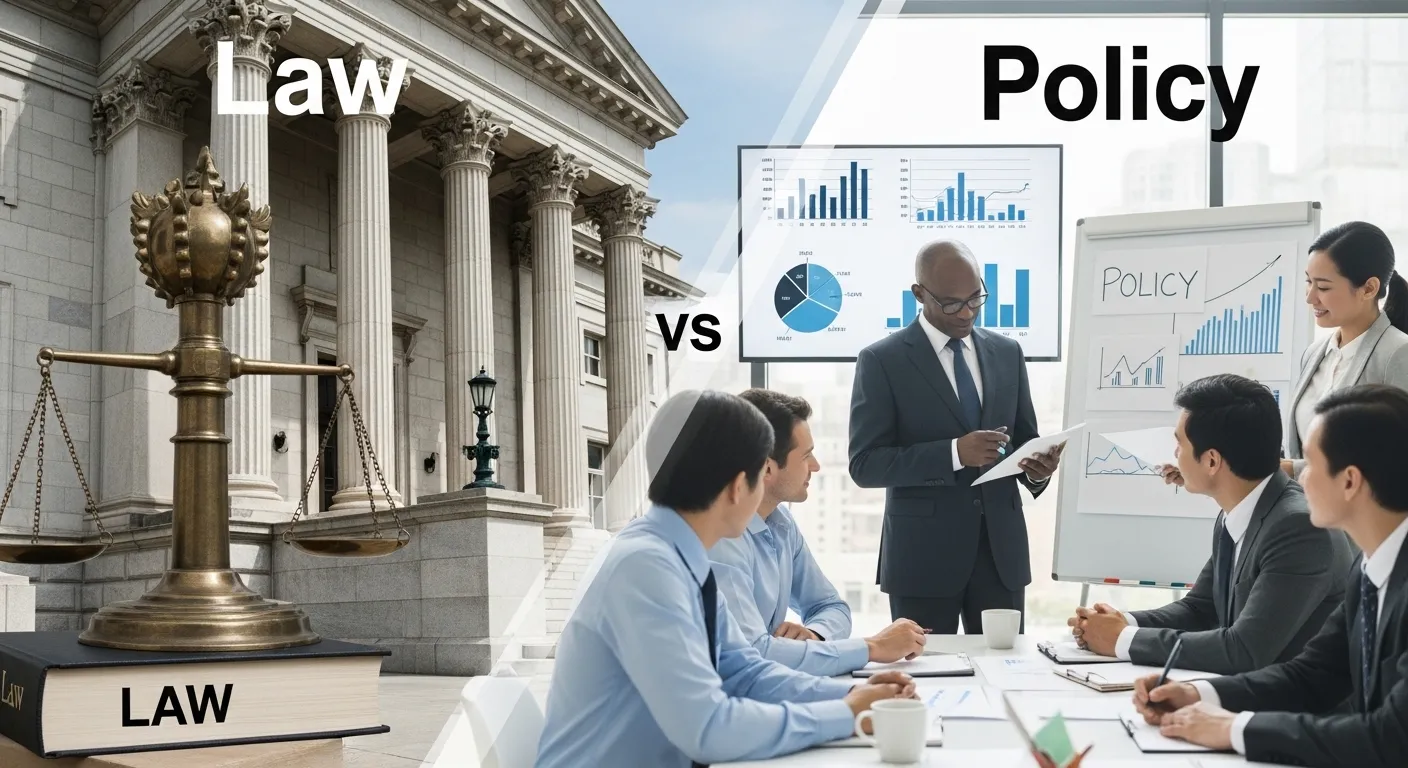
The difference between law and policy becomes clearer when we see that law is enforced by the state, while policy is a plan or guideline created by organizations or governments.
Many students struggle to understand the difference between law and policy because both guide behavior.
However, the difference between law and policy lies in authority, enforcement, and purpose. Understanding the difference between law and policy helps learners and experts make better decisions in society.
Pronunciation (US & UK)
- Law
- US: /lɔː/
- UK: /lɔː/
- US: /lɔː/
- Policy
- US: /ˈpɑː.lə.si/
- UK: /ˈpɒl.ɪ.si/
- US: /ˈpɑː.lə.si/
Before we explore deeper distinctions, let us connect this real-world understanding to structured comparisons that explain their core differences.
Key Difference Between the Both
The main difference is that law is a legally binding rule made by a governing authority, while policy is a plan or guideline designed to achieve certain goals.
Why Is Their Difference Necessary to Know for Learners and Experts?
Understanding this distinction is important in society because:
- It helps citizens know their rights and duties.
- It guides businesses in compliance and planning.
- It supports legal and administrative decision-making.
- It prevents misuse of authority.
- It strengthens democratic systems.
Learners gain clarity in civic studies, while experts such as lawyers, administrators, and policymakers apply this knowledge in professional environments.
Difference Between Law and Policy
1. Authority
Law: Created by a government body such as parliament.
- Example 1: The Constitution of the United States sets national laws.
- Example 2: Traffic laws passed by the Parliament of the United Kingdom.
Policy: Created by organizations or institutions.
- Example 1: A school’s attendance policy.
- Example 2: A company’s privacy policy.
2. Legal Binding Power
Law: Must be obeyed; breaking it leads to punishment.
- Example 1: Not paying taxes can result in fines.
- Example 2: Theft leads to imprisonment.
Policy: May not involve legal punishment.
- Example 1: Violating office dress policy may result in warning.
- Example 2: Ignoring company leave policy may reduce benefits.
3. Enforcement
Law: Enforced by police and courts.
- Example 1: Courts enforce criminal law.
- Example 2: Police enforce traffic law.
Policy: Enforced internally by management.
- Example 1: HR enforces company policies.
- Example 2: School administration enforces exam policy.
4. Scope
Law: Applies to all citizens within a jurisdiction.
- Example 1: National tax laws apply to everyone.
- Example 2: Labor laws apply to all workers.
Policy: Applies only within an organization.
- Example 1: Bank loan policy applies to customers.
- Example 2: Hospital visiting policy applies to visitors.
5. Purpose
Law: Maintains order and justice.
- Example 1: Criminal law prevents crime.
- Example 2: Environmental law protects nature.
Policy: Achieves specific goals.
- Example 1: Education policy improves literacy.
- Example 2: Company growth policy increases profit.
6. Flexibility
Law: Difficult to change.
- Example 1: Constitutional amendments require special process.
- Example 2: Legislative approval is needed for change.
Policy: Easier to modify.
- Example 1: Company updates policy yearly.
- Example 2: School changes grading policy.
7. Creation Process
Law: Passed through legislative procedure.
- Example 1: Bill debated in parliament.
- Example 2: Signed by president or monarch.
Policy: Drafted by administrators.
- Example 1: Company board drafts policy.
- Example 2: Ministry prepares education policy.
8. Penalty
Law: Legal punishment.
- Example 1: Fine or jail.
- Example 2: Court order.
Policy: Organizational consequences.
- Example 1: Suspension.
- Example 2: Termination.
9. Public vs Private
Law: Public rule.
- Example 1: Civil law affects citizens.
- Example 2: Criminal law protects society.
Policy: Can be private.
- Example 1: Company refund policy.
- Example 2: NGO funding policy.
10. Examples in Real Life
Law: Speed limit law.
- Example 1: 60 mph rule.
- Example 2: Helmet law for bikers.
Policy: Office remote work policy.
- Example 1: Work-from-home rule.
- Example 2: Flexible timing policy.
Nature and Behaviour
Law is strict, formal, and compulsory. It reflects authority and justice.
Policy is strategic, flexible, and goal-oriented. It reflects planning and management.
Why Are People Confused?
People confuse them because both regulate behavior. Government policies can also lead to laws, which makes the difference less visible.
Table Showing Difference and Similarity
| Feature | Law | Policy | Similarity |
| Authority | Government | Organization/Government | Both guide behavior |
| Enforcement | Courts/Police | Management | Both have consequences |
| Scope | Public | Limited | Both regulate actions |
| Flexibility | Rigid | Flexible | Both can change |
| Purpose | Justice & Order | Goals & Plans | Both shape society |
Which Is Better in What Situation?
Law is better when society needs strict order and equal enforcement.
For example, criminal activities require legal punishment to protect citizens. Laws ensure fairness and justice across the nation.
Policy is better when organizations need flexibility and strategic planning.
For example, businesses require policies to manage employees, customers, and internal systems without court involvement.
Metaphors and Similes
- Law is like a strong wall protecting society.
- Policy is like a roadmap guiding an organization.
Connotative Meanings
Law
- Positive: Justice, protection (Example: “The law saved the innocent.”)
- Negative: Strictness, fear (Example: “He feared the law.”)
- Neutral: Rule (Example: “The law was updated.”)
Policy
- Positive: Planning, strategy (Example: “The policy improved education.”)
- Negative: Bureaucracy (Example: “The policy delayed action.”)
- Neutral: Guideline (Example: “Company policy requires ID.”)
Idioms and Proverbs
- “The law of the land” Example: Citizens must respect the law of the land.
- “Lay down the law” Example: The manager laid down the law about deadlines.
- “Honesty is the best policy” Example: He admitted his mistake because honesty is the best policy.
Works in Literature
- Bleak House Novel by Charles Dickens (1853) Genre: Social criticism (focus on legal system).
- The Republic By Plato (c. 380 BC) Genre: Philosophy (discussion of justice and governance).
Movies Related to Law and Policy
- A Few Good Men 1992, USA
- The Trial 1962, France/Italy
FAQs
1. Is policy a law?
No, policy is a guideline; law is legally binding.
2. Can policy become law?
Yes, government policies may later become laws.
3. Who enforces laws?
Courts and police.
4. Who creates policies?
Organizations or government departments.
5. Why is understanding the difference important?
It helps in legal awareness and organizational management.
How Both Are Useful for Surroundings
Law maintains safety and justice in society. Policy improves management and progress in institutions. Together, they create organized and balanced communities.
Final Words for the Both
Law ensures order and justice. Policy ensures planning and growth. Both are essential pillars of a structured society.
Conclusion
Understanding the difference between law and policy is essential for responsible citizenship and professional growth.
Law represents authority, justice, and enforcement backed by the state. Policy represents strategy, planning, and organizational direction.
While laws protect society and maintain order, policies guide institutions toward achieving specific goals. Confusion arises because both regulate behavior, yet their authority and enforcement differ greatly.
In modern society, both law and policy work together to create stability and development. By recognizing their unique roles, learners and experts can make informed decisions and contribute positively to social systems.

I am E.M. Forster (1879–1970), a renowned English novelist and essayist, famous for A Room with a View, Howards End, and A Passage to India. I explore human relationships, social class, and personal freedom, making my work a key part of 20th-century English literature.