Imagine you are getting ready for work and suddenly feel a soft lump under your skin. It does not hurt, but it feels unusual. Naturally, you worry.
Is it serious? Is it dangerous? Many people in real life face this situation and start searching for the difference between lipoma and cyst.
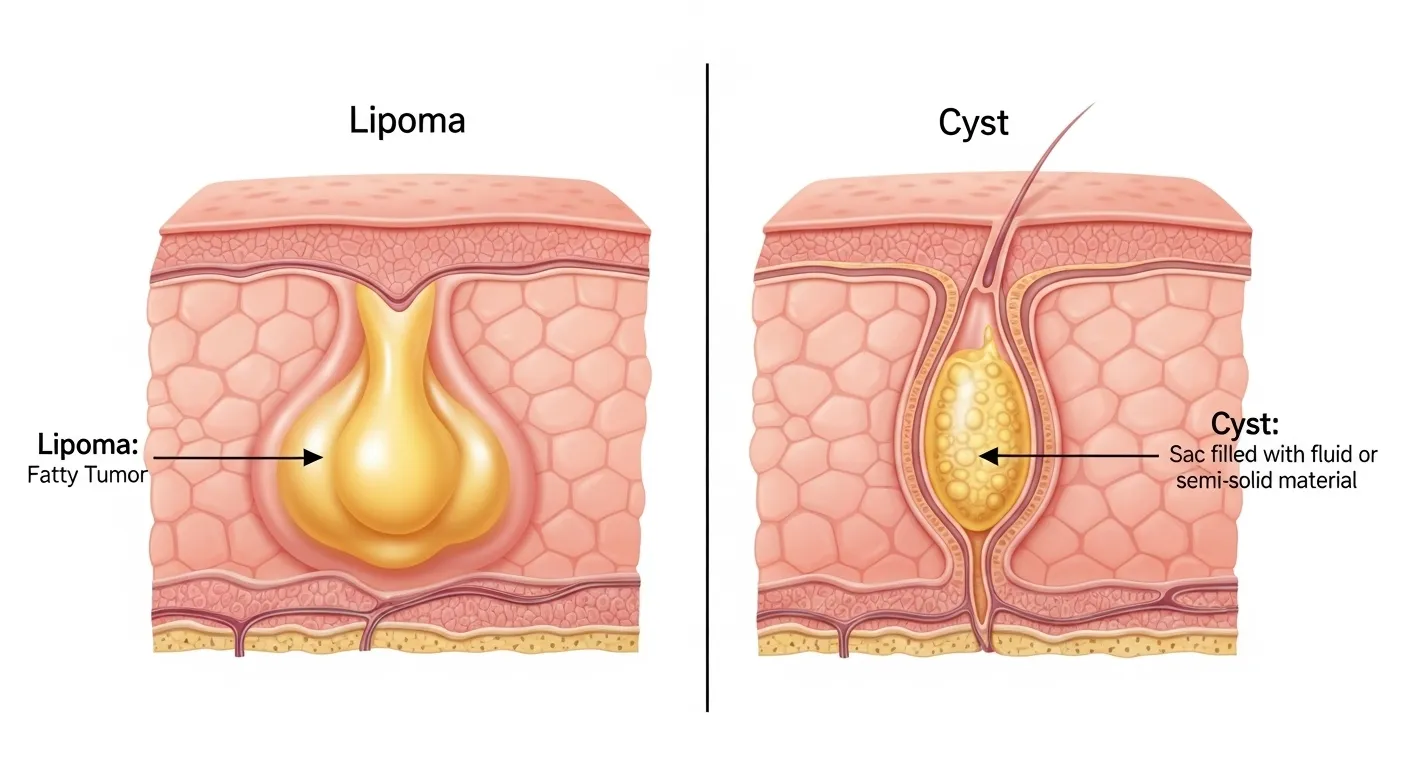
A lipoma is a slow-growing, soft lump made of fat cells. A cyst is a closed sac under the skin filled with fluid, pus, or other material.
Understanding the difference between lipoma and cyst helps reduce fear and confusion. Doctors often explain the difference between lipoma and cyst to patients to guide proper treatment.
Knowing the difference between lipoma and cyst can prevent unnecessary panic and wrong self-diagnosis.Before we explore deeper, let’s first understand how these two conditions truly differ in medical and social understanding.
Pronunciation (US & UK)
- Lipoma
- US: lie-POH-muh
- UK: ly-POH-muh
- US: lie-POH-muh
- Cyst
- US: sist
- UK: sist
- US: sist
Key Difference Between the Both
The main difference is simple:
- A lipoma is made of fat tissue.
- A cyst is a sac filled with fluid, pus, or semi-solid material.
Lipomas are usually soft and movable. Cysts may feel firm and sometimes painful.
Why Is Their Difference Necessary to Know for Learners and Experts?
Understanding the difference is important because:
- It prevents unnecessary fear about cancer.
- It helps doctors choose the right treatment.
- It improves public health awareness.
- It avoids wrong home remedies.
- It supports early medical consultation.
In society, health education reduces myths and promotes informed decisions. For medical students and healthcare experts, correct identification ensures safe and effective care.
Difference Between Lipoma and Cyst
Below are 10 clear points explaining their differences.
1. Composition
- Lipoma: Made of fat cells.
- Example 1: A soft fatty lump on the shoulder.
- Example 2: A movable mass under the arm.
- Example 1: A soft fatty lump on the shoulder.
- Cyst: Filled with fluid or pus.
- Example 1: A pimple-like swelling on the face.
- Example 2: A fluid-filled lump on the scalp.
- Example 1: A pimple-like swelling on the face.
2. Texture
- Lipoma: Soft and dough-like.
- Example 1: Feels like rubber under skin.
- Example 2: Moves easily when touched.
- Example 1: Feels like rubber under skin.
- Cyst: Firmer or tense.
- Example 1: Feels tight and round.
- Example 2: Skin may stretch over it.
- Example 1: Feels tight and round.
3. Pain Level
- Lipoma: Usually painless.
- Example 1: Found accidentally.
- Example 2: No discomfort while pressing.
- Example 1: Found accidentally.
- Cyst: Can be painful if infected.
- Example 1: Red and swollen lump.
- Example 2: Pain when touched.
- Example 1: Red and swollen lump.
4. Growth Speed
- Lipoma: Slow growing.
- Example 1: Grows over years.
- Example 2: Remains stable long-term.
- Example 1: Grows over years.
- Cyst: Can grow faster.
- Example 1: Swells within weeks.
- Example 2: Suddenly increases in size.
- Example 1: Swells within weeks.
5. Cause
- Lipoma: Often genetic.
- Example 1: Family history present.
- Example 2: Appears without infection.
- Example 1: Family history present.
- Cyst: Blocked glands or infection.
- Example 1: Acne-related blockage.
- Example 2: Skin trauma causes cyst.
- Example 1: Acne-related blockage.
6. Movement
- Lipoma: Easily movable.
- Example 1: Slides under skin.
- Example 2: Changes position slightly.
- Example 1: Slides under skin.
- Cyst: Less movable.
- Example 1: Fixed in one spot.
- Example 2: Attached to the skin surface.
- Example 1: Fixed in one spot.
7. Risk Level
- Lipoma: Rarely dangerous.
- Example 1: Usually benign.
- Example 2: Cancer risk is very low.
- Example 1: Usually benign.
- Cyst: May get infected.
- Example 1: Pus formation.
- Example 2: Fever in severe cases.
- Example 1: Pus formation.
8. Treatment
- Lipoma: Surgery if large.
- Example 1: Cosmetic removal.
- Example 2: Removal due to pressure.
- Example 1: Cosmetic removal.
- Cyst: Draining or antibiotics.
- Example 1: Incision and drainage.
- Example 2: Medicine for infection.
- Example 1: Incision and drainage.
9. Appearance
- Lipoma: Normal skin color.
- Example 1: No redness.
- Example 2: Smooth surface.
- Example 1: No redness.
- Cyst: May be red.
- Example 1: Inflamed skin.
- Example 2: Visible central spot.
- Example 1: Inflamed skin.
10. Recurrence
- Lipoma: Rare after removal.
- Example 1: Complete excision.
- Example 2: Does not return commonly.
- Example 1: Complete excision.
- Cyst: May return if sac remains.
- Example 1: Incomplete drainage.
- Example 2: Repeated infection.
- Example 1: Incomplete drainage.
Nature and Behaviour
Lipoma:
Lipomas are benign and slow. They stay under the skin and rarely cause harm. They are calm in behavior and usually cosmetic issues only.
Cyst:
Cysts can become inflamed or infected. Their behavior depends on the cause. Some remain harmless, while others require treatment.
Why Are People Confused About Their Use?
- Both appear as lumps under the skin.
- Both are usually non-cancerous.
- Both may require minor surgery.
- Both can look similar externally.
Lack of medical knowledge increases confusion.
Table Showing Difference and Similarity
| Feature | Lipoma | Cyst | Similarity |
| Content | Fat | Fluid/Pus | Both are lumps |
| Pain | Usually painless | May hurt | Can be painless initially |
| Growth | Slow | Variable | Grow over time |
| Risk | Rarely serious | May infect | Usually benign |
| Treatment | Surgical removal | Drainage/Medicine | Minor procedures |
Which Is Better in What Situation?
A lipoma is “better” when compared in terms of risk because it rarely becomes infected and usually does not cause pain.
If a lump is soft, painless, and slow-growing, it may simply need observation. In such cases, patients feel less anxiety and often avoid urgent procedures.
A cyst may be manageable if treated early, especially when infection is controlled quickly.
However, infected cysts can cause discomfort. In situations where a cyst is small and not inflamed, it may resolve or remain harmless for years.
Metaphors and Similes
- “The lipoma sat under the skin like a soft pillow.”
- “The cyst swelled like a water balloon ready to burst.”
Connotative Meaning
- Lipoma Neutral (medical term).
- Example: “The diagnosis of lipoma brought relief.”
- Example: “The diagnosis of lipoma brought relief.”
- Cyst Slightly negative (associated with infection).
- Example: “She feared the painful cyst on her neck.”
- Example: “She feared the painful cyst on her neck.”
Idioms or Proverbs (Used Creatively)
While no direct idioms exist, we can relate:
- “A small lump can hide a big worry.”
- Example: Even a tiny cyst can cause anxiety.
- Example: Even a tiny cyst can cause anxiety.
- “Better safe than sorry.”
- Example: Check a lipoma early to avoid complications.
- Example: Check a lipoma early to avoid complications.
Works in Literature
(These terms appear in medical and non-fiction genres)
- Clinical Dermatology Medical Textbook, Thomas P. Habif, 2015
- Robbins Basic Pathology Medical Education, Kumar & Clark, 2017
Movies Related to Medical Conditions
(No major films specifically titled Lipoma or Cyst, but medical-themed films include:)
- Patch Adams 1998, USA
- The Doctor 1991, USA
Five Frequently Asked Questions
1. Is a lipoma cancerous?
No, it is usually benign.
2. Can a cyst burst?
Yes, especially if infected.
3. Do lipomas hurt?
Mostly no, unless pressing on nerves.
4. Should I remove a cyst?
If painful or infected, yes.
5. Can both appear anywhere?
Yes, but commonly on the neck, back, and shoulders.
How Both Are Useful for Surroundings
Though medical conditions, studying them helps improve public awareness, medical research, and early diagnosis systems. Health knowledge benefits communities.
Final Words for Both
Lipoma represents calm, slow growth and low risk.
Cyst represents caution, possible infection, and variable behavior.
Both require proper diagnosis by healthcare professionals.
Conclusion
Understanding the difference between lipoma and cyst is essential for personal health awareness.
While both appear as lumps under the skin, they differ in composition, risk, and treatment. Lipomas are fatty, slow-growing, and mostly harmless.
Cysts are fluid-filled and may become painful if infected. Recognizing these differences reduces unnecessary fear and promotes timely medical advice.
Whether you are a learner, healthcare expert, or general reader, knowing these distinctions supports better health decisions and community awareness.

I am D. H. Lawrence (David Herbert Lawrence) an influential English novelist, poet, essayist, and literary critic born on September 11, 1885, in Eastwood, Nottinghamshire, England. He is widely regarded as one of the most important writers of the 20th century.
I work often explored human relationships, emotional intimacy, industrialization, and the conflict between modern society and natural instincts.