Imagine you buy a new coffee machine. The instruction manual gives you a method step-by-step directions to brew coffee.
But inside the machine, there is a small programmed function that actually heats the water and pours it correctly. In everyday life, we follow a method to complete a task, while machines and software rely on functions to perform specific actions.
Understanding the difference between method and function is essential in both daily communication and programming. The difference between method and function often confuses students because both words relate to action and process.
However, the difference between method and function becomes clear when we see that one is about procedure and the other about operation. Learning the difference between both words helps learners and professionals communicate clearly and think logically.
Pronunciation
- Method
- US: /ˈmeθ.əd/
- UK: /ˈmeθ.əd/
- US: /ˈmeθ.əd/
- Function
- US: /ˈfʌŋk.ʃən/
- UK: /ˈfʌŋk.ʃən/
- US: /ˈfʌŋk.ʃən/
Before we explore deeper comparisons, let’s connect these meanings to practical understanding.
Key Difference Between the Both
A method is a planned way or procedure to do something.
A function is a specific action or purpose that something performs.
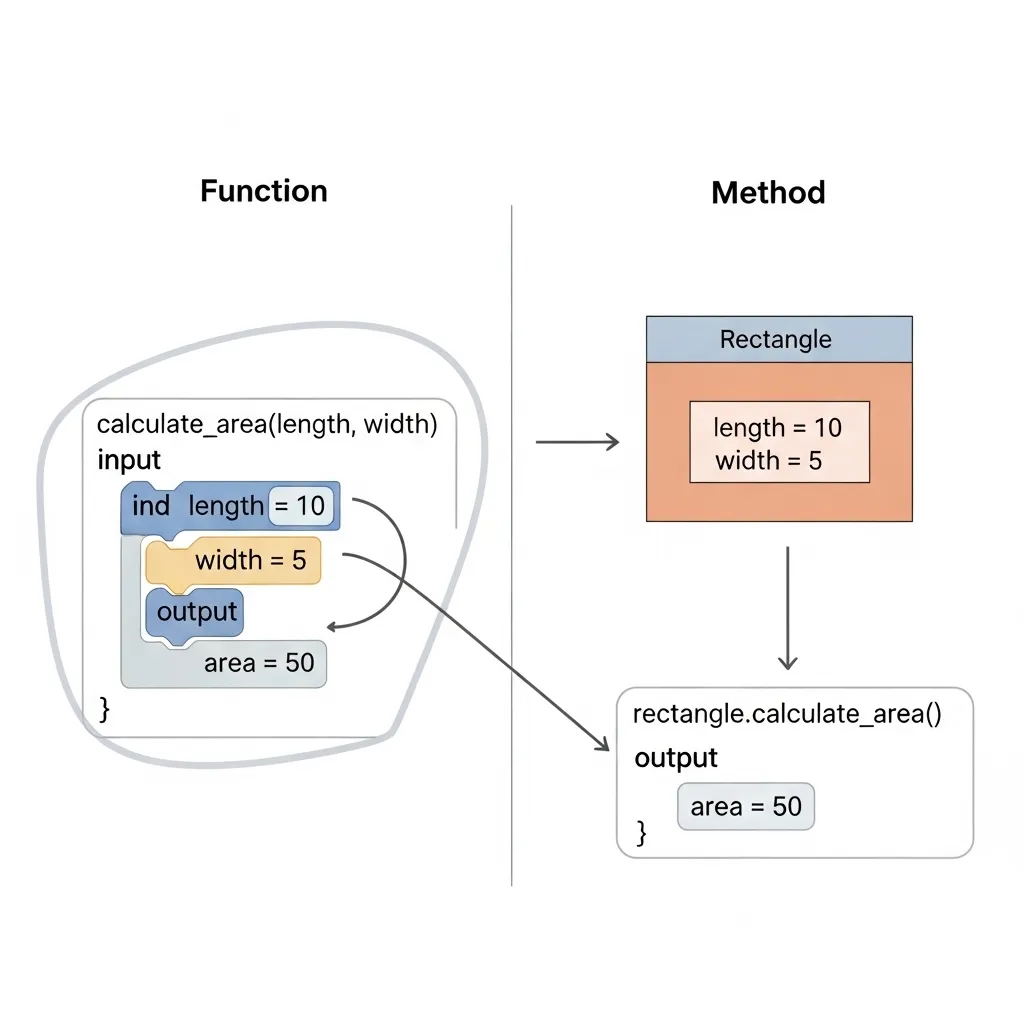
In programming, a method usually belongs to an object, while a function can stand alone. In daily language, a method is about “how,” and a function is about “what.”
Why Is Their Difference Necessary to Know for Learners and Experts?
Understanding the difference between method and function improves clarity in communication, education, science, and technology.
For learners, it strengthens logical thinking and writing skills.
For experts like software developers, engineers, and researchers, it prevents misunderstanding in technical documentation and teamwork.
In society, clear methods lead to organized systems (education, healthcare), while clear functions ensure efficient operations (machines, software, institutions). Knowing the distinction supports better innovation and structured problem-solving.
Difference Between Method and Function
1. Meaning
Method: A procedure or way of doing something.
Function: A specific task or role performed.
Method Examples:
- The teacher explained a new method of solving equations.
- She used a simple cooking method.
Function Examples:
- The function of the heart is to pump blood.
- This button’s function is to start the machine.
2. Focus
Method: Focuses on process.
Function: Focuses on result or purpose.
Method Examples:
- His study method improved his grades.
- The cleaning method saved time.
Function Examples:
- The function of the brake is to stop the car.
- This app’s function is to track steps.
3. Usage in Programming
Method: Belongs to an object or class.
Function: Can exist independently.
Method Examples:
- In Java, methods belong to classes.
- The object calls its own method.
Function Examples:
- A function in C can exist outside classes.
- Python allows standalone functions.
4. Nature
Method: Systematic and structured.
Function: Operational and purposeful.
Method Examples:
- Scientific method follows steps.
- Meditation method requires routine.
Function Examples:
- The function of lungs is breathing.
- A phone’s function includes calling.
5. Flexibility
Method: Can vary depending on approach.
Function: Usually fixed in purpose.
Method Examples:
- Different teaching methods exist.
- Farmers use various planting methods.
Function Examples:
- The function of a key is unlocking.
- The function of a battery is storing energy.
6. Field of Use
Method: Common in education, science, daily tasks.
Function: Common in biology, mathematics, technology.
Method Examples:
- Research method matters in studies.
- Workout methods improve fitness.
Function Examples:
- In math, a function links input and output.
- In biology, organ function is essential.
7. Relationship with Objects
Method: Connected to a subject performing action.
Function: Describes role of something.
Method Examples:
- Her learning method suits her style.
- The artist’s painting method is unique.
Function Examples:
- The function of government is governance.
- The function of wheels is movement.
8. Abstract vs Practical
Method: Often abstract planning.
Function: Practical execution.
Method Examples:
- The planning method affects success.
- Writing method shapes creativity.
Function Examples:
- Alarm function wakes you up.
- The camera function captures photos.
9. In Mathematics
Method: Way to solve a problem.
Function: Mathematical relation between variables.
Method Examples:
- Use a substitution method.
- Apply elimination method.
Function Examples:
- f(x) = x² is a function.
- The function shows growth rate.
10. Dependency
Method: May depend on the situation.
Function: Usually inherent purpose.
Method Examples:
- The cooking method depends on the recipe.
- The teaching method depends on students.
Function Examples:
- The function of eyes is seeing.
- The function of software is processing data.
Sea vs Ocean: What’s the Real Difference?
Nature and Behaviour
A method behaves like a guide. It is adaptable and can change with circumstances.
A function behaves like a performer. It executes a specific role consistently.
Why Are People Confused?
People confuse them because both involve action. In programming, the terms overlap. In daily language, both seem similar because they relate to tasks and performance.
Table: Difference and Similarity Between Method and Function
| Aspect | Method | Function | Similarity |
| Meaning | Procedure | Purpose/Role | Both relate to action |
| Focus | How | What | Both describe tasks |
| Programming | Part of object | Independent | Used in coding |
| Flexibility | Variable | Fixed role | Help achieve goals |
| Usage | Education & science | Tech & biology | Improve systems |
Which Is Better in What Situation?
A method is better when planning or organizing tasks. For example, in education, choosing the right teaching method improves learning results.
In research, using a scientific method ensures accurate conclusions. When creativity or flexibility is needed, methods provide multiple approaches.
A function is better when defining clear roles or technical operations. In programming, functions make code reusable and efficient. In biology or mechanics, understanding function explains how systems work. When precision and specific action are required, function is more suitable.
Use in Metaphors and Similes
- “Success is a method, not magic.”
- “Her brain functions like a computer.”
- “Life has its own method of teaching lessons.”
Connotative Meaning
Method – Neutral to positive (organized, systematic).
- Positive: “She has a smart method.”
- Negative: “His method is too rigid.”
Function – Neutral (technical, practical).
- Positive: “The function works perfectly.”
- Negative: “The system failed to function.”
Idioms or Proverbs
- “There is a method in the madness.”
- Example: His strange schedule has a method in the madness.
- Example: His strange schedule has a method in the madness.
- “Form follows function.”
- Example: In architecture, form follows function.
- Example: In architecture, form follows function.
Works in Literature
- “Discourse on Method” (Philosophy, René Descartes, 1637)
- “The Function of Criticism at the Present Time” (Essay, Matthew Arnold, 1864)
Movies Related to the Keywords
- The Method (2005, Spain)
- The Function of the Orgasm (1957, USA)
Alternator vs Starter: Understanding the Real Difference
FAQs
1. Is a method the same as a function?
No. A method is a procedure; a function is a role or action.
2. Can a function be a method?
In programming, yes. A method is a type of function linked to an object.
3. Which term is older?
Both come from Latin roots but developed differently in English.
4. Why do programmers use both terms?
To show whether code belongs to an object or stands alone.
5. Is method more general than function?
Yes, the method applies to broader contexts.
How Both Are Useful for Surroundings
Methods create structured systems in schools, hospitals, and businesses.
Functions ensure machines, technology, and organs operate properly.
Final Words for Both
A method guides the path.
A function performs the purpose.
Conclusion
Alternator vs Starter: Understanding the Real Difference
The difference between method and function lies in procedure versus purpose. A method explains how something is done, while a function defines what something does. Both words are powerful in daily life, education, mathematics, and programming.
Understanding their distinction improves clarity, communication, and critical thinking. When you choose the right word, you express ideas more accurately. Whether solving a math problem or writing code, knowing the both words helps you work smarter and communicate better.

I am D. H. Lawrence (David Herbert Lawrence) an influential English novelist, poet, essayist, and literary critic born on September 11, 1885, in Eastwood, Nottinghamshire, England. He is widely regarded as one of the most important writers of the 20th century.
I work often explored human relationships, emotional intimacy, industrialization, and the conflict between modern society and natural instincts.