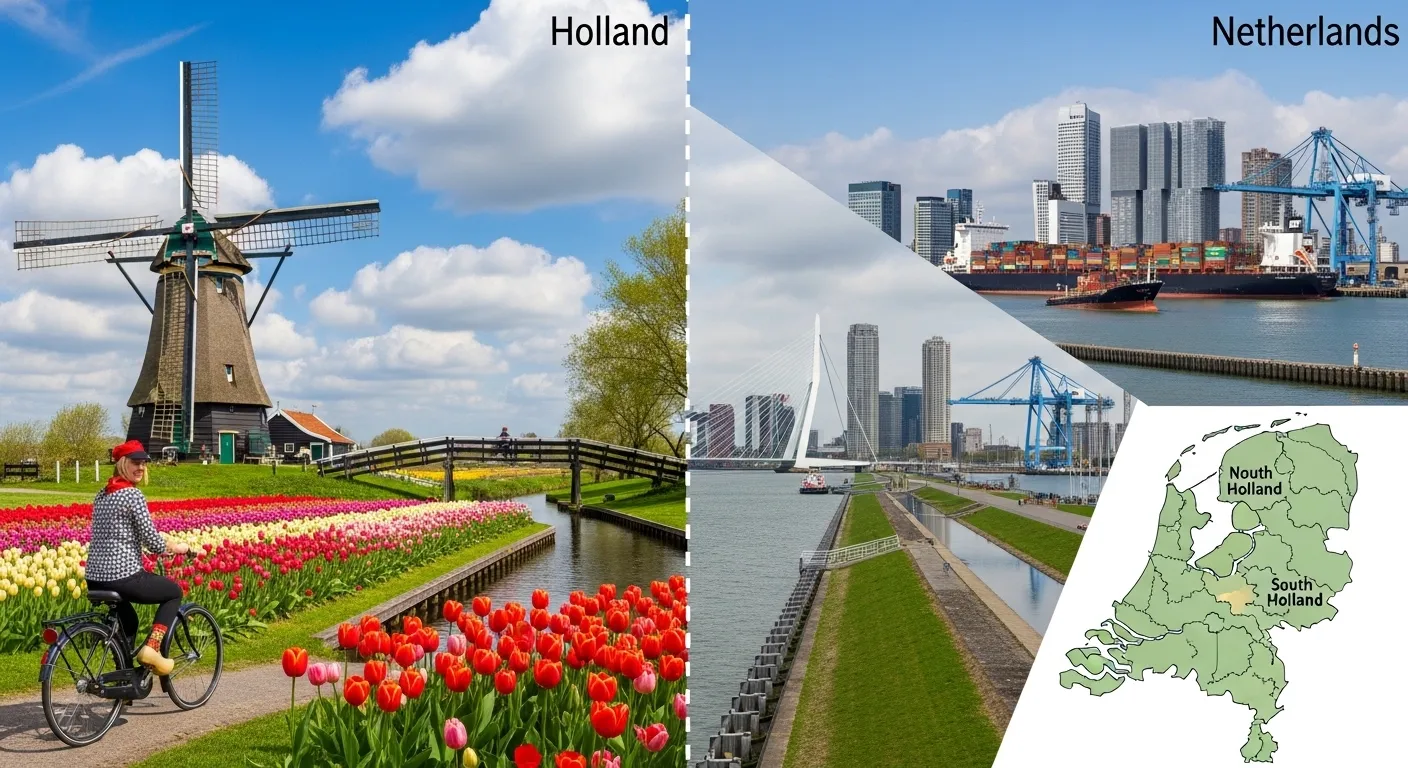
Imagine a traveler planning a trip to Europe. While booking tickets, he tells his friend he is visiting “Holland.” Later, someone corrects him and says the country’s official name is the Netherlands, not Holland. This small moment reflects a common confusion.
Many people use the terms interchangeably, but they are not exactly the same.The difference between Netherlands and Holland lies mainly in geography and historical usage. The Netherlands is the official country, while Holland refers only to a specific region inside that country. Yet, globally, the term Holland is often used casually to describe the whole nation.
Understanding the difference between Netherlands and Holland helps travelers, students, and researchers communicate more accurately. In fact, the difference between Netherlands and Holland also reflects historical, cultural, and political developments. Learning the difference between Netherlands and Holland clears a common misunderstanding in geography and international discussions.
Key Difference Between the Both
The Netherlands is the official sovereign country in Western Europe.
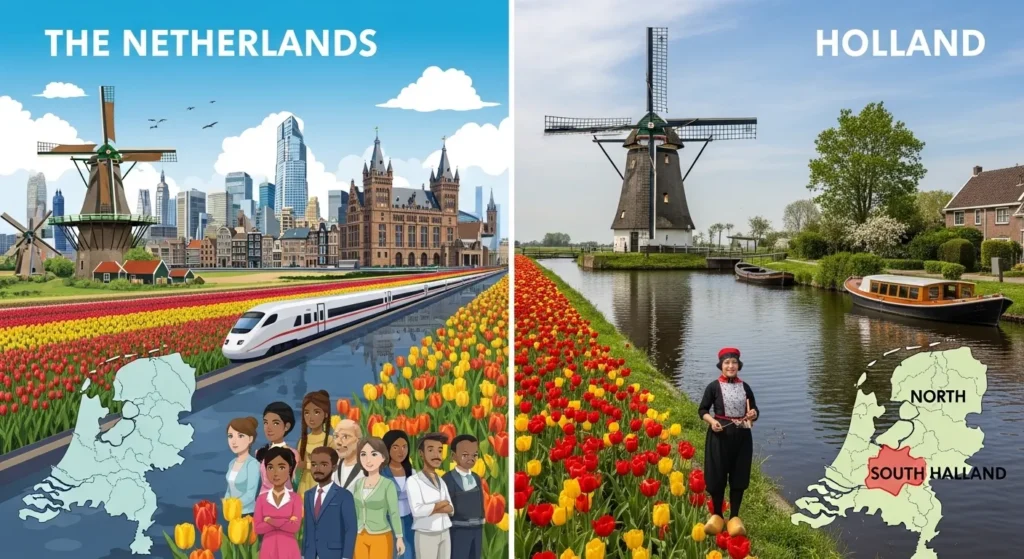
Holland, on the other hand, refers specifically to two provinces within the Netherlands: North Holland and South Holland.
Why Is Their Difference Necessary to Know for Learners and Experts?
Understanding the difference between the Netherlands and Holland is important in education, journalism, geography, and diplomacy. Scholars and researchers must use the correct term to maintain accuracy in academic discussions.
For example, when discussing the country’s government, economy, or international relations, the correct term is the Netherlands. However, Holland may appear in historical references or cultural discussions related to specific regions. Knowing this difference prevents misinformation and helps maintain clarity in global communication.
Pronunciation
Netherlands
- US: /ˈneðərləndz/
- UK: /ˈneðələndz/
Holland
- US: /ˈhɑːlənd/
- UK: /ˈhɒlənd/
Linking Hook
Now that we understand the basic idea behind these two terms, let’s explore the difference between Netherlands and Holland in detail through clear and practical comparisons.
Difference Between Netherlands and Holland
1. Official Status
Netherlands:
It is the official name of the country.
Examples:
- The government of the Netherlands operates from The Hague.
- The Netherlands participates in global organizations such as the European Union.
Holland:
It is only a regional term within the Netherlands.
Examples:
- North Holland is home to Amsterdam.
- South Holland includes major cities like Rotterdam.
2. Geographic Coverage
Netherlands:
The entire country consists of 12 provinces.
Examples:
- The Netherlands includes provinces like Friesland and Limburg.
- The country stretches across Western Europe along the North Sea coast.
Holland:
Only two provinces.
Examples:
- North Holland contains Amsterdam.
- South Holland contains Rotterdam.
3. Historical Meaning
Netherlands:
Refers historically to “low lands.”
Examples:
- Much of the land lies below sea level.
- The name reflects the country’s geography.
Holland:
Historically the most powerful region.
Examples:
- It dominated trade during the Dutch Golden Age.
- Merchants from Holland influenced global trade.
4. Political Identity
Netherlands:
Used in official political contexts.
Examples:
- International treaties use the Netherlands.
- Diplomatic relations refer to the Netherlands.
Holland:
Not used officially in government.
Examples:
- It appears in informal speech.
- It may appear in tourism promotions.
5. Population Coverage
Netherlands:
Represents the entire population.
Examples:
- Citizens across all provinces are Dutch nationals.
- Policies apply nationwide.
Holland:
Represents only part of the population.
Examples:
- People living in North Holland are residents of Holland.
- Residents of other provinces are not from Holland.
6. Cultural Representation
Netherlands:
Represents national culture.
Examples:
- Dutch traditions belong to the Netherlands.
- National holidays represent the entire country.
Holland:
Represents regional culture.
Examples:
- Certain traditions are specific to Holland.
- Local dialects exist in the region.
7. International Use
Netherlands:
Preferred in official communication.
Examples:
- International organizations use the Netherlands.
- Diplomatic meetings refer to the Netherlands.
Holland:
Used casually worldwide.
Examples:
- Tourists often say they are visiting Holland.
- Sports fans sometimes use Holland for the national team.
8. Economic Influence
Netherlands:
Represents the country’s full economy.
Examples:
- Agriculture and technology sectors exist nationwide.
- Trade occurs across several ports.
Holland:
Historically the economic center.
Examples:
- Rotterdam is one of Europe’s largest ports.
- Amsterdam is a financial hub.
9. Tourism Branding
Netherlands:
Official tourism branding increasingly uses this name.
Examples:
- Government campaigns promote the Netherlands.
- Tourism boards encourage accurate naming.
Holland:
Historically used for marketing.
Examples:
- Old tourism slogans used Holland.
- Many travel guides still mention Holland.
10. Language Context
Netherlands:
Formal and accurate.
Examples:
- Used in academic writing.
- Used in official documents.
Holland:
Informal or traditional.
Examples:
- Used in everyday conversations.
- Often used in sports commentary.
Nature and Behaviour of Both
Netherlands:
Represents a complete nation with political authority, diverse culture, and international relations.
Holland:
Represents a historical and geographic region that influenced the country’s development.
Why People Are Confused About Their Use
The confusion exists because Holland historically dominated trade and politics in the country. As a result, foreigners began using the term Holland to represent the entire Netherlands. Over time, the habit spread through tourism, media, and sports.
Difference and Similarity Table
| Aspect | Netherlands | Holland | Similarity |
| Status | Official country | Region | Both refer to parts of the same nation |
| Geography | 12 provinces | 2 provinces | Located in Western Europe |
| Usage | Formal | Informal | Often used interchangeably |
| Politics | Official government | No political identity | Same national culture |
| International recognition | Correct term globally | Common nickname | Associated with Dutch identity |
Which Is Better in What Situation?
Netherlands
The Netherlands is better in official, academic, and professional contexts. It provides clarity and accuracy when discussing geography, politics, and international relations. Scholars, journalists, and diplomats prefer this term because it represents the entire country without confusion.
Holland
Holland is often used in casual conversations, tourism marketing, and sports commentary. While it is not technically accurate for the whole country, many people still recognize it easily, making it useful in informal communication.
Use in Metaphors and Similes
Sometimes these terms appear metaphorically.
Examples:
- “He defended his company like Holland defended its dikes.”
- “Her strategy was as precise as Dutch engineering in the Netherlands.”
Connotative Meaning
Netherlands
- Positive: Innovation, sustainability, windmills.
Example: “The Netherlands symbolizes smart water management.”
Holland
- Neutral to positive: Traditional Dutch culture.
Example: “Holland often evokes images of tulips and canals.”
Idioms or Proverbs Related
Although no direct idioms exist, cultural references appear:
Example sentences:
- “Like Dutch engineers, they solved the flooding problem quickly.”
- “A strategy as organized as Dutch canals.”
Works in Literature
- The Diary of a Young Girl Memoir Anne Frank 1947 (set in the Netherlands)
- The Black Tulip Historical novel Alexandre Dumas 1850
Movies Related
- The Diary of Anne Frank 1959 USA
- Black Book 2006 Netherlands
Frequently Asked Questions
1. Is Holland the same as the Netherlands?
No. Holland refers only to two provinces, while the Netherlands is the entire country.
2. Why do people say Holland instead of Netherlands?
Because Holland historically dominated trade and became widely known internationally.
3. Is it wrong to say Holland?
It is not completely wrong, but it is less accurate.
4. How many provinces are in the Netherlands?
The Netherlands has 12 provinces.
5. Which term should I use officially?
Use the Netherlands in formal contexts.
How Both Are Useful for Surroundings
The Netherlands represents national governance, infrastructure, and global cooperation. Holland represents regional identity and cultural heritage. Together, they reflect the historical and modern identity of the Dutch nation.
Final Words for Both
The Netherlands represents the full nation, while Holland highlights an important historical region within it. Both terms are connected but should be used appropriately.
Conclusion
The difference between Netherlands and Holland may seem small, but it reflects a significant geographic and historical distinction.
The Netherlands is the official country, made up of multiple provinces and recognized worldwide in political and academic contexts.Holland, however, refers specifically to two provinces that once held great economic power.
Because these regions were historically influential, the term Holland became widely used to represent the entire nation. Understanding this difference improves geographical accuracy and helps avoid confusion in communication. Whether discussing history, travel, or global affairs, using the correct term shows a clearer understanding of the country and its regional identity.

I am David, a passionate blog writer who loves creating informative and easy-to-understand content. I write articles that explain the difference between common topics, language concepts, and everyday knowledge. My goal is to help readers learn new things in a simple and clear way. Through research and practical examples, I try to provide useful and reliable information for students, learners, and curious readers around the world.