Last week, my friend bought a new USB drive to transfer a large video file from his laptop to his TV. When he tried copying the 8GB file, an error appeared. He was confused.
The problem was not the USB itself, but the file system NTFS or FAT32. This real-life example clearly shows why understanding the difference between NTFS and FAT32 is important.
The difference between NTFS and FAT32 is not just technical jargon; it affects file size limits, security, compatibility, and performance. When we talk about the difference between NTFS and FAT32.
We are comparing two file systems used to organize and manage data on storage devices. Knowing the difference between NTFS and FAT32 helps users choose the right format for USB drives, hard disks, and memory cards.Before we explore deeper, let’s understand how these terms are pronounced.
Pronunciation (US & UK)
- NTFS
- US: /ˌɛn tiː ɛf ˈɛs/
- UK: /ˌɛn tiː ɛf ˈɛs/
- US: /ˌɛn tiː ɛf ˈɛs/
- FAT32
- US: /fæt ˌθɜːrti ˈtuː/
- UK: /fæt ˌθɜːti ˈtuː/
- US: /fæt ˌθɜːrti ˈtuː/
Now that we understand the basics, let’s connect this introduction to the main content and explore the detailed difference between NTFS and FAT32 step by step.
Key Difference Between the Both
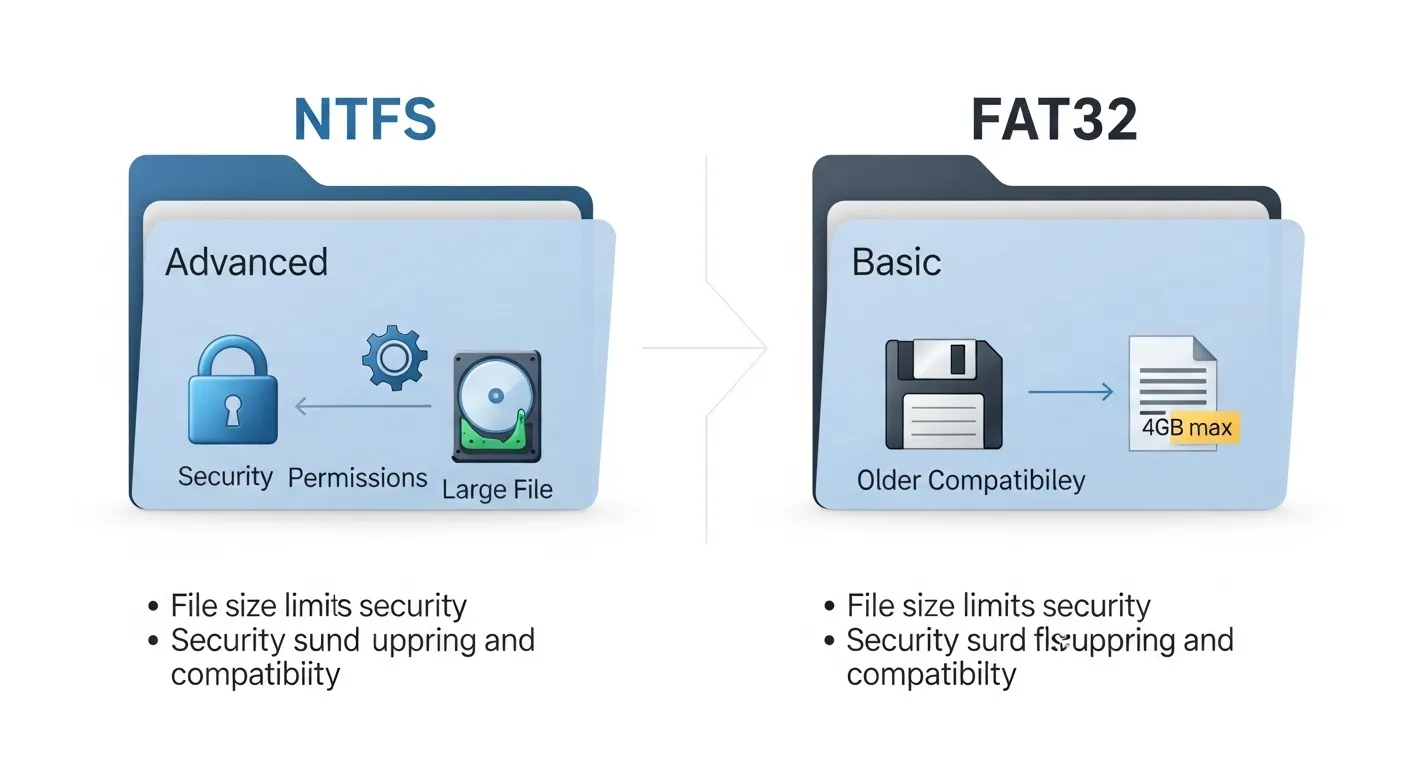
The main difference is that NTFS (New Technology File System) is advanced and secure, while FAT32 (File Allocation Table 32) is older and more compatible with many devices.
NTFS supports large files and permissions, whereas FAT32 has size limitations but works almost everywhere.
Why Is Their Difference Necessary to Know for Learners and Experts?
Understanding the difference between NTFS and FAT32 is important in modern society because digital storage is everywhere. Students store assignments, businesses store financial data, and professionals manage servers.
For learners, knowing which format to use prevents data loss and errors. For experts, file systems impact security, data recovery, and performance. In companies, choosing NTFS ensures protection and reliability. In everyday life, FAT32 ensures compatibility with TVs, gaming consoles, and cameras.
Technology runs society, and file systems are its silent backbone.
Difference Between NTFS and FAT32
Here are 10 major points explaining the difference separately with examples:
1. Maximum File Size
- NTFS: Supports files larger than 4GB.
- Example 1: A 10GB movie file can be stored.
- Example 2: A large software installation file works smoothly.
- Example 1: A 10GB movie file can be stored.
- FAT32: Maximum file size is 4GB.
- Example 1: An 8GB video cannot be copied.
- Example 2: Large game files show an error.
- Example 1: An 8GB video cannot be copied.
2. Partition Size Limit
- NTFS: Supports very large partitions (up to terabytes).
- Example 1: 2TB hard drive works perfectly.
- Example 2: External storage for servers functions smoothly.
- Example 1: 2TB hard drive works perfectly.
- FAT32: Limited to smaller partitions.
- Example 1: Large drives may not format fully.
- Example 2: Storage is restricted in use.
- Example 1: Large drives may not format fully.
3. Security
- NTFS: Offers file permissions and encryption.
- Example 1: Office files can be password-protected.
- Example 2: Users can restrict access.
- Example 1: Office files can be password-protected.
- FAT32: No built-in security.
- Example 1: Anyone can open files.
- Example 2: No encryption option.
- Example 1: Anyone can open files.
4. Compatibility
- NTFS: Best with Microsoft Windows.
- Example 1: Windows 10 runs NTFS by default.
- Example 2: Windows servers use NTFS.
- Example 1: Windows 10 runs NTFS by default.
- FAT32: Works with Windows, macOS, Linux, TVs, and consoles.
- Example 1: USB works in Smart TV.
- Example 2: Gaming consoles detect FAT32 easily.
- Example 1: USB works in Smart TV.
5. Performance
- NTFS: Faster for large data handling.
- Example 1: Editing large video projects.
- Example 2: Installing heavy software.
- Example 1: Editing large video projects.
- FAT32: Slower with big data.
- Example 1: Large file transfers take time.
- Example 2: Slows down on heavy usage.
- Example 1: Large file transfers take time.
6. Reliability
- NTFS: Has a journaling feature to prevent corruption.
- Example 1: Power failure recovery.
- Example 2: Reduced risk of data loss.
- Example 1: Power failure recovery.
- FAT32: No journaling.
- Example 1: Sudden removal can corrupt data.
- Example 2: Higher risk after power cuts.
- Example 1: Sudden removal can corrupt data.
7. Compression
- NTFS: Supports file compression.
- Example 1: Save space on hard drive.
- Example 2: Compress documents easily.
- Example 1: Save space on hard drive.
- FAT32: No compression feature.
- Example 1: Full space used.
- Example 2: Cannot shrink file size internally.
- Example 1: Full space used.
8. File Permissions
- NTFS: Allows multiple user permissions.
- Example 1: Admin vs guest control.
- Example 2: Company network restrictions.
- Example 1: Admin vs guest control.
- FAT32: No user-level permissions.
- Example 1: Open access to everyone.
- Example 2: No restriction system.
- Example 1: Open access to everyone.
9. Error Handling
- NTFS: Automatically checks and repairs errors.
- Example 1: Disk scan tool works better.
- Example 2: Reduces crash risks.
- Example 1: Disk scan tool works better.
- FAT32: Manual repair required.
- Example 1: Need disk utility tool.
- Example 2: Corruption is more common.
- Example 1: Need disk utility tool.
10. Best Use Case
- NTFS: Internal hard drives and Windows systems.
- Example 1: Laptop main drive.
- Example 2: Office desktop storage.
- Example 1: Laptop main drive.
- FAT32: USB drives and external devices.
- Example 1: Flash drives.
- Example 2: Memory cards.
- Example 1: Flash drives.
Nature and Behaviour
NTFS is modern, secure, structured, and professional. It behaves like a guarded office building with security cameras and controlled access.
FAT32 is simple, open, and widely friendly. It behaves like a public park, easy to access but less secure.
Why Are People Confused About Their Use?
People are confused because both store files and look similar during formatting. Beginners often think they are just names. The confusion increases when devices only support one format.
Table Showing Difference and Similarity
| Feature | NTFS | FAT32 |
| Max File Size | Very large | 4GB limit |
| Security | Yes | No |
| Compatibility | Windows focused | Almost all devices |
| Performance | High | Moderate |
| Journaling | Yes | No |
| Compression | Yes | No |
| Best For | Internal drives | USB & external |
| Similarity | Both are file systems used to store and organize data |
Which Is Better in What Situation?
NTFS is better when using Windows computers, storing large files, managing sensitive data, or running software. It is ideal for internal hard drives and office environments where security and performance matter.
FAT32 is better when using USB drives for TVs, gaming consoles, cameras, or transferring small files between different operating systems. It is perfect for maximum compatibility.
Metaphors and Similes
- NTFS is like a bank locker, secure and organized.
- FAT32 is like a school notebook, simple and easy to use.
Connotative Meaning
- NTFS – Positive (secure, professional, advanced)
- Example: “His system is NTFS-like, very secure.”
- Example: “His system is NTFS-like, very secure.”
- FAT32 – Neutral (simple, universal)
- Example: “Keep it FAT32 style simple and compatible.”
- Example: “Keep it FAT32 style simple and compatible.”
Idioms or Proverbs Related
There are no direct idioms about NTFS or FAT32, but related tech sayings include:
- “Better safe than sorry.” (Related to NTFS security)
- “Simplicity is the ultimate sophistication.” (Related to FAT32 simplicity)
Works in Literature
There are no famous classical literary works named exactly NTFS or FAT32 because they are technical terms related to computer science.
Movies Based on Keywords
There are no movies specifically made on NTFS or FAT32 as they are file system technologies.
Five Frequently Asked Questions
1. What is the main difference between NTFS and FAT32?
NTFS supports larger files and security, FAT32 has size limits but better compatibility.
2. Can I convert FAT32 to NTFS?
Yes, Windows allows conversion without losing data.
3. Why can’t I copy large files to FAT32?
Because FAT32 has a 4GB file size limit.
4. Is NTFS faster than FAT32?
Yes, especially for large files.
5. Which is safer?
NTFS is safer due to encryption and permissions.
How Both Are Useful for Surroundings
Both help in organizing digital life. NTFS protects office data, while FAT32 helps share files across devices. They support education, business, entertainment, and communication.
Final Words for the Both
NTFS represents advancement and security in modern computing. FAT32 represents simplicity and universal compatibility. Both serve important roles depending on needs.
Conclusion
Understanding the difference between NTFS and FAT32 is essential in today’s digital world.
NTFS offers security, large file support, and advanced features, making it ideal for professional and Windows-based systems. FAT32, on the other hand, provides excellent compatibility and simplicity, making it perfect for USB drives and multimedia devices.
The right choice depends on your purpose. If you need performance and protection, choose NTFS. If you need compatibility across devices, choose FAT32. Making the correct decision prevents errors, saves time, and protects your valuable data.

I am James Anderson an English author known for his insightful and engaging writing in contemporary literature. With a focus on [insert genre, e.g., fiction, non-fiction, or specific themes], he explores complex human emotions and social dynamics, blending thought-provoking ideas with accessible storytelling. His work has earned recognition for its clarity, depth, and ability to connect with a wide audience, establishing him as a respected voice in modern English literature.