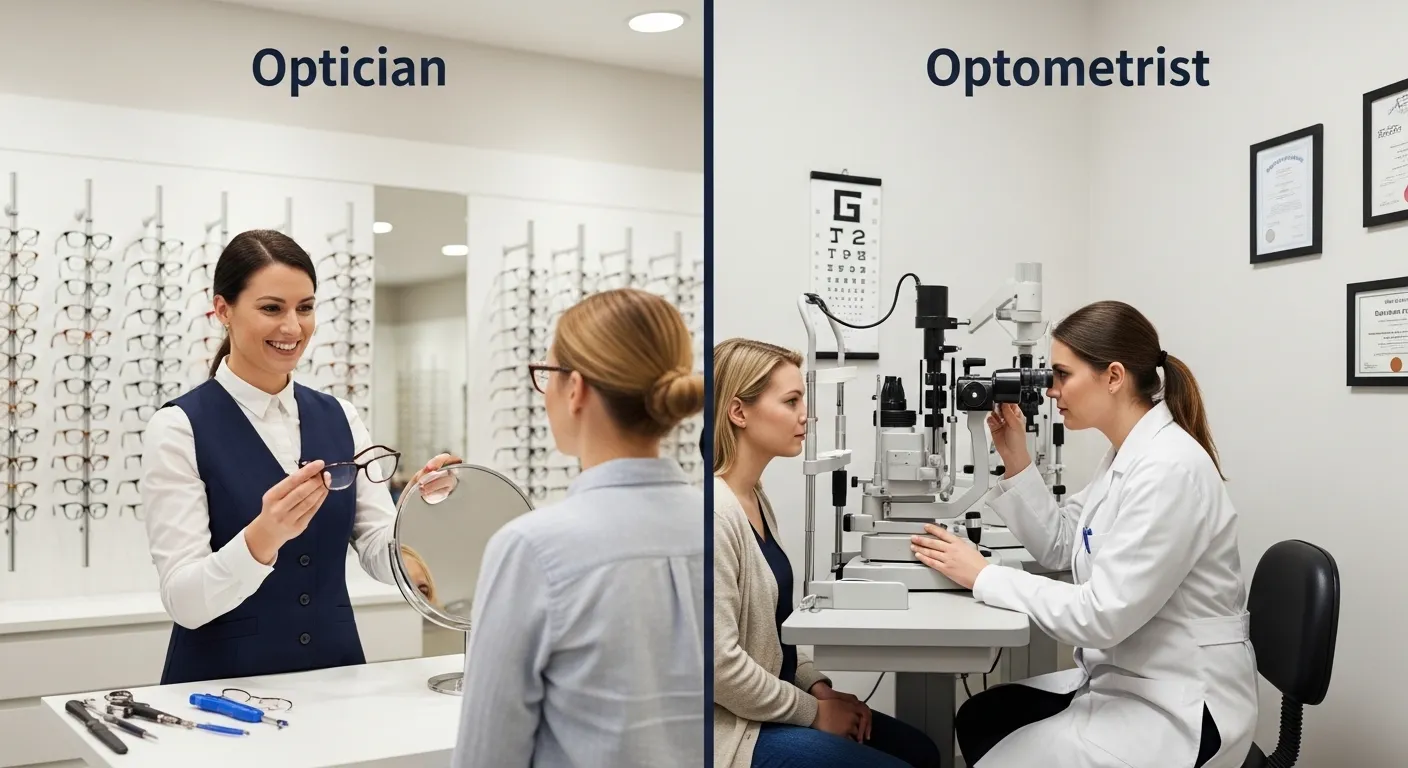
Have you ever felt confused about who to visit for your eye care needs? Many people use the terms Optician and Optometrist interchangeably, but they actually refer to different roles. Understanding the difference between optician and optometrist can help you make better decisions about your eye health.
Both professionals play important roles in vision care, but their training, responsibilities, and services are not the same. One focuses more on fitting glasses, while the other examines your eyes and checks your vision. If you choose the wrong one, you might not get the care you need.
This is especially important if you’re experiencing vision problems, eye strain, or need new glasses. Knowing who does what can save you time, money, and confusion. It also helps you get the right treatment faster.
This optician vs optometrist comparison highlights the key differences, similarities, and when to visit each professional. By the end, you’ll clearly understand which one is right for your situation.
Let’s compare opticians and optometrists in detail below.
Quick Summary
Here’s a simple overview to understand their roles:
- Opticians help fit and adjust glasses or contact lenses
- Optometrists perform eye exams and diagnose vision issues
- Optometrists have more medical training than opticians
- Opticians do not diagnose or treat eye diseases
Quick Comparison Table of Optician vs Optometrist
| Feature | Optician | Optometrist |
| Role | Fits eyewear | Examines eyes and vision |
| Education | Technical training or diploma | Doctor of Optometry (OD) degree |
| Eye Exams | No | Yes |
| Diagnosis | No | Yes |
| Prescriptions | Follows prescription | Writes prescriptions |
| Treatment | No | Limited treatment of eye issues |
| Work Setting | Optical stores | Clinics or eye care centers |
| Tools Used | Measuring and fitting tools | Medical eye exam equipment |
| Contact Lenses | Fitting and guidance | Prescribes and monitors use |
| Cost | Usually lower | Usually higher |
What Is an Optician? (Definition & Uses)
An optician is a trained professional who helps you choose, fit, and adjust eyewear. They work with prescriptions provided by optometrists or ophthalmologists.
Opticians guide you in selecting frames that suit your face and lifestyle. They also make sure your glasses fit comfortably and your lenses are properly aligned.
In addition, opticians may repair glasses or adjust them if they become loose. They play a key role in making sure your vision correction works effectively in daily life.
What Is an Optometrist? (Definition & Uses)
An optometrist is a licensed healthcare professional who examines your eyes and checks your vision. They are trained to detect vision problems and some eye health issues.
Optometrists perform eye exams, prescribe glasses or contact lenses, and may treat minor eye conditions. They can also detect early signs of diseases like glaucoma or dry eye.
While they are not medical doctors, they have advanced training in eye care and can refer you to specialists if needed.
Key Differences Between Optician and Optometrist
Education and Training
• Opticians usually complete a diploma or short training program. Optometrists earn a Doctor of Optometry degree, which takes several years.
• For example, an optometrist studies eye health in depth, while an optician focuses on fitting eyewear.
Scope of Work
• Opticians deal mainly with glasses and lenses, while optometrists handle vision testing and diagnosis.
• For instance, if you need a new prescription, you must visit an optometrist, not an optician.
Eye Exams
• Opticians do not perform eye exams. Optometrists are trained to test your vision and eye health.
• For example, blurry vision requires an eye exam by an optometrist.
Prescribing Authority
• Opticians cannot write prescriptions. Optometrists can prescribe glasses and contact lenses.
• For instance, after your exam, the optometrist provides a prescription that the optician uses.
Medical Knowledge
• Optometrists have deeper knowledge of eye conditions. Opticians have limited medical training.
• For example, an optometrist can identify early signs of glaucoma, while an optician cannot.
Patient Interaction
• Opticians help with product selection and fitting. Optometrists focus on diagnosis and care.
• For instance, you see an optician when choosing frames after your exam.
Tools and Equipment
• Opticians use tools for measuring and adjusting frames. Optometrists use medical devices for exams.
• For example, an optometrist uses machines to check eye pressure and vision clarity.
Treatment Ability
• Opticians do not treat eye conditions. Optometrists can manage minor eye problems.
• For instance, an optometrist may treat dry eye, but an optician cannot.
Work Environment
• Opticians usually work in retail optical shops. Optometrists work in clinics or medical settings.
• For example, you’ll find opticians in eyewear stores and optometrists in eye clinics.
Detailed Comparison
When comparing these two roles, the biggest difference lies in their level of responsibility and expertise.
Optometrists are healthcare providers. They assess your vision, diagnose problems, and prescribe solutions. Their work focuses on your eye health and ensuring your vision is correct.
Opticians, on the other hand, focus on the practical side. They take the prescription and turn it into usable eyewear. Their role is essential for comfort and proper fit.
Another important difference is decision-making. Optometrists make clinical decisions, while opticians follow those decisions. This makes optometrists the first point of contact for vision concerns.
In simple terms, optometrists diagnose, and opticians deliver the solution.
Similarities
Despite their differences, they share some common ground:
- Both are involved in eye care and vision improvement
- Both work with glasses and contact lenses
- Both interact directly with patients
- Both aim to improve visual comfort and clarity
When to Choose Optician vs Optometrist
Choosing the right professional depends on your needs:
Choose an optician if:
- You already have a valid prescription
- You need help selecting or adjusting glasses
- You want repairs or fitting services
Choose an optometrist if:
- You have vision problems or eye discomfort
- You need an eye exam
- You want a new prescription
Simple tip: If you’re unsure, start with an optometrist. They can guide you further.
FAQs
1. Can an optician check my eyes?
No, opticians do not perform eye exams. You need an optometrist for that.
2. Do I need a prescription to visit an optician?
Yes, in most cases, you need a prescription to get glasses or contact lenses.
3. Are optometrists doctors?
Optometrists are not medical doctors, but they have a Doctor of Optometry (OD) degree.
4. Can an optometrist treat eye diseases?
They can treat minor conditions and detect serious ones, but may refer you to specialists.
5. Who should I see for blurry vision?
You should visit an optometrist for a proper eye exam and diagnosis.
Conclusion
The difference between optician and optometrist is clear once you understand their roles. Optometrists focus on eye health, exams, and prescriptions, while opticians handle the fitting and adjustment of eyewear.
Both are essential parts of the eye care system, but they serve different purposes. Choosing the right one ensures you get the care you need without confusion.
If you’re dealing with vision issues, start with an optometrist. Once you have a prescription, an optician will help you find the perfect glasses for your lifestyle.

I am D. H. Lawrence (David Herbert Lawrence) an influential English novelist, poet, essayist, and literary critic born on September 11, 1885, in Eastwood, Nottinghamshire, England. He is widely regarded as one of the most important writers of the 20th century.
I work often explored human relationships, emotional intimacy, industrialization, and the conflict between modern society and natural instincts.