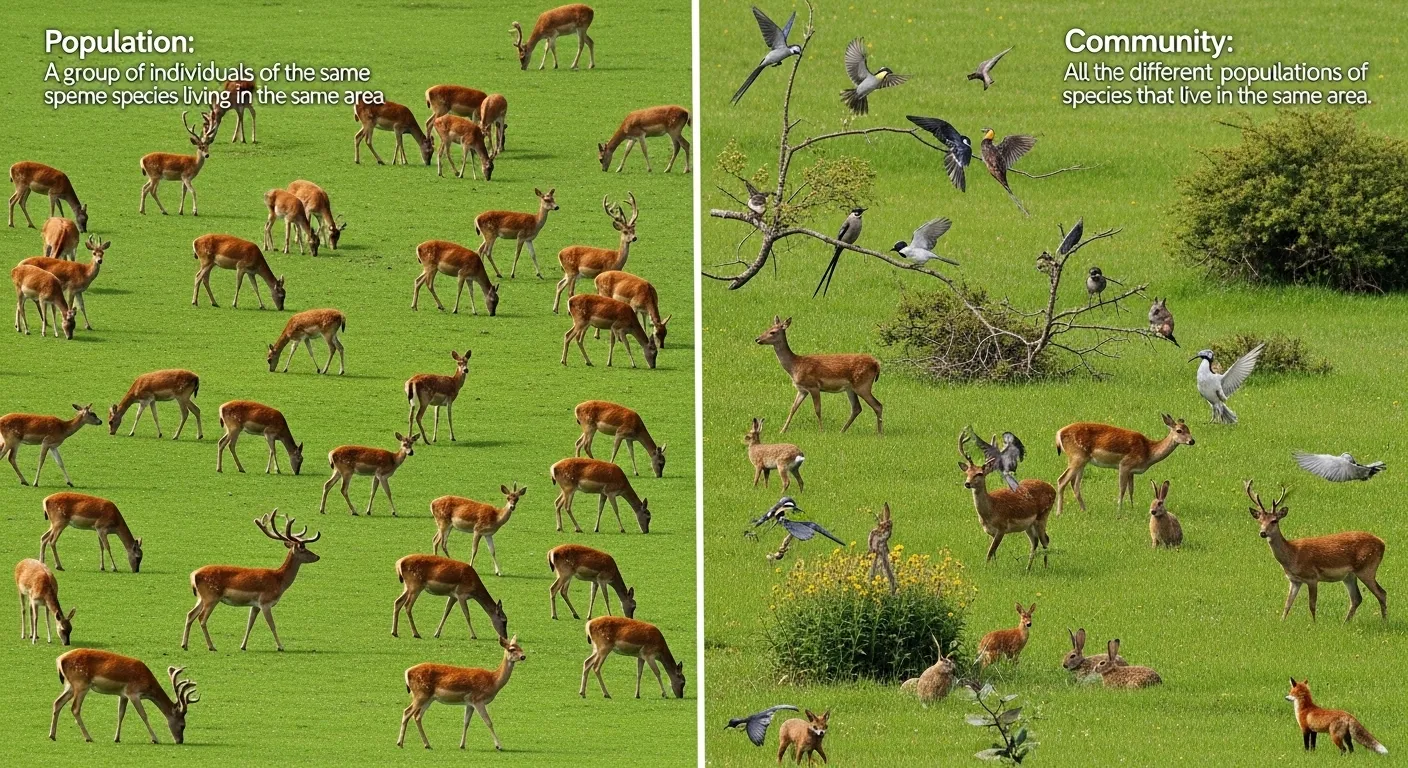
In the real world, every city, town, or village functions as a living system. When you walk through a busy marketplace, you see a population of shopkeepers, buyers, and passersby all interacting.
At the same time, the same area represents a community collection of different populations of humans, animals, and even plants coexisting together. Understanding the difference between population and community helps us study ecology, sociology, and urban planning more effectively.
Both population and community play critical roles in shaping our environment, yet many students and learners confuse them because they are closely related. By learning the difference between population and community, one can analyze both individual groups and collective interactions in nature and society.
Pronunciation:
- Population: US /ˌpɑː.pjəˈleɪ.ʃən/, UK /ˌpɒp.jʊˈleɪ.ʃən/
- Community: US /kəˈmjuː.nə.ti/, UK /kəˈmjuː.nɪ.ti/
Linking Hook:
To fully grasp the impact of humans and other species on our surroundings, let’s explore the difference between population and community in detail.
Key Differences Between Population and Community
Here are 10 major differences between population and community:
- Definition
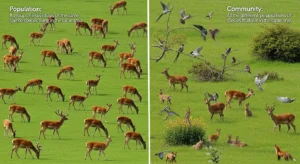
- Population: A group of individuals of the same species living in a particular area.
- Example 1: All the oak trees in Central Park form a population.
- Example 2: All students in a school classroom represent a population.
- Example 1: All the oak trees in Central Park form a population.
- Community: All populations of different species living together in the same area.
- Example 1: Plants, birds, and insects in a garden form a community.
- Example 2: Humans, dogs, and pigeons in a city park represent a community.
- Example 1: Plants, birds, and insects in a garden form a community.
- Species Variety
- Population: Only one species is included.
- Community: Multiple species coexist.
- Examples are similar to point 1.
- Focus of Study
- Population: Focuses on size, density, and growth of one species.
- Community: Focuses on interactions between different species.
- Interaction
- Population: Individuals interact mostly among themselves.
- Community: Interactions include predation, competition, and mutualism.
- Measurement
- Population: Measured using population density, birth/death rates.
- Community: Measured by biodiversity, species richness, and dominance.
- Scope
- Population: Narrower scope; deals with one species.
- Community: Broader scope; includes all species in an ecosystem.
- Change Over Time
- Population: Changes occur due to births, deaths, and migration.
- Community: Changes due to succession, species extinction, or introduction.
- Examples in Society
- Population: Residents of a street or members of a club.
- Community: A whole neighborhood with families, schools, and shops.
- Ecological Role
- Population: Maintains species-specific balance.
- Community: Maintains ecosystem balance through interspecies interactions.
- Complexity
- Population: Simple to study.
- Community: Complex because of multiple interactions.
Nature and Behaviour
- Population: Predictable, mostly uniform behavior within species.
- Community: Dynamic, diverse, with complex relationships between species.
Why People Are Confused
People often confuse population and community because both involve groups living in the same area. However, population is about one species, while community includes all species.
Population vs Community Table
| Feature | Population | Community | Similarity |
| Species | Single species | Multiple species | Both involve living organisms |
| Scope | Narrow | Broad | Exist in the same habitat |
| Interaction | Within species | Between species | Both show social/ecological interactions |
| Measurement | Density, size, growth | Biodiversity, richness | Both can be studied scientifically |
| Complexity | Simple | Complex | Both change over time |
Which Is Better in What Situation?
- Studying population is better when we want to understand species survival, growth, or conservation strategies. For example, analyzing a population of tigers helps in protecting them.
- Studying community is better for understanding ecosystem health, species interactions, and biodiversity conservation. For example, examining all species in a forest shows the balance of nature.
Use in Metaphors and Similes
- Population: “The classroom was a population of young minds buzzing with ideas.”
- Community: “The garden was a community of life, each plant and insect playing its role.”
Connotative Meanings
- Population: Neutral. Example: “The city’s population is growing rapidly.”
- Community: Positive. Example: “The local community came together to help flood victims.”
Idioms/Proverbs Related
- “It takes a village to raise a child” → highlights community effort.
- “A growing population is both a blessing and a challenge” → reflects population change.
Works in Literature
- The Population Bomb (Non-fiction, Paul R. Ehrlich, 1968)
- Community and Society (Sociology, Ferdinand Tönnies, 1887)
Movies Related
- Children of Men (Population, 2006, UK)
- The Village (Community, 2004, USA)
FAQs
- Is population part of a community?
Yes, a population is a subset of a community. - Can a community exist without populations?
No, a community is made of populations of different species. - Are humans considered a population or a community?
Humans can be a population (same group) or part of a larger community (different groups together). - Does population always refer to humans?
No, population refers to any species. - Why is understanding the difference important?
It helps in conservation, urban planning, and ecological studies.
How Both Are Useful for Surroundings
- Population: Ensures species survival and guides conservation efforts.
- Community: Maintains ecosystem balance, promotes biodiversity, and supports ecological stability.
Final Words
Understanding the difference between population and community is vital for students, ecologists, and society.
Populations provide insight into species-specific dynamics, while communities explain the interconnectedness of life.
Conclusion
In conclusion, populations and communities are fundamental concepts in ecology and sociology.
A population refers to a single species in a given area, focusing on its size, growth, and behavior.
A community, however, includes multiple populations interacting together, highlighting biodiversity and ecological interactions.
Recognizing the difference is crucial for environmental planning, conservation, and understanding human society.
Both concepts are complementary: populations ensure species survival, while communities maintain ecosystem harmony.
By understanding their differences, learners and experts can develop strategies for sustainability, biodiversity conservation, and societal development. Studying them together gives a complete picture of life on Earth.

I am D. H. Lawrence (David Herbert Lawrence) an influential English novelist, poet, essayist, and literary critic born on September 11, 1885, in Eastwood, Nottinghamshire, England. He is widely regarded as one of the most important writers of the 20th century.
I work often explored human relationships, emotional intimacy, industrialization, and the conflict between modern society and natural instincts.