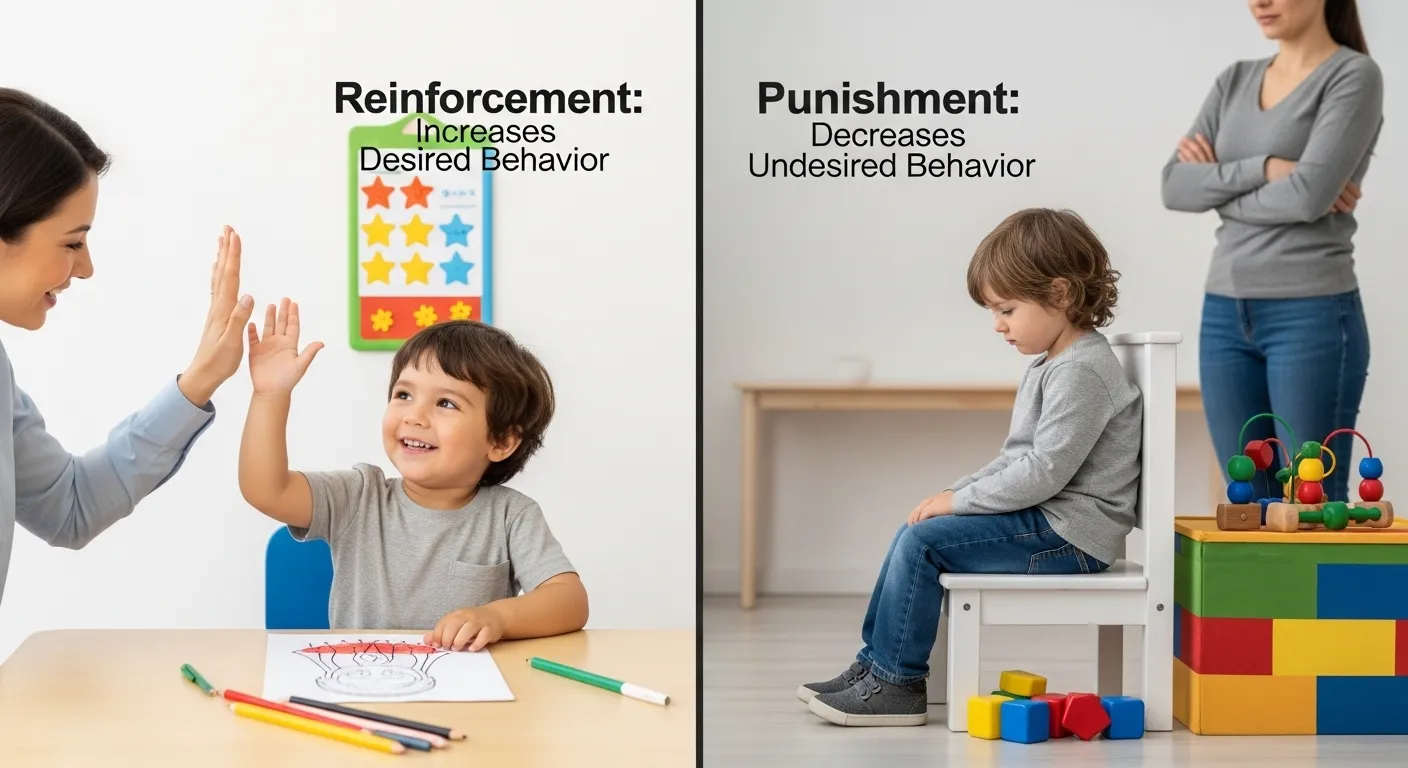
In our daily lives, we are constantly influenced by actions that encourage or discourage certain behaviors. This is where reinforcement and punishment come into play.
Imagine a teacher praising a student for completing homework on time (reinforcement) versus giving a student detention for misbehaving (punishment). Both shape behavior, yet in very different ways.
The term reinforcement involves increasing the likelihood of a behavior, while punishment involves decreasing it. Understanding the difference between reinforcement and punishment is crucial for educators, psychologists, and parents alike.
Proper application of these strategies can help guide positive behavior, correct mistakes, and improve learning environments. In essence, knowing when to reinforce and when to punish can dramatically affect outcomes in education, parenting, and society.
Pronunciation:
- Reinforcement: US /ˌriː.ɪnˈfɔːrs.mənt/, UK /ˌriː.ɪnˈfɔːsmənt/
- Punishment: US /ˈpʌn.ɪʃ.mənt/, UK /ˈpʌn.ɪʃ.mənt/
Let’s dive deeper to explore the difference between reinforcement and punishment, and how each plays a unique role in shaping human behavior.
Difference Between Reinforcement and Punishment
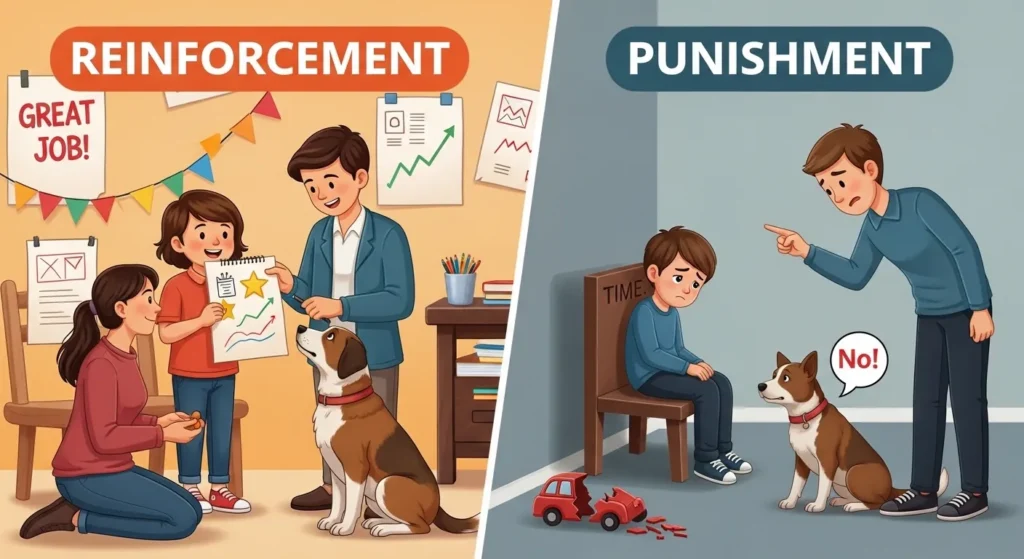
Here are 10 points explaining their differences clearly:
- Definition
- Reinforcement: Increases the probability of a behavior happening again.
- Example 1: Giving a child candy for cleaning their room.
- Example 2: Employee bonus for meeting sales target.
- Example 1: Giving a child candy for cleaning their room.
- Punishment: Decreases the probability of a behavior recurring.
- Example 1: Taking away video games for breaking rules.
- Example 2: Fining drivers for speeding.
- Example 1: Taking away video games for breaking rules.
- Reinforcement: Increases the probability of a behavior happening again.
- Goal
- Reinforcement aims to encourage good behavior.
- Punishment aims to discourage bad behavior.
- Examples similar to above.
- Reinforcement aims to encourage good behavior.
- Emotional Impact
- Reinforcement often produces positive feelings.
- Punishment can cause fear, anxiety, or resentment.
- Examples: Praise a student (reinforcement) vs. public scolding (punishment).
- Reinforcement often produces positive feelings.
- Timing
- Reinforcement is most effective immediately after the desired behavior.
- Punishment is effective when applied promptly after the undesired act.
- Examples: Instant bonus (reinforcement) vs. immediate penalty (punishment).
- Reinforcement is most effective immediately after the desired behavior.
- Behavior Focus
- Reinforcement strengthens specific behaviors.
- Punishment aims to reduce undesirable behaviors.
- Reinforcement strengthens specific behaviors.
- Long-term Effects
- Reinforcement generally produces lasting positive habits.
- Punishment may suppress behavior temporarily but not teach alternatives.
- Reinforcement generally produces lasting positive habits.
- Method of Delivery
- Reinforcement can be positive (reward) or negative (removing something unpleasant).
- Punishment can be positive (adding unpleasant stimulus) or negative (removing pleasant stimulus).
- Reinforcement can be positive (reward) or negative (removing something unpleasant).
- Motivation Type
- Reinforcement relies on intrinsic or extrinsic motivation.
- Punishment often relies on fear-based motivation.
- Reinforcement relies on intrinsic or extrinsic motivation.
- Social Acceptability
- Reinforcement is widely accepted socially and ethically.
- Punishment can be controversial if excessive or harsh.
- Reinforcement is widely accepted socially and ethically.
- Learning Application
- Reinforcement is central to behavioral therapy, education, and training.
- Punishment is used sparingly in discipline or law enforcement.
- Reinforcement is central to behavioral therapy, education, and training.
Nature and Behavior of Both
- Reinforcement: Encouraging, motivating, positive, and supportive.
- Punishment: Corrective, restraining, negative, and sometimes feared.
Why People Are Confused
Many confuse the two because both involve behavior modification, but their objectives are oppositeone encourages, the other discourages. Misapplication can lead to misunderstanding and ineffective outcomes.
Comparative Table
| Feature | Reinforcement | Punishment | Similarity |
| Purpose | Increase behavior | Decrease behavior | Both influence behavior |
| Emotion | Positive feelings | Negative feelings | Immediate emotional response |
| Timing | After behavior | After behavior | Requires timing for effectiveness |
| Long-term Effect | Lasting positive habits | Temporary suppression | Both affect learning |
| Method | Positive/negative | Positive/negative | Can be delivered in two ways |
Which is Better in What Situation?
- Reinforcement works best in learning environments, parenting, and employee motivation where the goal is to cultivate good habits. Positive reinforcement encourages repeated success and builds confidence.
- Punishment is better in situations where safety or rules must be enforced immediately, such as legal compliance, traffic laws, or urgent corrective measures. Overuse can backfire.
Use in Metaphors and Similes
- Reinforcement: “Like water to a plant, encouragement strengthens growth.”
- Punishment: “Like a storm, it can deter reckless actions but may damage morale.”
Connotative Meaning
- Reinforcement: Positive “Rewarding honesty builds trust.”
- Punishment: Negative “Fines discourage illegal parking.”
Idioms/Proverbs
- “Spare the rod and spoil the child” relates to punishment.
- “You reap what you sow” relates to reinforcement.
Works in Literature
- Behavioral Psychology by B.F. Skinner (Non-fiction, 1938) Reinforcement/Punishment in learning
- Beyond Freedom and Dignity by B.F. Skinner (Non-fiction, 1971)
Movies Related to Concepts
- A Beautiful Mind (2001, USA) Depicts reinforcement in learning and behavior
- Dead Poets Society (1989, USA) Shows both reinforcement and punishment in education
FAQs
- What is reinforcement?
Encouragement to increase desired behavior. - What is punishment?
Action to decrease undesired behavior. - Can reinforcement be negative?
Yes, removing unpleasant stimuli to encourage behavior. - Does punishment always work?
Not always; can suppress behavior temporarily but may not teach alternatives. - Why are they often confused?
Both modify behavior but in opposite ways; the objectives differ.
Usefulness in Surroundings
Both strategies shape society’s reinforcement builds positive habits and social cooperation, while punishment ensures safety, rules, and accountability.
Final Words
Understanding the difference between reinforcement and punishment equips parents, teachers, and leaders to nurture positive behaviors while minimizing harmful ones, fostering balanced personal and societal growth.
Conclusion
Reinforcement and punishment are core behavioral strategies with distinct purposes. Reinforcement promotes positive behavior through rewards or removing discomfort, while punishment suppresses undesirable behavior using penalties or removing privileges.
Both are essential in shaping individual actions, societal rules, and learning processes. Correct application enhances growth, motivation, and ethical conduct, while misuse can create confusion or resentment.
By recognizing the difference between reinforcement and punishment, one can skillfully balance encouragement and correction, leading to a healthier, more productive environment.

I am Stephen King is a spiritual writer and digital creator dedicated to exploring the deeper meaning behind numbers, synchronicity, and divine guidance. Through his platform, spiritualdigits.com he shares insights on angel numbers, spiritual symbolism, and personal awakening to help readers align with their higher purpose. His work blends intuition, research, and practical wisdom to make spiritual concepts clear, accessible, and transformative.