Last summer, a family from Karachi visited the Arabian coast. The children excitedly shouted, “Look at the ocean!” while their father gently corrected them, “This is the sea.”
That small moment shows how common the confusion is when discussing the difference between sea and ocean.
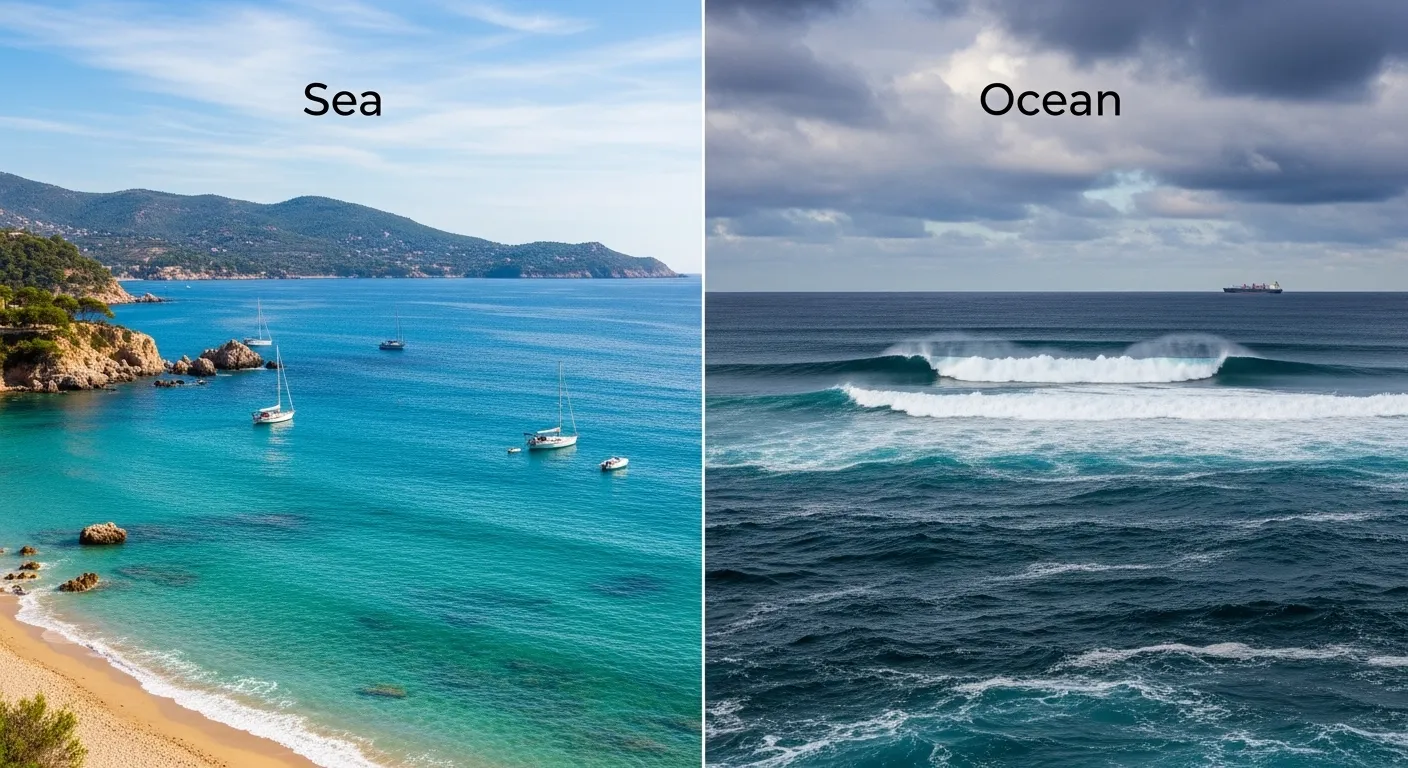
In simple words, a sea is a large body of saltwater that is usually partly enclosed by land, while an ocean is a vast, open body of saltwater that covers huge portions of the Earth.
Understanding the difference between sea and ocean helps us speak accurately and learn geography correctly.
Many people use the terms interchangeably, but the difference between sea and ocean is real and meaningful. In this article, we will clearly explain the difference between sea and ocean with examples and practical insights.
Key Difference Between the Both
The main difference lies in size, depth, and location. Oceans are much larger and deeper than seas. Seas are often connected to oceans and are partially surrounded by land.
Why Is Their Difference Necessary to Know for Learners and Experts?
Understanding this difference is important because:
- It improves geographical knowledge.
- It helps in environmental studies and marine science.
- It supports accurate communication in education and media.
- It assists policymakers in marine resource management.
For society, knowing the correct terms encourages environmental awareness and scientific clarity.
Pronunciation (US & UK)
- Sea
- US: /siː/
- UK: /siː/
- US: /siː/
- Ocean
- US: /ˈoʊʃən/
- UK: /ˈəʊʃən/
- US: /ˈoʊʃən/
Now that we understand the basics, let’s explore their detailed differences.
Difference Between Sea and Ocean
1. Size
Ocean: Oceans are the largest water bodies on Earth.
Examples:
- Pacific Ocean
- Atlantic Ocean
Sea: Seas are smaller than oceans.
Examples:
- Arabian Sea
- Mediterranean Sea
2. Depth
Ocean: Oceans are much deeper.
Examples:
- Mariana Trench in the Pacific Ocean.
- Deep Atlantic basins.
Sea: Seas are generally shallower.
Examples:
- Baltic Sea.
- North Sea.
3. Location
Ocean: Not enclosed by land.
Examples:
- Pacific Ocean between Asia and America.
- Southern Ocean around Antarctica.
Sea: Often partially enclosed by land.
Examples:
- Mediterranean Sea surrounded by Europe and Africa.
- Red Sea between Africa and Asia.
4. Number
Ocean: There are five major oceans.
Examples: Pacific, Atlantic.
Sea: There are many seas around the world.
Examples: Caribbean Sea, Black Sea.
5. Water Movement
Ocean: Strong global currents.
Examples: Gulf Stream, Antarctic currents.
Sea: Less powerful currents.
Examples: Mediterranean currents.
6. Marine Life
Ocean: Greater biodiversity.
Examples: Whales in Pacific Ocean, Sharks in Atlantic Ocean.
Sea: Rich but limited diversity.
Examples: Coral reefs in Arabian Sea, Fish in Mediterranean Sea.
7. Climate Influence
Ocean: Major role in global climate regulation.
Examples: Pacific affecting El Niño, Atlantic influencing Europe’s climate.
Sea: Regional climate effects.
Examples: Mediterranean climate, Arabian Sea monsoon effects.
8. Salinity Levels
Ocean: Stable salinity.
Examples: Pacific, Atlantic.
Sea: Salinity varies.
Examples: Dead Sea (very salty), Baltic Sea (less salty).
9. Geological Importance
Ocean: Oceanic crust and tectonic plates.
Examples: Pacific Ring of Fire, Mid-Atlantic Ridge.
Sea: Coastal and continental shelf features.
Examples: North Sea oil fields, Mediterranean basins.
10. Economic Importance
Ocean: Global trade routes.
Examples: Atlantic shipping routes, Pacific trade lanes.
Sea: Regional fishing and tourism.
Examples: Mediterranean tourism, Arabian Sea fisheries.
Nature and Behaviour
Oceans are vast, deep, and powerful. They have strong tides and influence global weather systems.
Seas are comparatively calmer, more enclosed, and strongly influenced by nearby land conditions.
Why Are People Confused?
- Both contain saltwater.
- Seas are connected to oceans.
- Daily language often uses both words interchangeably.
- Media and movies sometimes mix the terms.
Table: Difference and Similarity Between Sea and Ocean
| Feature | Sea | Ocean |
| Size | Smaller | Larger |
| Depth | Shallower | Deeper |
| Location | Partly enclosed | Open and vast |
| Climate Role | Regional | Global |
| Salinity | Varies | Stable |
| Similarity | Both are saltwater bodies | Both support marine life |
Which Is Better in What Situation?
If someone wants peaceful coastal tourism, seas are often better. Many seas like the Mediterranean Sea offer calm beaches, mild weather, and scenic coastal cities. Seas are suitable for fishing communities and local trade.
Oceans are better for global shipping, scientific research, and studying climate systems. They support international trade routes and deep-sea exploration. However, they can be rougher and more dangerous.
Use in Metaphors and Similes
- “A sea of people” means a large crowd.
- “An ocean of knowledge” means unlimited knowledge.
- “Tears flowed like the sea.”
- “Her love was as deep as the ocean.”
Connotative Meanings
Sea
- Positive: Peace, beauty (“a calm sea at sunset”)
- Negative: Danger (“lost at sea”)
- Neutral: Geographical term
Ocean
- Positive: Vast opportunity (“an ocean of possibilities”)
- Negative: Overwhelming (“drowning in an ocean of problems”)
- Neutral: Scientific term
Idioms and Proverbs
- “A drop in the ocean” is a very small amount.
- “There are plenty more fish in the sea” other opportunities exist.
- “Between the devil and the deep blue sea” facing two dangers.
Example: Losing that job is just a drop in the ocean compared to your future success.
Works in Literature
- The Old Man and the Sea Novel, Ernest Hemingway, 1952
- The Sea, The Sea Novel, Iris Murdoch, 1978
- Moby-Dick (about the ocean) Novel, Herman Melville, 1851
Movies Based on Sea or Ocean
- The Sea Inside 2004, Spain
- Ocean’s Eleven 2001, USA
- Deep Blue Sea 1999, USA
Frequently Asked Questions
1. Is a sea part of an ocean?
Yes, most seas are connected to oceans.
2. Which is bigger, sea or ocean?
The ocean is much bigger.
3. How many oceans are there?
There are five major oceans.
4. Why is the Dead Sea called a sea?
Because of its saltwater, though it is technically a lake.
5. Do seas affect climate?
Yes, but mainly the regional climate.
How Both Are Useful for Surroundings
- Provide food resources.
- Support biodiversity.
- Regulate climate.
- Enable trade and transportation.
- Offer tourism and recreation opportunities.
Final Words for Both
Seas and oceans are both powerful natural features. While oceans represent vastness and global influence, seas show regional beauty and cultural importance.
Conclusion
The difference between sea and ocean lies mainly in size, depth, and geographical position.
Oceans are vast, deep, and globally influential, while seas are smaller and often partly enclosed by land.
Although people often confuse them, understanding their distinction improves geographical knowledge and communication.
Both are essential for climate balance, marine life, and human survival. By learning their differences and similarities, we gain a deeper respect for Earth’s water systems and their role in shaping our world.

I am D. H. Lawrence (David Herbert Lawrence) an influential English novelist, poet, essayist, and literary critic born on September 11, 1885, in Eastwood, Nottinghamshire, England. He is widely regarded as one of the most important writers of the 20th century.
I work often explored human relationships, emotional intimacy, industrialization, and the conflict between modern society and natural instincts.