In our daily lives, we often hear people talk about shortages and scarcity, but many are unaware that these two terms have distinct meanings.
Imagine walking into a grocery store only to find that your favorite brand of milk is temporarily unavailable.That is a classic case of a shortage.
On the other hand, think about natural resources like fresh water or oil, which are limited and cannot meet everyone’s long-term needs. Understanding the difference between shortage and scarcity is crucial for learners, economists, and policymakers alike.
By exploring these concepts, we can make better decisions in resource allocation, planning, and problem-solving in society. In this article, we will clarify the difference between shortage and scarcity, how they behave, and why knowing their distinction matters.
Pronunciation
- Shortage: /ˈʃɔːr.tɪdʒ/ (US & UK: shor-tij)
- Scarcity: /ˈsker.sɪ.ti/ (US & UK: skair-si-tee)
Linking Hook:
Now that we understand the basic meanings, let’s explore the core differences between shortage and scarcity, their nature, and how each affects our daily lives and society.
H2: Difference Between Shortage and Scarcity
Here are 10 key differences between shortage and scarcity, each with examples:
- Definition
- Shortage: A temporary condition when demand exceeds supply.
Example 1: A sudden cold wave causes a shortage of heaters in the market.
Example 2: During the pandemic, masks faced a global shortage. - Scarcity: A permanent condition where resources are limited.
Example 1: Oil is scarce because there is a finite amount underground.
Example 2: Freshwater scarcity is a challenge in desert regions.
- Shortage: A temporary condition when demand exceeds supply.
- Duration
- Shortage: Usually short-term and can be resolved.
- Scarcity: Long-term or permanent due to limited availability.
- Shortage: Usually short-term and can be resolved.
- Cause
- Shortage: Caused by supply chain issues, strikes, or sudden demand.
- Scarcity: Caused by nature or inherent limitations of resources.
- Shortage: Caused by supply chain issues, strikes, or sudden demand.
- Economic Concept
- Shortage: A market-related concept.
- Scarcity: A fundamental economic principle that affects everyone.
- Shortage: A market-related concept.
- Solution
- Shortage: Can be solved by increasing supply.
- Scarcity: Can only be managed, not fully solved.
- Shortage: Can be solved by increasing supply.
- Examples in Daily Life
- Shortage: Limited stock of smartphones during launch week.
- Scarcity: Land is scarce in large cities.
- Shortage: Limited stock of smartphones during launch week.
- Predictability
- Shortage: Often unpredictable and sudden.
- Scarcity: Predictable due to natural constraints.
- Shortage: Often unpredictable and sudden.
- Human Intervention
- Shortage: Can be controlled by human action.
- Scarcity: Cannot be completely controlled; requires careful planning.
- Shortage: Can be controlled by human action.
- Impact on Prices
- Shortage: Prices rise temporarily until supply meets demand.
- Scarcity: Prices may rise consistently due to permanent limitations.
- Shortage: Prices rise temporarily until supply meets demand.
- Nature of Resource
- Shortage: Applies to both goods and services.
- Scarcity: Mostly applies to natural and limited resources.
- Shortage: Applies to both goods and services.
Behavior of Both:
- Shortage: Reactive; appears and disappears based on market forces.
- Scarcity: Persistent; requires strategic management and planning.
Why People Are Confused:
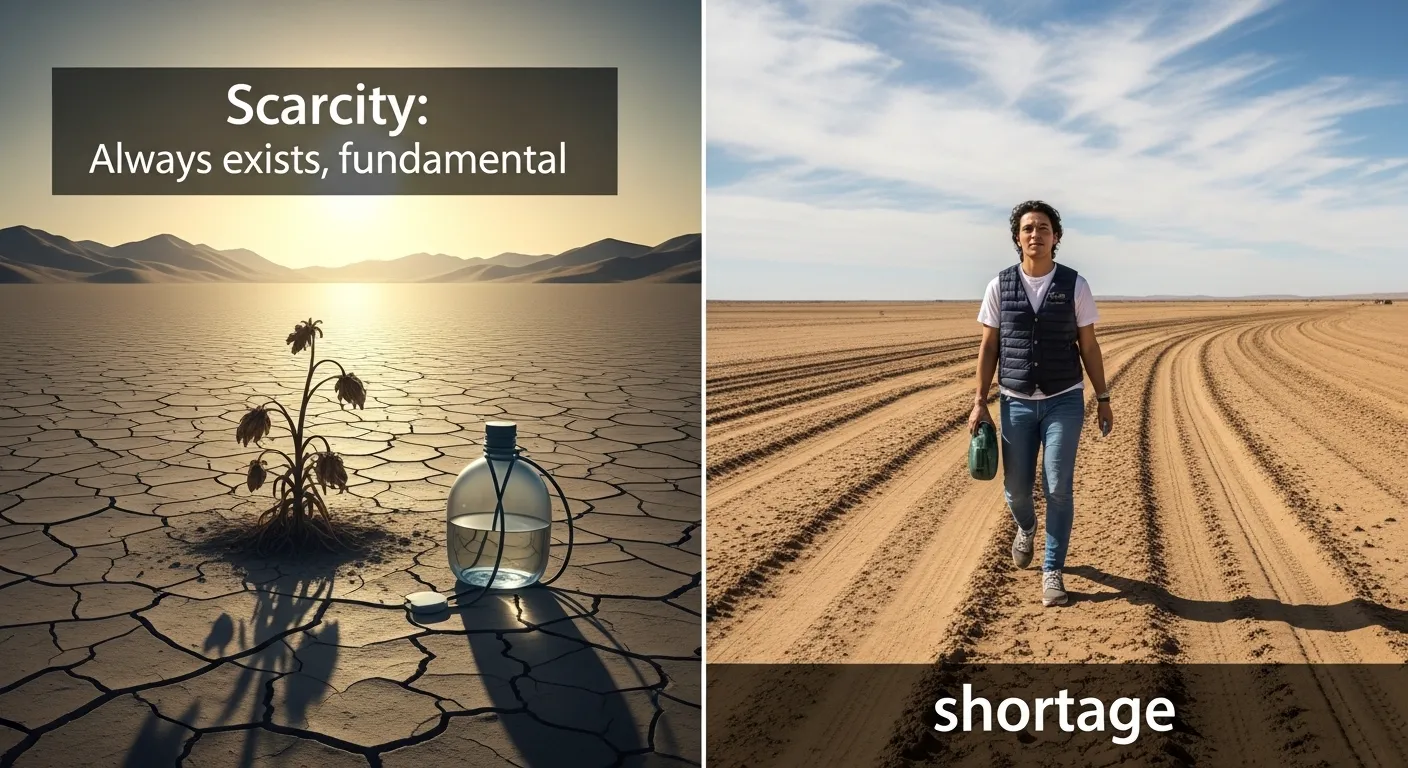
Many people use the terms interchangeably because both involve limited availability. However, shortage is temporary, while scarcity is permanent and fundamental.
Table: Difference and Similarity Between Shortage and Scarcity
| Feature | Shortage | Scarcity | Similarity |
| Definition | Temporary lack of goods/services | Permanent limited resources | Both involve limited availability |
| Duration | Short-term | Long-term | Affect consumption decisions |
| Cause | Market fluctuations | Natural limitations | Can affect prices |
| Solution | Increase supply | Efficient resource management | Need planning and attention |
| Examples | Masks, smartphones | Water, oil, land | Both impact society |
Which is Better in What Situation?
- Shortage: Understanding shortages helps businesses and consumers respond quickly to temporary market changes. For example, stocking up essentials during festival seasons prevents inconvenience.
- Scarcity: Awareness of scarcity encourages sustainable practices. Governments and planners can create policies to manage water, energy, and other limited resources effectively.
Metaphors and Similes
- Shortage: “A shortage is like a temporary traffic jam; it causes inconvenience but eventually clears.”
- Scarcity: “Scarcity is like a desert; no matter how far you search, resources are limited.”
Connotative Meaning:
- Shortage: Neutral (temporary and solvable)
- Scarcity: Negative (permanent and challenging)
Idioms/Proverbs:
- “Make hay while the sun shines” is useful when addressing temporary shortages.
- “A drop in the ocean” shows scarcity of resources compared to demand.
Works in Literature
- “Scarcity and Society” Non-fiction, John Smith, 2015
- “The Shortage Effect” Fiction, Emma Clarke, 2019
Movies on the Keywords
- The Scarcity (2020, UK)
- Shortage Crisis (2018, USA)
Frequently Asked Questions
- What is the main difference between shortage and scarcity?
- Shortage is temporary; scarcity is permanent.
- Shortage is temporary; scarcity is permanent.
- Can shortage lead to scarcity?
- No, shortage is short-term; scarcity is due to limited resources.
- No, shortage is short-term; scarcity is due to limited resources.
- Are shortages always negative?
- Not always; they can be managed quickly.
- Not always; they can be managed quickly.
- Why is scarcity more concerning than shortage?
- Scarcity requires long-term planning due to its permanent nature.
- Scarcity requires long-term planning due to its permanent nature.
- Can both affect prices?
- Yes, both can increase prices, but scarcity has long-term effects.
- Yes, both can increase prices, but scarcity has long-term effects.
How Both Are Useful for Surroundings
Shortages push businesses to improve supply chains, while scarcity encourages sustainable use of natural resources, protecting the environment and ensuring long-term survival.
Final Words
Understanding the difference between shortage and scarcity empowers individuals, businesses, and governments to make better economic and environmental decisions. While shortages are challenges to overcome, scarcity is a reminder to value and manage resources wisely.
Conclusion
The concepts of shortage and scarcity are crucial in economics and everyday life. Shortage refers to a temporary gap between demand and supply, easily addressed by market adjustments.
Scarcity, however, is a permanent limitation of resources, requiring strategic management and sustainable planning. Confusing these terms can lead to poor decision-making, whether in personal life, business, or public policy.
Recognizing their differences allows us to react appropriately to immediate needs while planning for long-term sustainability. By understanding both, societies can efficiently allocate resources, avoid wastage, and ensure a stable economic and environmental future

I am D. H. Lawrence (David Herbert Lawrence) an influential English novelist, poet, essayist, and literary critic born on September 11, 1885, in Eastwood, Nottinghamshire, England. He is widely regarded as one of the most important writers of the 20th century.
I work often explored human relationships, emotional intimacy, industrialization, and the conflict between modern society and natural instincts.