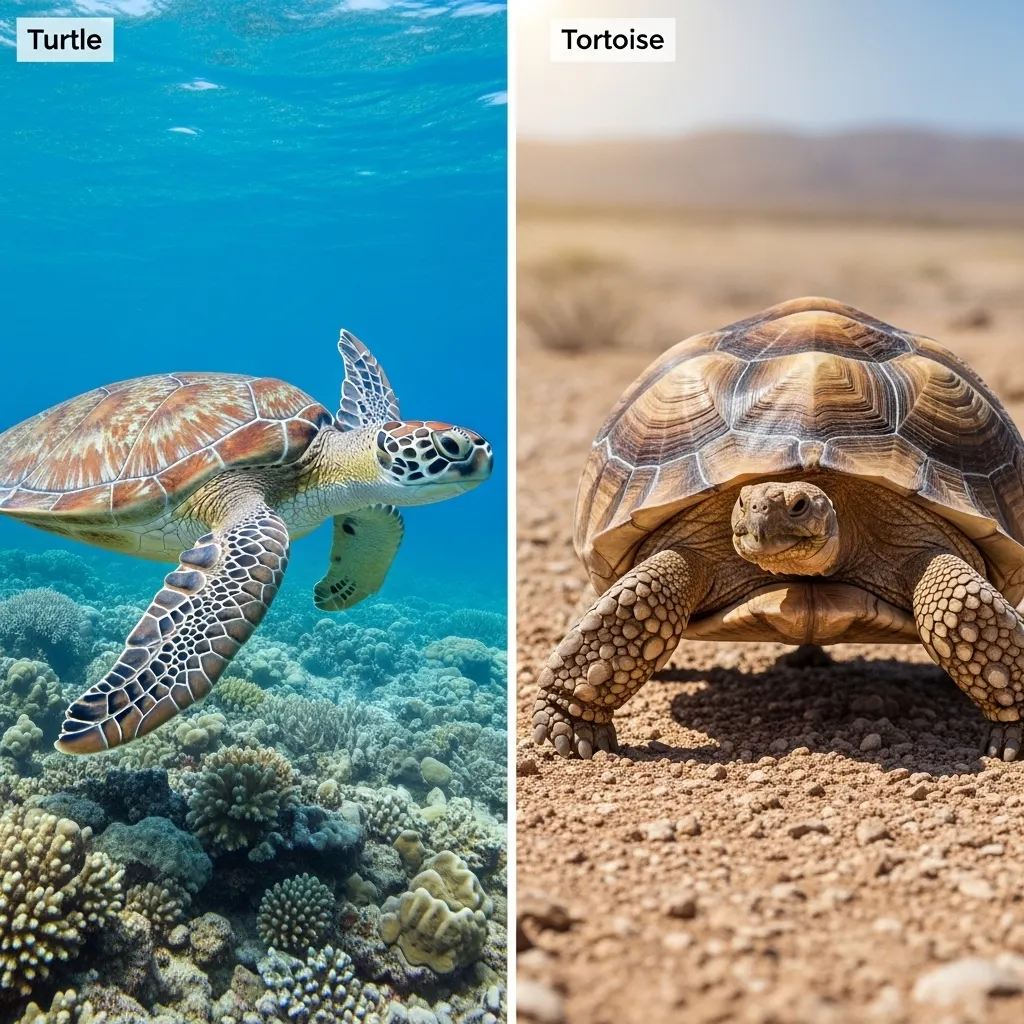
Turtles and tortoises are fascinating creatures that have roamed the Earth for millions of years. While many people use the words interchangeably, understanding the difference between turtle and tortoise is essential for animal lovers, learners, and experts alike.
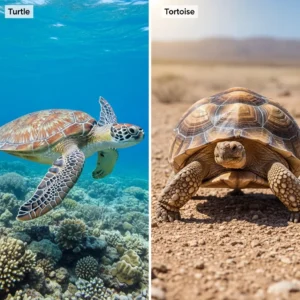
Imagine visiting a beach and spotting a turtle gliding gracefully through the water, while far inland, a tortoise slowly ambles through a garden. Both are reptiles, but their habitats, behaviors, and even physical structures differ significantly.
The difference between turtle and tortoise is not just scientific, it helps in conservation, education, and even in cultural references. Knowing this distinction enhances our appreciation of wildlife and ensures accurate communication when describing these amazing creatures.
Pronunciation:
- Turtle: /ˈtɜːr.tl/ (US & UK similar)
- Tortoise: /ˈtɔːr.təs/ (US & UK similar)
Now that we know what turtles and tortoises are, let’s explore their key differences.
Difference Between Turtle and Tortoise
1. Habitat
- Turtle: Lives mostly in water, oceans, rivers, and ponds.
- Example 1: A sea turtle swims across the Pacific Ocean.
- Example 2: Freshwater turtles live in rivers and lakes.
- Example 1: A sea turtle swims across the Pacific Ocean.
- Tortoise: Lives on land, especially in forests, deserts, and grasslands.
- Example 1: The Galapagos tortoise roams the islands.
- Example 2: Indian star tortoises prefer dry forests.
- Example 1: The Galapagos tortoise roams the islands.
2. Shell Shape
- Turtle: Flat, streamlined shell for swimming.
- Example 1: Loggerhead turtles have smooth, rounded shells.
- Example 2: Green sea turtles glide easily with their flat shells.
- Example 1: Loggerhead turtles have smooth, rounded shells.
- Tortoise: Dome-shaped, heavy shell for protection.
- Example 1: Sulcata tortoises have thick, domed shells.
- Example 2: African spurred tortoise uses its shell to shield itself from predators.
- Example 1: Sulcata tortoises have thick, domed shells.
3. Leg Structure
- Turtle: Webbed feet or flippers for swimming.
- Example 1: Sea turtles’ flippers propel them through water.
- Example 2: Pond turtles use webbed feet to paddle.
- Example 1: Sea turtles’ flippers propel them through water.
- Tortoise: Short, sturdy legs for walking on land.
- Example 1: Hermann’s tortoise crawls slowly on rocky terrain.
- Example 2: Leopard tortoise uses strong legs to dig burrows.
- Example 1: Hermann’s tortoise crawls slowly on rocky terrain.
4. Diet
- Turtle: Mostly omnivorous plants, insects, and small fish.
- Example 1: Red-eared sliders eat aquatic plants and tiny fish.
- Example 2: Sea turtles feed on jellyfish and algae.
- Example 1: Red-eared sliders eat aquatic plants and tiny fish.
- Tortoise: Primarily herbivorous grass, leaves, fruits.
- Example 1: Galapagos tortoise eats cactus and shrubs.
- Example 2: Indian star tortoise feeds on fruits and flowers.
- Example 1: Galapagos tortoise eats cactus and shrubs.
5. Lifespan
- Turtle: Usually 20–50 years depending on species.
- Example 1: Box turtles live around 40 years.
- Example 2: Sea turtles can reach 50 years.
- Example 1: Box turtles live around 40 years.
- Tortoise: Can live 80–150 years.
- Example 1: Aldabra tortoise may live 120 years.
- Example 2: Galapagos tortoise may exceed 150 years.
- Example 1: Aldabra tortoise may live 120 years.
6. Speed
- Turtle: Faster in water but slow on land.
- Example 1: Leatherback turtles swim swiftly in oceans.
- Example 2: Pond turtles crawl slowly on riverbanks.
- Example 1: Leatherback turtles swim swiftly in oceans.
- Tortoise: Slow movers on land.
- Example 1: Giant tortoises take hours to cross a small field.
- Example 2: Indian star tortoise moves cautiously to avoid predators.
- Example 1: Giant tortoises take hours to cross a small field.
7. Reproduction
- Turtle: Lays eggs on sand near water bodies.
- Example 1: Sea turtles return to the same beach to lay eggs.
- Example 2: Freshwater turtles bury eggs in riverbanks.
- Example 1: Sea turtles return to the same beach to lay eggs.
- Tortoise: Lays eggs on land in burrows.
- Example 1: Desert tortoises lay eggs in sand burrows.
- Example 2: Galapagos tortoises deposit eggs in soil nests.
- Example 1: Desert tortoises lay eggs in sand burrows.
8. Skin Texture
- Turtle: Smooth, moist skin to aid swimming.
- Example 1: Red-eared slider has slick, soft skin.
- Example 2: Sea turtles’ skin helps reduce friction in water.
- Example 1: Red-eared slider has slick, soft skin.
- Tortoise: Rough, dry skin for land adaptation.
- Example 1: Sulcata tortoise has scaly skin for desert survival.
- Example 2: Leopard tortoise skin protects against rough terrain.
- Example 1: Sulcata tortoise has scaly skin for desert survival.
9. Temperature Sensitivity
- Turtle: Prefers moderate temperatures and water regulates body heat.
- Example 1: Aquatic turtles bask under the sun but stay in water.
- Example 2: Sea turtles migrate to warmer waters.
- Example 1: Aquatic turtles bask under the sun but stay in water.
- Tortoise: Can tolerate high heat but needs shade and burrows.
- Example 1: Desert tortoises avoid scorching midday sun.
- Example 2: Galapagos tortoise seeks shelter in volcanic rocks.
- Example 1: Desert tortoises avoid scorching midday sun.
10. Behavior
- Turtle: Social, swims in groups, migratory.
- Example 1: Loggerhead turtles migrate thousands of miles.
- Example 2: Freshwater turtles bask together in ponds.
- Example 1: Loggerhead turtles migrate thousands of miles.
- Tortoise: Solitary, territorial, slow-paced.
- Example 1: Aldabra tortoise wanders alone in islands.
- Example 2: Indian star tortoise avoids crowds and stays hidden.
- Example 1: Aldabra tortoise wanders alone in islands.
Nature and Behavior
- Turtle: Agile, curious, adaptable to water and land, enjoys basking and social interactions.
- Tortoise: Calm, patient, slow-moving, territorial, prefers solitude and protection.
Why People Are Confused
Many confuse turtles and tortoises because both are shelled reptiles. Popular media, cartoons, and casual conversation often misuse the terms interchangeably. However, understanding their habitats and behavior clarifies the distinction.
Table of Differences and Similarities
| Feature | Turtle | Tortoise | Similarity |
| Habitat | Water | Land | Both are reptiles |
| Shell | Flat/streamlined | Dome-shaped | Hard protective shell |
| Legs | Webbed/flippers | Short/sturdy | Four limbs |
| Diet | Omnivorous | Herbivorous | Eat plants to some extent |
| Lifespan | 20–50 years | 80–150 years | Can live decades |
| Speed | Fast in water | Slow on land | Slow on land |
| Behavior | Social | Solitary | Both lay eggs |
| Skin | Smooth/moist | Rough/dry | Reptilian skin |
| Reproduction | Sand nests | Burrow nests | Egg-laying |
| Temperature | Moderate | Heat-tolerant | Ectothermic |
Which Is Better in What Situation?
- Turtle: Ideal for aquatic environments, research on marine life, and educational programs. Its swimming skills make it perfect for water-based ecosystems.
- Tortoise: Best for land conservation projects, gardens, and educational studies on slow-paced terrestrial reptiles. Its long lifespan and calm nature make it a great pet in suitable climates.
Turtles and Tortoises in Metaphors and Similes
- Metaphor: “He is a tortoise in a race of hares,” symbolizing patience.
- Simile: “She glided like a turtle through the pond,” indicating smooth movement.
Connotative Meaning:
- Turtle – Neutral/positive (patience, adaptability).
- Tortoise – Positive (steadfast, longevity).
Idioms and Proverbs
- “Slow and steady wins the race” – Refers to tortoise.
- “As wise as an old turtle” – Symbolizes knowledge and experience.
Works in Literature
- “The Tortoise and the Hare” (Fable, Aesop, 600 BC)
- “Teenage Mutant Ninja Turtles” (Comic, Kevin Eastman & Peter Laird, 1984)
Movies Based on Keywords
- “Teenage Mutant Ninja Turtles” (1990, USA)
- “A Turtle’s Tale: Sammy’s Adventures” (2010, France/Belgium)
Frequently Asked Questions
- Are all turtles sea creatures?
- No, some turtles live in freshwater rivers and ponds.
- No, some turtles live in freshwater rivers and ponds.
- Can tortoises swim?
- Very poorly; they are primarily land-dwellers.
- Very poorly; they are primarily land-dwellers.
- Which lives longer, turtle or tortoise?
- Tortoises live longer, often 80–150 years.
- Tortoises live longer, often 80–150 years.
- Do turtles and tortoises eat the same food?
- No, turtles are omnivorous; tortoises are mostly herbivorous.
- No, turtles are omnivorous; tortoises are mostly herbivorous.
- Why are turtles faster than tortoises?
- Turtles are adapted to swimming; tortoises are land-based and slow.
- Turtles are adapted to swimming; tortoises are land-based and slow.
Environmental Benefits
- Turtles: Maintain aquatic ecosystems, control insect and fish populations.
- Tortoises: Aid in seed dispersal, soil aeration, and maintaining biodiversity on land.
Final Words
Both turtles and tortoises are remarkable reptiles that showcase nature’s diversity. Appreciating their differences enriches our understanding and helps in wildlife preservation.
Conclusion
Turtles and tortoises, though often confused, are distinct in habitat, shell structure, behavior, and lifespan. Turtles excel in aquatic environments with their swimming abilities, while tortoises thrive on land with slow, steady movements.
Recognizing these differences not only clarifies scientific understanding but also aids conservation efforts. Their symbolism in literature, idioms, and metaphors highlights patience, resilience, and adaptability.
By respecting their unique traits, humans can contribute to their survival and the ecological balance they maintain. Learning the difference between turtle and tortoise is essential for students, animal enthusiasts, and researchers alike, enhancing both knowledge and appreciation of these ancient reptiles.

I am D. H. Lawrence (David Herbert Lawrence) an influential English novelist, poet, essayist, and literary critic born on September 11, 1885, in Eastwood, Nottinghamshire, England. He is widely regarded as one of the most important writers of the 20th century.
I work often explored human relationships, emotional intimacy, industrialization, and the conflict between modern society and natural instincts.