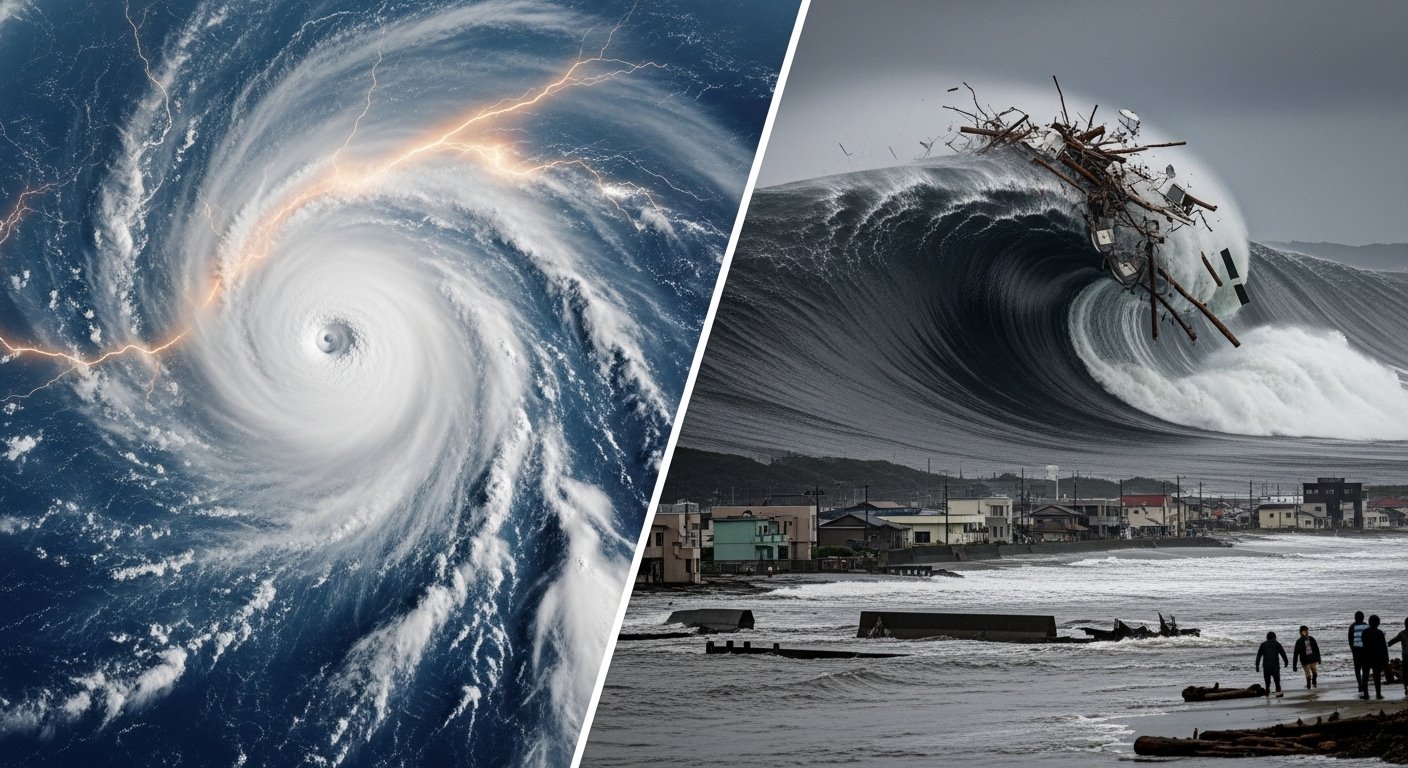
Natural disasters have always fascinated and terrified humans. Imagine a small coastal village in the Philippines where people hear warnings of a massive storm approaching.
The weather reports say a typhoon is coming, while scientists also warn about the possibility of a tsunami due to undersea earthquakes.
Many villagers wonder: what exactly is the difference between a typhoon and a tsunami? Both are powerful and destructive, but they are very different in nature.
Understanding the difference between a typhoon and tsunami is crucial not only for safety but also for preparing emergency plans.
In many cases, experts emphasize that confusing the two can be dangerous. In this blog, we’ll explore everything from definitions to real-world examples, pronunciation, and cultural references of typhoons and tsunami.
Pronunciation:
- Typhoon US: /taɪˈfuːn/ | UK: /taɪˈfuːn/
- Tsunami US: /tsuːˈnɑːmi/ | UK: /tsuːˈnɑːmi/
Let’s dive deeper to fully understand the difference between typhoons and tsunamis, their behaviors, and their impact.
Difference Between Typhoon and Tsunami
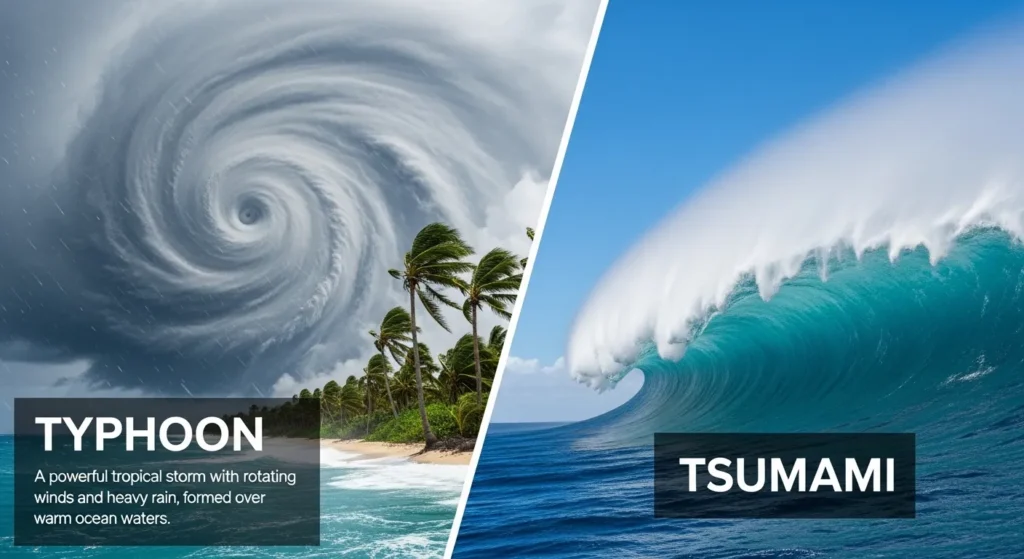
1. Origin
- Typhoon: Formed due to atmospheric disturbances, warm ocean water, and wind patterns.
- Example 1: Typhoon Haiyan (2013, Philippines) caused strong winds and heavy rain.
- Example 2: Typhoon Mangkhut (2018, Philippines & China) brought widespread flooding.
- Example 1: Typhoon Haiyan (2013, Philippines) caused strong winds and heavy rain.
- Tsunami: Caused by underwater earthquakes, volcanic eruptions, or landslides.
- Example 1: 2004 Indian Ocean tsunami devastated coastal countries.
- Example 2: 2011 Tōhoku tsunami in Japan caused nuclear plant damage.
- Example 1: 2004 Indian Ocean tsunami devastated coastal countries.
2. Nature of Movement
- A typhoon moves through the air as a rotating storm.
- A tsunami travels through the sea as a massive wave.
3. Speed
- Typhoon: Travels at 1560 km/h.
- Tsunami: Can travel up to 800 km/h in deep water.
4. Warning Signs
- Typhoon: Cloud patterns, heavy rainfall, and wind speed alerts.
- Tsunami: Earthquake tremors, unusual sea-level changes.
5. Duration
- Typhoon: Can last for days or weeks.
- Tsunami: Usually lasts minutes but can have multiple waves.
6. Impact Area
- Typhoon: Affects large land regions with wind and rain.
- Tsunami: Primarily affects coastal areas.
7. Destruction Type
- Typhoon: Wind damage, flooding, uprooted trees.
- Tsunami: Drowning, structural collapse from water pressure.
8. Predictability
- Typhoon: Can be tracked via weather satellites.
- Tsunami: Harder to predict unless seismic activity is detected.
9. Human Preparedness
- Typhoon: Evacuation centers, windproof structures.
- Tsunami: Early warning systems, coastal barriers.
10. Frequency
- Typhoon: Seasonal, more common in tropical regions.
- Tsunami: Rare but catastrophic.
Examples to elaborate:
- Typhoon Tip (1979, Japan) strongest recorded typhoon.
- Sumatra Tsunami (2004, Indonesia) caused massive loss of life.
Nature and Behavior
Typhoon: Whirling storms, heavy rains, and wind. Behavior is slow-moving but prolonged.
Tsunami: Sudden, fast-moving, destructive water waves. Behavior is abrupt but short-lived.
Why People Are Confused
Both can cause flooding and destruction, which makes them appear similar. Media reports sometimes interchange them, adding to confusion.
Table: Difference & Similarity
| Feature | Typhoon | Tsunami | Similarity |
| Origin | Atmosphere & warm ocean | Underwater earthquake/volcano | Both natural disasters |
| Movement | Air (rotating storm) | Sea (wave) | Cause damage |
| Speed | 1560 km/h | 500800 km/h | Affected areas require warning |
| Duration | Days/weeks | Minutes | Both can impact humans |
| Area Affected | Wide land regions | Coastal areas | Can destroy infrastructure |
| Predictability | High via satellites | Low, seismic dependent | Early warning saves lives |
| Destruction Type | Wind & flood damage | Drowning & water pressure | Both require preparedness |
Which Is Better in What Situation?
Neither is “better” in reality; it depends on context. Typhoons are easier to track and prepare for, making them manageable with evacuation plans.
Tsunamis strike suddenly, requiring efficient warning systems. In disaster planning, understanding their differences saves lives and infrastructure.
Metaphors, Similes & Connotation
- Typhoon: Metaphor for strong emotions (“Her anger was a typhoon”). Connotation: Negative
- Tsunami: Metaphor for overwhelming events (“A tsunami of grief”). Connotation: Negative
Idioms/Proverbs:
- “Ride out the typhoon” face challenges calmly.
- “A tsunami of change” sudden overwhelming transformation.
Works in Literature
- Typhoon Joseph Conrad, Novel, 1902
- Tsunami Takashi Hiroshi, Short Story, 2008
Movies
- Typhoon (2005, South Korea)
- Tsunami: The Aftermath (2006, UK/USA)
FAQs
- Are typhoons and tsunamis the same? No, typhoons are storms; tsunamis are waves caused by seismic events.
- Can a typhoon trigger a tsunami? Rarely, usually only indirectly through underwater landslides.
- Which is faster? Tsunami waves are much faster than typhoon winds.
- Which causes more casualties? Tsunamis often cause sudden mass fatalities.
- How to prepare for each? Typhoons: shelters and evacuation. Tsunami: early warning and moving inland.
Environmental Importance
Both play roles in nature: typhoons distribute heat and rainfall, while tsunamis reshape coastlines and replenish nutrients.
Final Words
Understanding the difference between typhoons and tsunamis is essential for safety, science, and communication. Awareness saves lives and reduces panic.
Conclusion
Typhoons and tsunamis are two of nature’s most destructive forces, but they differ fundamentally.
Typhoons are atmospheric storms that bring wind and rain over days, while tsunamis are massive water waves triggered by underwater seismic activity.
Confusing the two can lead to inadequate preparedness. By studying their differences in origin, speed, movement, and impact, experts, students, and society can better prepare for natural disasters.
Proper knowledge ensures timely warnings, minimizes damage, and fosters resilience. Both disasters, while dangerous, teach us the power of nature and the importance of preparedness, helping communities survive and rebuild.

I am James Anderson an English author known for his insightful and engaging writing in contemporary literature. With a focus on [insert genre, e.g., fiction, non-fiction, or specific themes], he explores complex human emotions and social dynamics, blending thought-provoking ideas with accessible storytelling. His work has earned recognition for its clarity, depth, and ability to connect with a wide audience, establishing him as a respected voice in modern English literature.