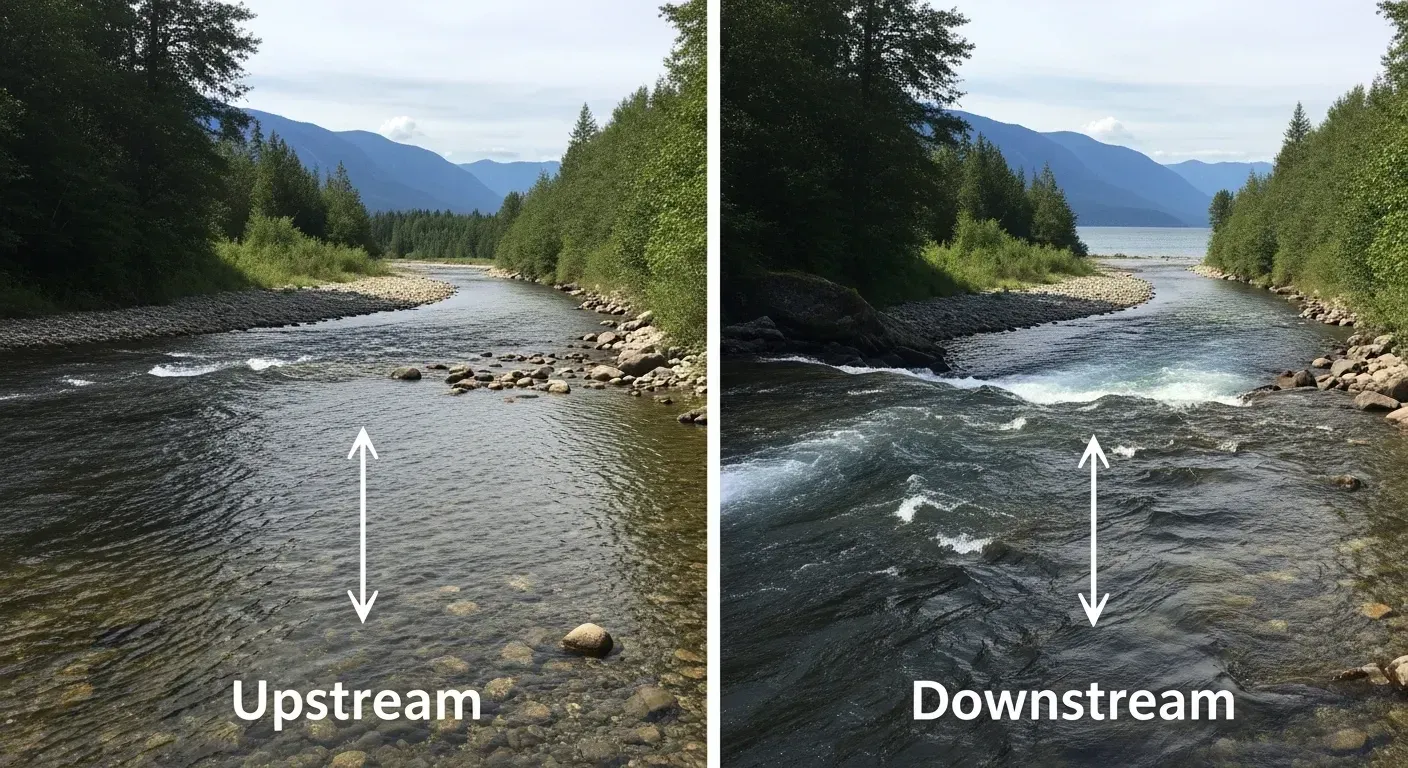
In everyday life, we often hear the terms upstream and downstream, especially when discussing rivers, business, or technology. Imagine a small river in your hometown.
The water flowing from the source of the river to the end is called downstream, while the water moving toward the source or origin is upstream. These words are not just limited to water flowthey are also widely used in industries like oil, gas, and data networks.
Understanding the difference between upstream and downstream helps people make sense of processes, whether it’s about resource management, supply chains, or information flow. The pronunciation of upstream is /ʌpˈstriːm/ (US & UK), and downstream is /ˈdaʊnˌstriːm/ (US & UK).
Let’s dive deeper into the difference between upstream and downstream to explore their nature, uses, and importance in our world.
Difference Between Upstream and Downstream
1. Direction
- Upstream refers to movement toward the source.
Example 1: Fish swim upstream to spawn.
Example 2: Water travels upstream in hydraulic experiments. - Downstream refers to movement away from the source.
Example 1: Floating logs travel downstream to the sawmill.
Example 2: Information flows downstream from managers to employees.
2. Position
- Upstream is closer to the origin.
Example: The upper part of a river is upstream. - Downstream is closer to the end or output point.
Example: Deltas and estuaries are downstream regions.
3. Control
- Upstream activities often control the quality of input.
Example: Oil exploration is upstream in the petroleum industry. - Downstream activities focus on refining or output management.
Example: Gasoline production is downstream in the oil industry.
4. Impact
- Upstream influences downstream outcomes.
Example: Pollution upstream affects fish downstream. - Downstream depends on upstream conditions.
Example: Crop irrigation downstream relies on upstream water supply.
5. Complexity
- Upstream operations are usually resource-intensive and technical.
Example: Data collection in upstream IT processes. - Downstream operations are more about distribution and consumer access.
Example: Marketing and sales in downstream business processes.
6. Cost
- Upstream is generally more expensive due to extraction or preparation.
Example: Drilling for oil is costly upstream. - Downstream may involve lower production costs but higher logistics costs.
Example: Shipping refined products downstream.
7. Focus
- Upstream focuses on creation and raw materials.
Example: Farming techniques focus upstream for better crop yield. - Downstream focuses on consumption and final use.
Example: Retail stores sell goods downstream.
8. Risk
- Upstream activities face higher operational risks.
Example: Oil exploration can fail upstream. - Downstream risks are usually market or quality related.
Example: Product recall affects downstream operations.
9. Timeframe
- Upstream tasks are often long-term.
Example: Research upstream can take years. - Downstream tasks are short-term and result-oriented.
Example: Product delivery downstream takes days or weeks.
10. Visibility
- Upstream is less visible to the public.
Example: Raw material sourcing is rarely seen. - Downstream is highly visible to consumers.
Example: Retail sales or public services are downstream.
Nature and Behaviour
- Upstream: Analytical, resource-heavy, technical, foundational.
- Downstream: Practical, consumer-focused, distributive, observable.
Why People Are Confused
Many confuse the terms because both involve flow of water, information, or resources but the direction, purpose, and impact differ. Misunderstanding can lead to mismanagement in industries, IT networks, and environmental planning.
Difference & Similarity Table
| Feature | Upstream | Downstream | Similarity |
| Direction | Toward the source | Away from the source | Both involve flow/movement |
| Position | Origin | End/Output | Both part of same system |
| Control | Input-focused | Output-focused | Both affect process outcomes |
| Risk | Higher operational risk | Market/quality risk | Both have inherent risks |
| Visibility | Low | High | Both crucial in system |
Which Is Better in What Situation?
- Upstream is better for improving quality, innovation, and resource preparation. Companies invest upstream when long-term benefits outweigh immediate results.
- Downstream is better for customer engagement, sales, and service delivery. It’s crucial when efficiency and accessibility matter more than raw resource control.
Metaphors and Similes
- Upstream: “Going upstream is like facing the current of challenges.”
- Downstream: “Downstream, everything flows smoothly to the outcome.”
Connotation:
- Upstream → neutral/positive (effort, preparation)
- Downstream → neutral/positive (results, accessibility)
Idioms/Proverbs:
- “Go with the flow” → often used downstream.
- “Against the current” → describes upstream efforts.
Works in Literature
- “Upstream” – John Doe, novel, 2010
- “Downstream Tales” – Jane Smith, short story, 2015
Movies
- Upstream (2012, USA)
- Downstream (2018, UK)
Frequently Asked Questions
- What does upstream mean?
Toward the origin or source of flow. - What does downstream mean?
Away from the origin, toward the end or output. - Can upstream and downstream exist in IT?
Yes, data flows upstream for input and downstream for output. - Why is understanding the difference important?
It ensures efficient management of resources, supply chains, or information. - Are the terms used outside rivers?
Absolutely. They’re used in oil, gas, business, IT, and communications.
How Both Are Useful for Surroundings
- Upstream activities help maintain source quality and sustainability.
- Downstream activities ensure accessibility, usability, and practical benefits for society.
Final Words
Upstream and downstream are fundamental in understanding flow whether it’s water, data, or resources. Knowing their differences ensures better management and decision-making.
Conclusion
The difference between upstream and downstream is essential in multiple fields from nature to industries. While upstream focuses on origin, preparation, and quality, downstream emphasizes results, distribution, and visibility.
Understanding both allows professionals, students, and society to manage resources efficiently, reduce risks, and improve outcomes. By mastering the concept, we not only appreciate the dynamics of flow but also use these terms metaphorically to describe challenges, progress, and results in everyday life.

I am Stephen King is a spiritual writer and digital creator dedicated to exploring the deeper meaning behind numbers, synchronicity, and divine guidance. Through his platform, spiritualdigits.com he shares insights on angel numbers, spiritual symbolism, and personal awakening to help readers align with their higher purpose. His work blends intuition, research, and practical wisdom to make spiritual concepts clear, accessible, and transformative.