Imagine you are at home preparing an important document for printing. You click print, but suddenly the printer stops working.
The screen shows a message: “Replace Ink Cartridge” or “Replace Toner Cartridge.” Many people pause at this moment and wonder what the difference between ink and toner actually is.Both ink and toner are materials used in printers to create text and images on paper.
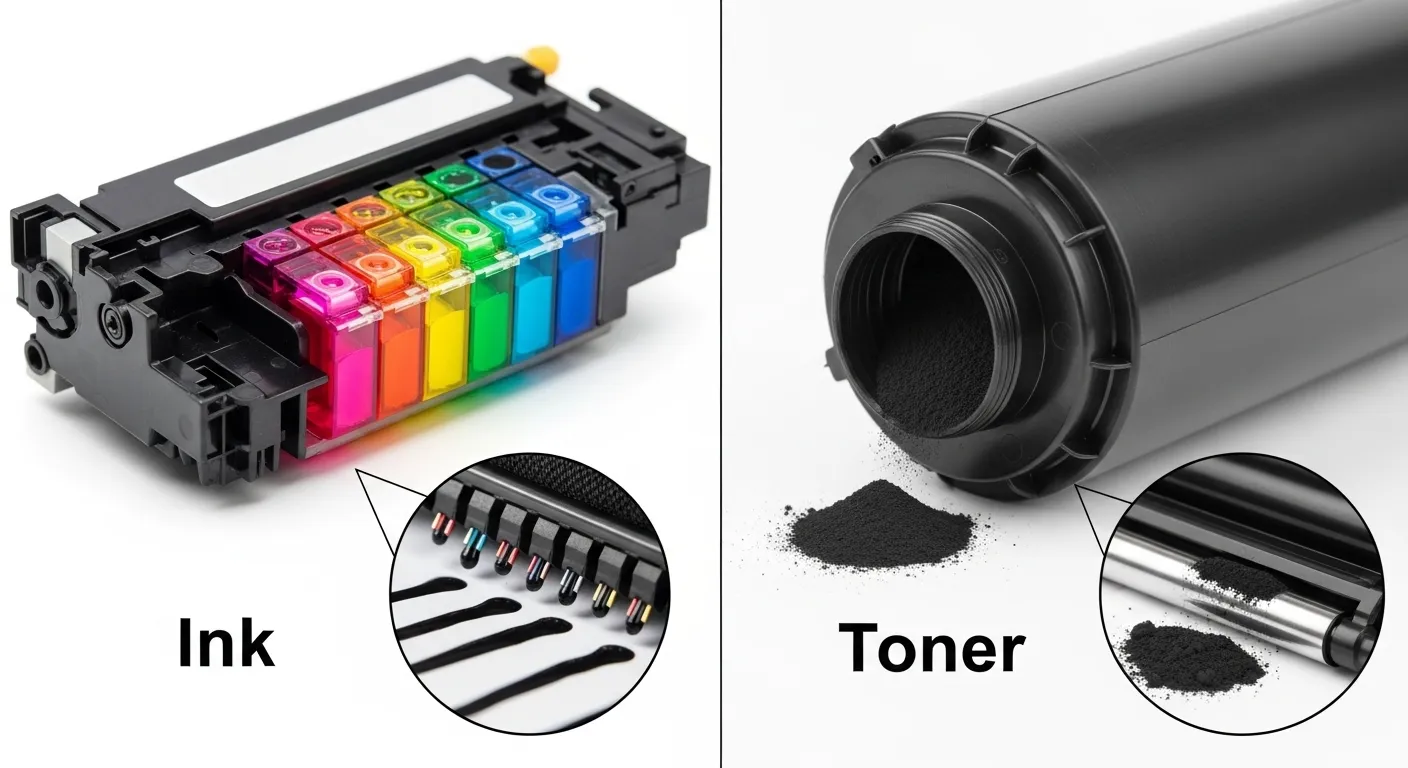
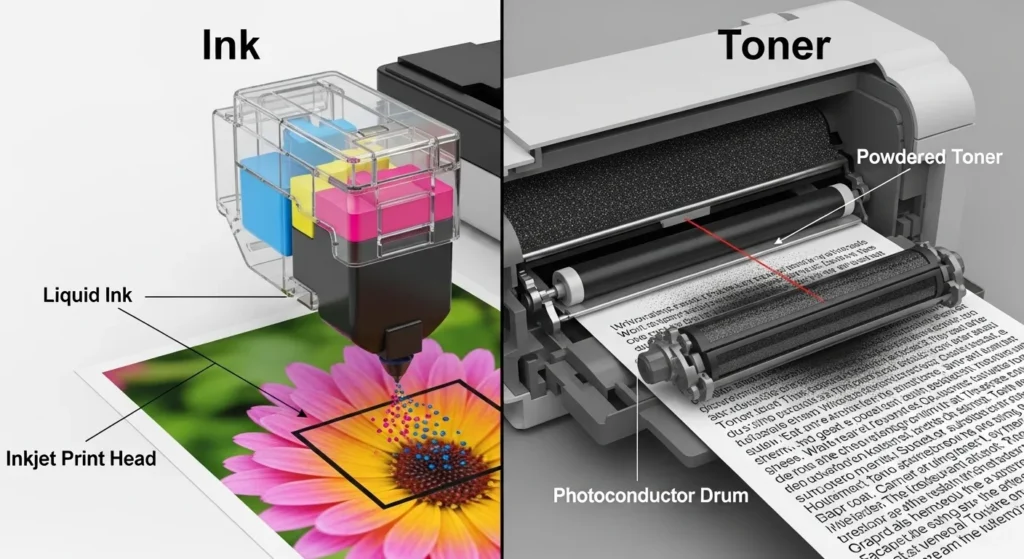
Ink is a liquid substance used mainly in inkjet printers, while toner is a fine powder used in laser printers.Understanding the difference between ink and toner can help users choose the right printer, reduce printing costs, and maintain better print quality.
In everyday offices, schools, and homes, knowing the difference between ink and toner helps avoid confusion when buying cartridges or troubleshooting printers. For learners, professionals, and business owners, understanding the difference between ink and toner is essential for making smarter technology choices.
Pronunciation
Ink
- US: /ɪŋk/
- UK: /ɪŋk/
Toner
- US: /ˈtoʊnər/
- UK: /ˈtəʊnə/
Before diving deeper, let us explore how the difference between ink and toner appears in practical printing situations.
Key Difference Between the Two
The main difference between ink and toner lies in their form and printing technology.
- Ink is a liquid dye or pigment sprayed onto paper by inkjet printers.
- Toner is a powdered substance fused onto paper using heat in laser printers.
This difference affects printing speed, cost, durability, and usage.
Why Knowing Their Difference Is Important for Learners and Experts
Understanding the difference between ink and toner is valuable for both beginners and professionals.
For students and learners, it helps them select the right printer for assignments and projects. Inkjet printers are often affordable and suitable for color images.
For business professionals, toner-based laser printers are more efficient for large volumes of documents. Offices rely on toner printers for fast and durable printing.
For society, this knowledge reduces waste and improves productivity. Organizations can choose printers that save money, energy, and resources.
Difference Between Ink and Toner
1. Physical Form
Ink:
Ink is a liquid substance made of dyes or pigments mixed with water or solvents.
Examples:
- Ink in a home inkjet printer producing colorful photos.
- Ink used in art pens and markers.
Toner:
Toner is a dry powder made from plastic particles and pigment.
Examples:
- Toner powder in office laser printers.
- Toner used for high-volume document printing.
2. Printer Type
Ink:
Used in inkjet printers.
Examples:
- Home printers used for school projects.
- Photo printers for high-quality pictures.
Toner:
Used in laser printers.
Examples:
- Office printers for bulk printing.
- Corporate printers printing hundreds of pages daily.
3. Printing Technology
Ink:
Sprayed onto paper through tiny nozzles.
Examples:
- Printing colorful brochures.
- Printing images with gradients.
Toner:
Fused onto paper using heat and static electricity.
Examples:
- Printing invoices quickly.
- Printing reports in large quantities.
4. Printing Speed
Ink:
Generally slower.
Examples:
- Printing homework pages.
- Printing family photos.
Toner:
Much faster.
Examples:
- Printing 100 office documents quickly.
- Printing exam papers in schools.
5. Cost Efficiency
Ink:
Cheaper printers but cartridges run out quickly.
Examples:
- Home users buying affordable printers.
- Students printing occasionally.
Toner:
More expensive printers but toner lasts longer.
Examples:
- Businesses printing thousands of pages.
- Libraries printing many documents daily.
6. Print Quality
Ink:
Excellent for images and photographs.
Examples:
- Printing wedding photos.
- Printing graphic design projects.
Toner:
Best for sharp text.
Examples:
- Printing contracts.
- Printing professional reports.
7. Durability
Ink:
Can smudge if wet.
Examples:
- Ink running when water spills on paper.
- Ink fading over time.
Toner:
More durable and water-resistant.
Examples:
- Documents lasting longer in archives.
- Printed reports surviving light moisture.
8. Maintenance
Ink:
Nozzles can clog if unused.
Examples:
- Printer unused for months causing clogged ink.
- Ink drying in cartridges.
Toner:
Requires less maintenance.
Examples:
- Laser printers work after long periods.
- Toner lasting for months.
9. Environmental Impact
Ink:
Cartridges are smaller but replaced frequently.
Examples:
- Home users discard empty cartridges.
- Schools replace cartridges regularly.
Toner:
Large cartridges but last longer.
Examples:
- Offices replacing toner less often.
- Recycling toner cartridges.
10. Usage Environment
Ink:
Best for personal and creative printing.
Examples:
- Printing family photos.
- Printing school artwork.
Toner:
Best for professional and large-scale printing.
Examples:
- Printing office reports.
- Printing legal documents.
Nature and Behaviour of Both
Ink:
Ink behaves like liquid dye that spreads slightly on paper. It produces vibrant colors and detailed images but can smear if touched before drying.
Toner:
Toner behaves like fine powder that melts onto paper during printing. It creates crisp text and long-lasting prints.
Why People Are Confused About Their Use
People often confuse ink and toner because both are used in printers and serve the same purpose of printing text and images. Additionally, cartridges for both look similar, and many users are unaware that inkjet printers and laser printers use completely different technologies.
Table Showing Difference and Similarity
| Feature | Ink | Toner | Similarity |
| Form | Liquid | Powder | Both used for printing |
| Printer Type | Inkjet | Laser | Both produce text/images |
| Speed | Slower | Faster | Used in offices and homes |
| Cost | Lower printer price | Higher printer price | Require cartridges |
| Quality | Best for photos | Best for text | Improve document presentation |
Which Is Better in What Situation?
Ink is better for creative printing.
Inkjet printers are ideal for homes, students, and photographers. They produce vibrant colors and detailed images, making them perfect for photos, posters, and artwork. If someone prints occasionally and values image quality more than speed, ink printers are the better choice.
Toner is better for professional printing.
Laser printers using toner are ideal for offices and businesses. They print faster, last longer, and handle high-volume printing efficiently. For organizations printing hundreds of pages daily, toner printers provide better cost efficiency and durability.
Use in Metaphors and Similes
Ink:
- “His ideas flowed like ink on paper.”
- “History is written in ink.”
Toner:
- “Her voice had a calm tone of authority.”
- “The document carried the official tone of the organization.”
Connotative Meaning
Ink
- Positive: creativity, expression
- Example: “The writer’s ink changed the world.”
- Example: “The writer’s ink changed the world.”
- Neutral: printing medium
- Negative: “spilled ink” meaning wasted effort.
Toner
- Neutral: technical printing material
- Positive: efficiency in professional work
- Negative: rarely used negatively.
Idioms or Proverbs
Ink-related expressions
- “Put something in ink.”
Example: The agreement was finally put in ink. - “The ink is not dry yet.”
Example: The contract is new; the ink is not dry yet.
Works in Literature
- “The Ink Black Heart” Mystery novel, Robert Galbraith, 2022
- “The Ink-Stained Fingers” Historical fiction, Eleanor Kuhns, 2018
Movies Related to the Keywords
- “Ink” 2009, USA (Fantasy film)
- “Black Ink Crew” 2013, USA (Reality TV series)
Frequently Asked Questions
1. What is the main difference between ink and toner?
Ink is liquid used in inkjet printers, while toner is powder used in laser printers.
2. Which lasts longer?
Toner cartridges generally last longer than ink cartridges.
3. Which is cheaper?
Ink printers are cheaper initially, but toner is cheaper for large printing volumes.
4. Which produces better photos?
Inkjet printers produce better photo quality.
5. Which is better for offices?
Laser printers with toner are better for offices due to speed and efficiency.
How Both Are Useful for Our Surroundings
Ink and toner help people communicate, educate, and document information. Schools use them to print learning materials, offices use them for reports and contracts, and homes use them for photos and creative work. Both technologies support productivity in modern society.
Final Words
Ink and toner may seem similar, but they represent two different printing technologies. Understanding their functions helps users choose the right tool for their needs.
Conclusion
The difference between ink and toner lies in their composition, technology, and usage. Ink is a liquid used in inkjet printers and is excellent for colorful images and photo printing.Toner, on the other hand, is a powder used in laser printers and is best suited for fast and high-volume document printing.
By understanding the difference between ink and toner, individuals and businesses can select the right printer, save money, and improve printing efficiency. Both play an important role in modern communication, education, and professional work. Choosing between them depends on the user’s printing needs, budget, and environment.

I am David, a passionate blog writer who loves creating informative and easy-to-understand content. I write articles that explain the difference between common topics, language concepts, and everyday knowledge. My goal is to help readers learn new things in a simple and clear way. Through research and practical examples, I try to provide useful and reliable information for students, learners, and curious readers around the world.