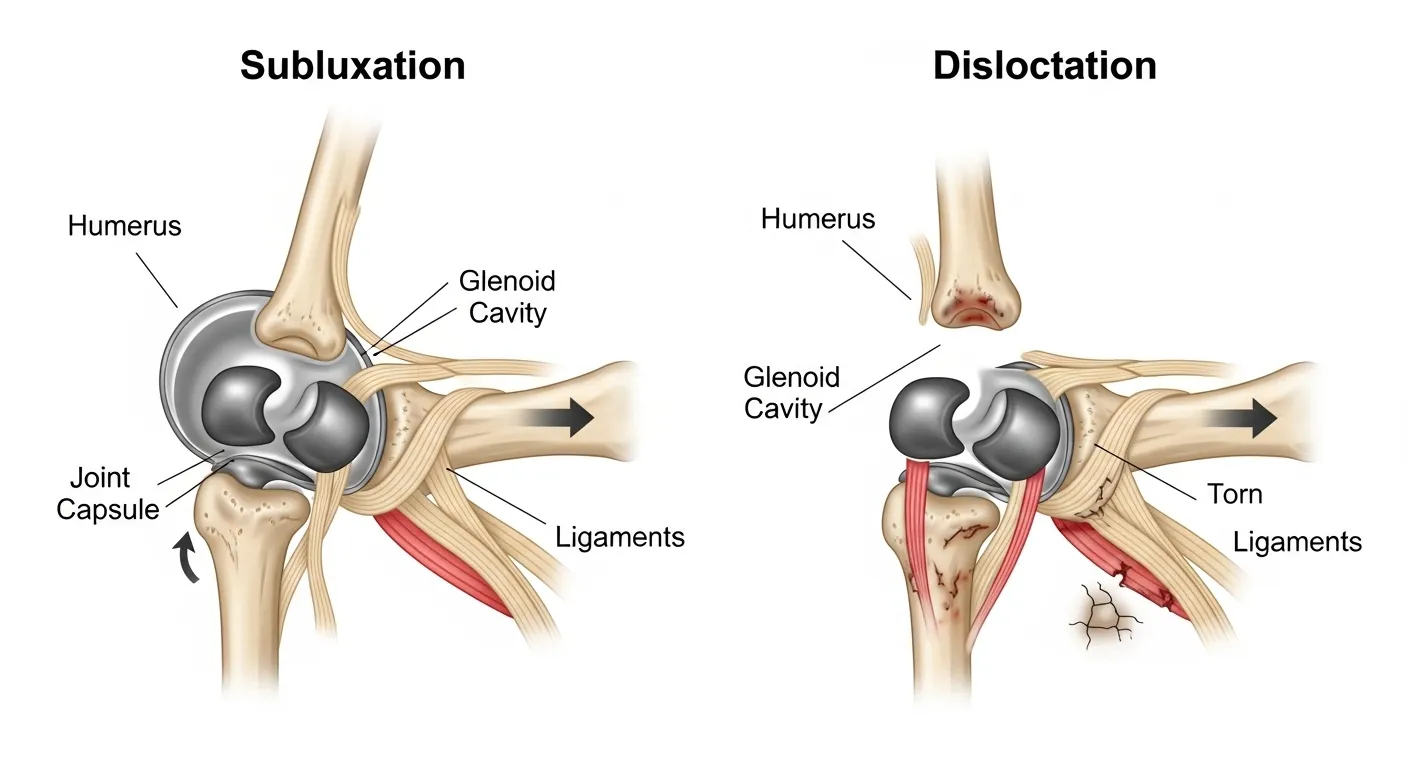
Imagine a football player who falls during a match and feels sudden pain in his shoulder. At the hospital, the doctor explains that the injury could be either a subluxation or a dislocation.
For many people, these terms sound similar, yet they describe different medical conditions. Understanding the difference between subluxation and dislocation is important not only for doctors but also for athletes, students, and anyone interested in health.
A subluxation refers to a partial displacement of a joint where the bones move out of their normal position but still remain partially connected. A dislocation, on the other hand, occurs when the bones in a joint completely separate from their normal alignment.
The difference between subluxation and dislocation lies mainly in the severity and extent of the joint movement.In daily life, injuries caused by sports, accidents, or sudden movements can lead to these conditions.
Knowing the difference between subluxation and dislocation helps people recognize symptoms early and seek proper treatment. Medical professionals also emphasize learning the difference between subluxation and dislocation to prevent long-term damage to joints.
Pronunciation of the Terms
Subluxation
- US: /ˌsʌb.lʌkˈseɪ.ʃən/
- UK: /ˌsʌb.lʌkˈseɪ.ʃən/
Dislocation
- US: /ˌdɪs.loʊˈkeɪ.ʃən/
- UK: /ˌdɪs.ləʊˈkeɪ.ʃən/
Linking Hook
Although both conditions involve joints moving out of place, the difference between subluxation and dislocation becomes clearer when we explore their causes, symptoms, and medical implications in detail.
Difference Between Subluxation and Dislocation
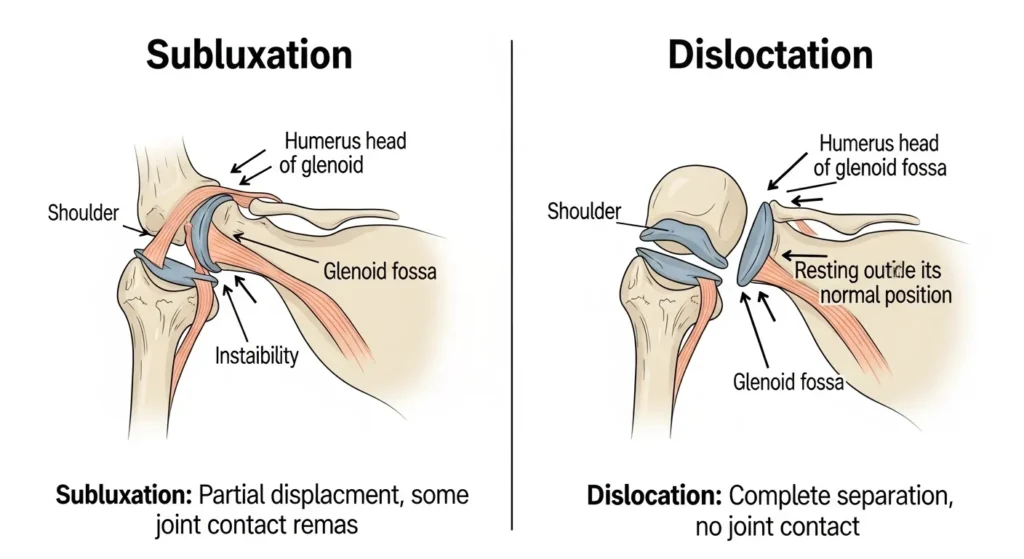
1. Degree of Joint Movement
Subluxation:
The joint is partially displaced but still maintains some contact.
Examples:
- A shoulder partially slips out but returns naturally.
- A spinal joint slightly shifts due to poor posture.
Dislocation:
The joint completely separates from its normal position.
Examples:
- A shoulder fully pops out after a sports injury.
- A finger joint completely moves out during a fall.
2. Severity of Injury
Subluxation:
Usually less severe and sometimes temporary.
Examples:
- Minor shoulder instability in swimmers.
- Slight knee misalignment during exercise.
Dislocation:
A severe injury requiring immediate medical attention.
Examples:
- Hip dislocation from a car accident.
- Elbow dislocation during a fall.
3. Pain Level
Subluxation:
Pain is mild to moderate and may come and go.
Examples:
- Occasional discomfort in the shoulder.
- Mild back pain due to vertebral subluxation.
Dislocation:
Pain is intense and sudden.
Examples:
- Severe shoulder pain immediately after impact.
- Extreme pain when the ankle dislocates.
4. Mobility of the Joint
Subluxation:
Movement is limited but still possible.
Examples:
- A partially displaced shoulder can still move slightly.
- A wrist subluxation allows weak motion.
Dislocation:
Movement becomes almost impossible.
Examples:
- A dislocated knee cannot bear weight.
- A dislocated finger cannot bend.
5. Medical Treatment
Subluxation:
Often treated with rest, therapy, or mild adjustment.
Examples:
- Chiropractic adjustment for spinal subluxation.
- Physiotherapy for shoulder instability.
Dislocation:
Requires professional repositioning.
Examples:
- A doctor manually resets a shoulder.
- Surgery may be required for severe hip dislocation.
6. Healing Time
Subluxation:
Heals relatively faster.
Examples:
- Mild shoulder subluxation recovering in weeks.
- Neck joint subluxation improving with therapy.
Dislocation:
Takes longer recovery time.
Examples:
- Hip dislocation needing months of rehabilitation.
- Knee dislocation requiring surgery and therapy.
7. Risk of Complications
Subluxation:
Lower risk of nerve or tissue damage.
Examples:
- Minor ligament strain.
- Temporary inflammation.
Dislocation:
Higher risk of serious complications.
Examples:
- Nerve damage in shoulder dislocation.
- Blood vessel injury in knee dislocation.
8. Causes
Subluxation:
Often caused by repetitive stress or weak ligaments.
Examples:
- Gymnastics training causing shoulder instability.
- Poor posture causing spinal misalignment.
Dislocation:
Usually caused by trauma or accidents.
Examples:
- Car crash causing hip dislocation.
- Sports collision causing shoulder dislocation.
9. Diagnosis
Subluxation:
Sometimes difficult to detect without imaging.
Examples:
- Mild spinal subluxation found through X-ray.
- Shoulder instability diagnosed by physical exam.
Dislocation:
Easy to detect due to visible deformity.
Examples:
- A visibly displaced shoulder.
- An abnormal finger angle.
10. Frequency
Subluxation:
More common in people with joint instability.
Examples:
- Athletes experiencing repeated shoulder slips.
- People with loose ligaments having recurrent subluxations.
Dislocation:
Less frequent but more serious.
Examples:
- Severe injury during contact sports.
- Traumatic accidents.
Nature and Behaviour of Both
Subluxation:
Subluxation behaves like a partial misalignment. The joint remains somewhat stable but may slip repeatedly if untreated. It often reflects joint weakness or instability.
Dislocation:
Dislocation behaves as a complete disruption of the joint structure. The bones lose their normal alignment entirely, making movement painful and dangerous without medical intervention.
Why People Are Confused About Their Use
Many people confuse these terms because both involve joints moving out of place and produce similar symptoms such as pain, swelling, and limited motion.
Additionally, medical terminology can sound complicated, and in casual conversation people often use the word “dislocation” for any joint problem. The subtle medical distinction between partial and complete displacement is not widely understood outside the healthcare field.
Table: Difference and Similarity
| Aspect | Subluxation | Dislocation | Similarity |
| Definition | Partial displacement | Complete displacement | Both involve joint misalignment |
| Severity | Mild to moderate | Severe | Both cause pain |
| Movement | Limited movement possible | Movement almost impossible | Both affect mobility |
| Treatment | Therapy or adjustment | Medical repositioning | Both need medical care |
| Risk | Lower complications | Higher complications | Both can damage ligaments |
Which Is Better in What Situation?
Subluxation
Subluxation is considered less serious compared to dislocation. In many cases, it can improve with rest, physical therapy, and strengthening exercises. For example, athletes with mild shoulder instability may recover through rehabilitation without surgery. Because the joint is not fully separated, the healing process is often quicker and complications are fewer.
Dislocation
Dislocation, however, demands urgent medical attention. Although it is more severe, proper treatment such as joint reduction and rehabilitation can restore function. In some situations, immediate treatment of a dislocation prevents permanent joint damage and restores normal movement.
Use in Metaphors and Similes
- “His plans were dislocated, like a joint knocked out of place.”
- “Her routine felt subluxated, slightly off balance but not completely broken.”
These metaphors describe instability or disruption.
Connotative Meaning
Subluxation Neutral/Negative
Usually neutral in medical context but slightly negative when describing instability.
Example: “The project suffered a minor subluxation in planning.”
Dislocation Negative
Often implies serious disruption.
Example: “The sudden policy change caused a dislocation in the market.”
Idioms or Proverbs (Related Concepts)
- “Put something back in place.”
Example: The doctor quickly put the shoulder back in place after the dislocation. - “Out of joint.”
Meaning: Something not working properly.
Example: After the accident, everything in his schedule felt out of joint.
Works in Literature (Keyword References)
- “Joint and Bone Disorders Explained” Medical Science, Dr. Harold Smith, 2012
- “Orthopedic Injuries and Rehabilitation” Medical Guide, Laura Bennett, 2018
- “The Body in Motion” Health Science, Peter Collins, 2009
Movies Related to Joint Injuries / Sports
- “Concussion” 2015, USA
- “Million Dollar Baby” 2004, USA
- “The Wrestler” 2008, USA
Frequently Asked Questions
1. What is the main difference between subluxation and dislocation?
Subluxation is partial joint displacement, while dislocation is complete separation of the joint.
2. Is subluxation painful?
Yes, but the pain is usually milder compared to a full dislocation.
3. Can a subluxation turn into a dislocation?
Yes, repeated instability may lead to a complete dislocation.
4. Which joints commonly experience dislocation?
Shoulders, fingers, hips, and knees.
5. How are these injuries treated?
Subluxation often requires therapy, while dislocation usually needs medical repositioning.
How Both Are Useful for Surroundings
Understanding these terms helps in healthcare awareness, sports safety, and injury prevention. Coaches, trainers, and ordinary people can identify symptoms early and respond correctly in emergencies. Medical knowledge about subluxation and dislocation also improves rehabilitation practices and helps maintain healthy communities.
Final Words for Both
Subluxation represents a warning sign of joint instability, while dislocation indicates a more serious structural injury. Both conditions highlight the importance of proper joint care, timely diagnosis, and professional medical treatment.
Conclusion
The difference between subluxation and dislocation lies mainly in the degree of joint displacement and the severity of the injury.
Subluxation is a partial displacement where the bones still maintain some contact, whereas dislocation occurs when the joint completely separates. Although they share similar symptoms such as pain and swelling, their treatment methods and risks differ significantly.
Recognizing the difference between subluxation and dislocation allows individuals to respond quickly and seek appropriate medical care. In sports, healthcare, and daily life, understanding this distinction promotes better injury prevention and effective treatment. Ultimately, knowledge of these conditions helps protect joint health and ensures a faster recovery for those affected.

I am James Anderson an English author known for his insightful and engaging writing in contemporary literature. With a focus on [insert genre, e.g., fiction, non-fiction, or specific themes], he explores complex human emotions and social dynamics, blending thought-provoking ideas with accessible storytelling. His work has earned recognition for its clarity, depth, and ability to connect with a wide audience, establishing him as a respected voice in modern English literature.