Imagine a teacher in a classroom asking students to share chocolates equally. If 12 chocolates are distributed among 3 students, each student gets 4 chocolates.
In this simple situation, mathematics quietly introduces two important ideas: factors and multiples.The difference between multiple and factor becomes clearer when we see how numbers relate to each other in everyday life.
A factor is a number that divides another number completely without leaving a remainder. On the other hand, a multiple is the result obtained when a number is multiplied by another whole number.
Understanding the difference between multiple and factor helps students recognize number patterns and perform calculations correctly. Many learners encounter confusion when studying multiplication and division because they do not fully grasp the difference between multiple and factor. Once this concept is clear, mathematical relationships become easier to understand.
Key Difference Between the Both
The basic difference between multiple and factor is that a factor divides a number, while a multiple is produced by multiplying a number.
For example:
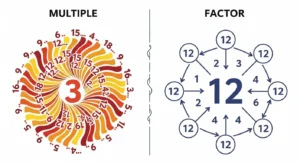
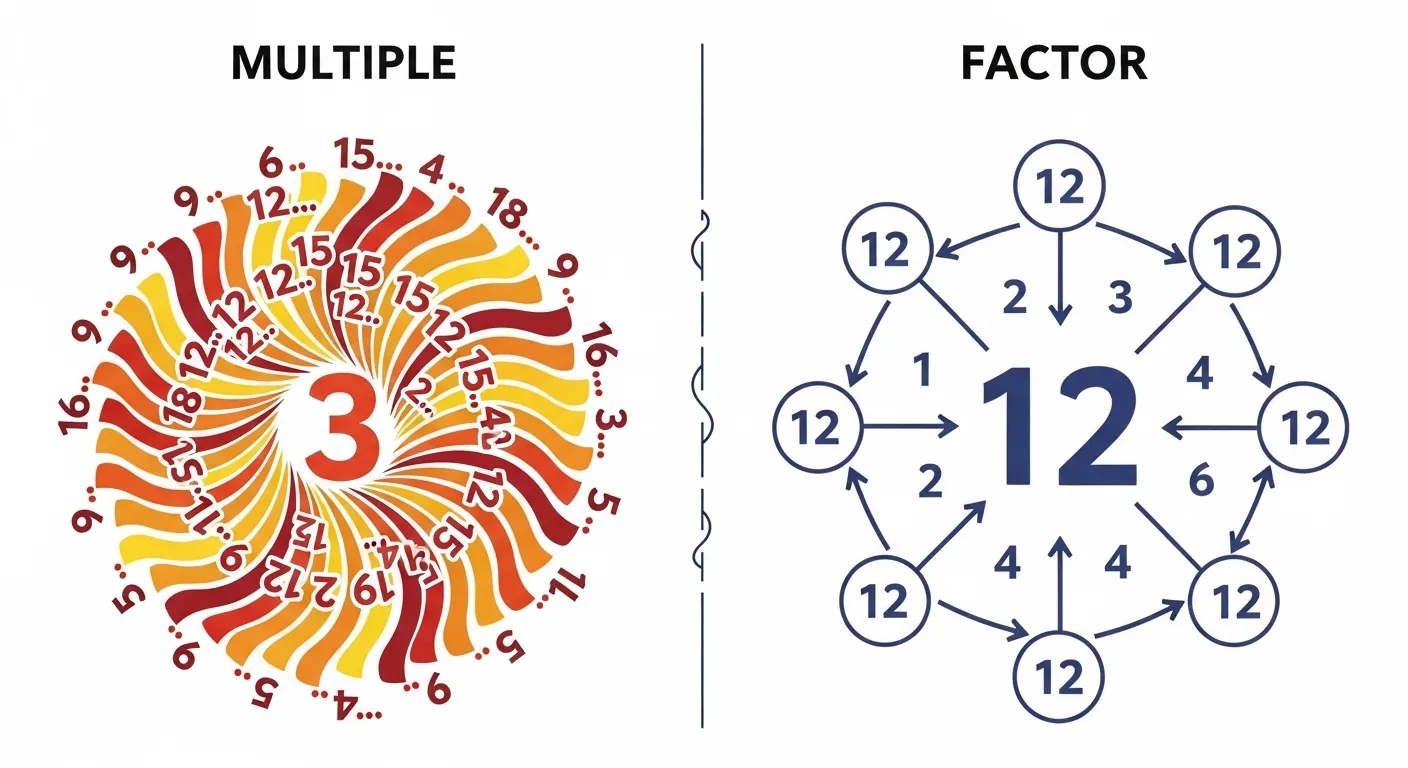
- In the number 12, the factors are 1, 2, 3, 4, 6, 12.
- The multiples of 3 are 3, 6, 9, 12, 15, 18, and so on.
Why Is Their Difference Necessary to Know for Learners and Experts?
Understanding the difference between multiple and factor is essential in education, science, engineering, and everyday problem-solving. Students use these concepts while learning fractions, algebra, and number theory. Experts apply them in programming, cryptography, statistics, and mathematical modeling.
In society, these ideas help people understand patterns, calculate measurements, and solve real-life problems. For example, construction workers determine measurements using factors, while programmers use multiples in algorithms and loops. Knowing the difference between multiple and factor strengthens logical thinking and analytical skills that are important for academic growth and professional fields.
Pronunciation
Multiple
- US: /ˈmʌl.tə.pəl/
- UK: /ˈmʌl.tɪ.pəl/
Factor
- US: /ˈfæk.tɚ/
- UK: /ˈfæk.tə/
Linking Hook
Now that we understand the basic meaning, pronunciation, and importance of these terms, let us explore the difference between multiple and factor in detail through clear explanations and examples.
Difference Between Multiple and Factor
1. Definition
Factor: A number that divides another number exactly.
Examples:
- Factors of 10 → 1, 2, 5, 10
- Factors of 15 → 1, 3, 5, 15
Multiple: A number obtained by multiplying a number with another whole number.
Examples:
- Multiples of 5 → 5, 10, 15, 20
- Multiples of 4 → 4, 8, 12, 16
2. Mathematical Operation
Factor: Related to division.
Examples:
- 20 ÷ 5 = 4 → 5 is a factor of 20
- 18 ÷ 3 = 6 → 3 is a factor of 18
Multiple: Related to multiplication.
Examples:
- 5 × 3 = 15 → 15 is a multiple of 5
- 6 × 4 = 24 → 24 is a multiple of 6
3. Quantity
Factor: A number has limited factors.
Examples:
- Factors of 8 → 1, 2, 4, 8
- Factors of 9 → 1, 3, 9
Multiple: A number has infinite multiples.
Examples:
- Multiples of 2 → 2, 4, 6, 8, 10…
- Multiples of 7 → 7, 14, 21, 28…
4. Size Relationship
Factor: Usually equal to or smaller than the number.
Examples:
- Factors of 12 → 1, 2, 3, 4, 6, 12
- Factors of 6 → 1, 2, 3, 6
Multiple: Usually equal to or larger than the number.
Examples:
- Multiples of 6 → 6, 12, 18
- Multiples of 9 → 9, 18, 27
5. Role in Number Structure
Factor: Shows how a number is built.
Examples:
- 12 = 3 × 4
- 15 = 3 × 5
Multiple: Shows how a number expands.
Examples:
- 3 → 3, 6, 9, 12
- 4 → 4, 8, 12, 16
6. Use in Mathematics
Factor: Used in factorization and simplification.
Examples:
- 24 = 2 × 12
- 16 = 4 × 4
Multiple: Used in finding common multiples.
Examples:
- LCM of 4 and 6 = 12
- Multiples of 3 and 5 → 15
7. Direction of Relationship
Factor: Moves toward smaller components.
Examples:
- 30 → 5 × 6
- 18 → 3 × 6
Multiple: Moves toward larger results.
Examples:
- 5 → 10 → 15
- 7 → 14 → 21
8. Application in Fractions
Factor: Used to simplify fractions.
Examples:
- 8/12 → divide by 4 → 2/3
- 10/15 → divide by 5 → 2/3
Multiple: Used to find common denominators.
Examples:
- LCM of 4 and 6 → 12
- LCM of 3 and 5 → 15
9. Mathematical Focus
Factor: Focuses on breaking numbers.
Examples:
- 20 = 4 × 5
- 14 = 2 × 7
Multiple: Focuses on growing numbers.
Examples:
- 3 → 6 → 9
- 4 → 8 → 12
10. Conceptual Role
Factor: Represents division relationships.
Examples:
- 2 divides 10
- 5 divides 20
Multiple: Represents multiplication relationships.
Examples:
- 8 = 4 × 2
- 21 = 7 × 3
Nature and Behaviour of Both
Factors behave like the building blocks of numbers. They break numbers into smaller components and help mathematicians understand how numbers are structured.
Multiples, on the other hand, behave like expanding sequences. They grow larger as multiplication continues and often appear in number patterns.
Why People Are Confused About Their Use
Many students confuse these terms because both are connected to multiplication and division. Additionally, the same numbers can appear as both factors and multiples depending on the context. For example, 6 is a factor of 12, but 6 is also a multiple of 3. This overlapping relationship makes the concepts seem similar.
Table: Difference and Similarity
| Aspect | Factor | Multiple |
| Meaning | Divides a number exactly | Result of multiplication |
| Mathematical process | Division | Multiplication |
| Quantity | Finite | Infinite |
| Size | Smaller or equal | Larger or equal |
| Example | Factors of 12 → 1,2,3,4,6,12 | Multiples of 3 → 3,6,9 |
| Relationship | Breaks numbers | Expands numbers |
Which Is Better in What Situation?
Factors are better when simplifying numbers or solving equations. In mathematics, factors help break numbers into smaller components. For example, factorization is essential in algebra, cryptography, and simplifying fractions.
Multiples are better when identifying number patterns or finding common denominators. In arithmetic and algebra, multiples help determine the least common multiple (LCM), which is useful when adding or comparing fractions.
Metaphors and Similes
- Factors are like the roots of a tree, supporting the number from below.
- Multiples are like branches, extending outward as numbers grow.
Examples:
- “The factors of a number are the roots that hold it together.”
- “Multiples spread like ripples in water.”
Connotative Meaning
Factor Neutral/Positive
Examples:
- “Education is a major factor in success.”
- “Weather is an important factor in agriculture.”
Multiple Neutral
Examples:
- “The company faced multiple challenges.”
- “She has multiple skills.”
Idioms or Proverbs Related
Factor in
Example:
- “Always factor in unexpected costs when planning a project.”
Multiple chances
Example:
- “Life gives multiple chances to learn from mistakes.”
Works in Literature
- Factors of Civilization Non-fiction, Arnold Toynbee, 1934
- The Multiple Man Science fiction, Ben Bova, 1976
- The Factor of Life Philosophical essay collection, 20th century
Movies Related
- The Multiple Man (2025, USA inspired by Marvel character)
- Factor 8 (2009, Germany thriller film)
Frequently Asked Questions
1. What is the main difference between multiple and factor?
A factor divides a number exactly, while a multiple is produced by multiplying a number.
2. Can a number be both a factor and a multiple?
Yes. For example, 6 is a factor of 12 and a multiple of 3.
3. Do numbers have unlimited factors?
No. Each number has a limited number of factors.
4. Are multiples infinite?
Yes. Multiples continue endlessly.
5. Why are these concepts important?
They help in fractions, algebra, and mathematical problem-solving.
How Both Are Useful for Surroundings
Factors help people divide resources equally, calculate measurements, and solve structural problems in engineering. Multiples help recognize patterns in scheduling, technology, and computer algorithms. Together, they form the foundation of many mathematical systems used in science and daily life.
Final Words for Both
Factors and multiples represent two sides of numerical relationships. One breaks numbers down, while the other builds them up. Their combined understanding forms the basis of many mathematical operations.
Conclusion
Understanding the difference between multiple and factor is essential for anyone learning mathematics. A factor divides a number exactly, while a multiple is created through multiplication.
Although these ideas seem similar at first, they represent opposite directions of numerical relationships: one moves toward smaller components, while the other moves toward larger sequences.
Mastering the difference between multiple and factor helps students solve problems in arithmetic, algebra, and number theory more efficiently. It also develops logical thinking and analytical skills that are useful in many fields. Once learners grasp these concepts clearly, numbers become easier to understand and mathematical patterns become more meaningful.

I am Stephen King is a spiritual writer and digital creator dedicated to exploring the deeper meaning behind numbers, synchronicity, and divine guidance. Through his platform, spiritualdigits.com he shares insights on angel numbers, spiritual symbolism, and personal awakening to help readers align with their higher purpose. His work blends intuition, research, and practical wisdom to make spiritual concepts clear, accessible, and transformative.